Conjunctions Class 6 Worksheet English Grammar
Instructions
- Read the following questions carefully and answer them according to the given options.
- The difficulty level of the questions will be mixed from easy to hard.
- The marking scheme and word limit for each question will be mentioned at the beginning of each section.
Section - A
Q.1. Multiple Choice Questions (MCQs) [1 x 5 = 5 marks]
(i) Choose the correct conjunction to complete the sentence: She needs to study hard, __________ she will not pass the exam.
(a) because
(b) or
(c) but
(d) and
Correct Answer is Option (b)
(ii) Identify the conjunction in the following sentence: I like apples, but I do not like oranges.
(a) I
(b) like
(c) but
(d) not
Correct Answer is Option (c)
(iii) Choose the correct conjunction to complete the sentence: I will go to the mall ___________ my friends are going too.
a) if
b) and
c) but
d) so
Correct Answer is Option (a)
(iv) Which of the following conjunctions is used to show contrast?
(a) and
(b) but
(c) so
(d) if
Correct Answer is Option (b)
(v) Choose the correct conjunction to complete the sentence: She was tired, __________ she decided to take a nap.
(a) so
(b) and
(c) but
(d) if
Correct Answer is Option (a)
Section - B
Q.2. Short Questions [2x5=10 marks]
(i) What is the purpose of a conjunction in a sentence?
The purpose of a conjunction in a sentence is to connect words, phrases, or clauses and show the relationship between them.
(ii) Give an example of a sentence using the conjunction "and."
Example: I like to read books and watch movies.
(iii) Give an example of a sentence using the conjunction "or."
Example: You can have pizza or pasta for dinner.
(iv) What is the function of the conjunction "if" in a sentence?
The function of the conjunction "if" in a sentence is to show a condition or possibility.
(v) Give an example of a sentence using the conjunction "but."
Example: She is intelligent but lazy.
Section - C
Q.3. Fill in the blanks [1x5=5 marks]
(i) She was feeling sick, __________ she went to see a doctor.
so
(ii) I will go to the party __________ I finish my homework.
if
(iii) You can have tea __________ coffee, whichever you prefer.
or
(iv) He did not study for the test, __________ he still managed to pass.
but
(v) I want to buy a new phone, __________ I don't have enough money.
but
Section - D
Q.4. Match the sentences in Column A with the correct conjunction in Column B. [1x5=5 marks]
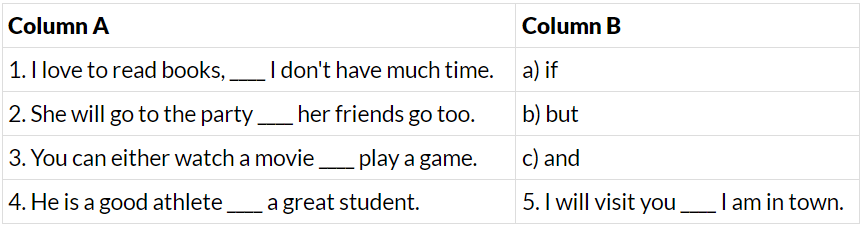
1. b) but
2. a) if
3. d) or
4. c) and
5. e) so
Section - E
Q.5. Read the following statements and mark them as True (T) or False (F). [1x5=5 marks]
(i) Conjunctions are used to connect words, phrases, and clauses in a sentence. ( )
True
(ii) The conjunction "and" is used to show contrast between two ideas. ( )
False
(iii) The conjunction "or" is used to show a choice between two options. ( )
True
(iv) The conjunction "but" is used to show a cause and effect relationship. ( )
False
(v) The conjunction "so" is used to show a result or consequence. ( )
True
|
47 videos|188 docs|46 tests
|

|
4.72/5 Rating |

|
Dec 22, 2024 Last updated |

|
Explore Courses for Class 6 exam
|

|
Semester Notes
,Objective type Questions
,Viva Questions
,Conjunctions Class 6 Worksheet English Grammar
,past year papers
,Sample Paper
,mock tests for examination
,video lectures
,practice quizzes
,MCQs
,Extra Questions
,Previous Year Questions with Solutions
,Summary
,Conjunctions Class 6 Worksheet English Grammar
,Free
,Exam
,Conjunctions Class 6 Worksheet English Grammar
,study material
,shortcuts and tricks
,ppt
,Important questions
,




Worksheet Solutions: Conjunctions Free PDF Download
Importance of Worksheet Solutions: Conjunctions
Worksheet Solutions: Conjunctions Notes
Worksheet Solutions: Conjunctions Class 6 Questions
Study Worksheet Solutions: Conjunctions on the App
|
© EduRev
|
Education Revolution
|


|


