Essay Writing | English Grammar for Class 6 PDF Download
| Table of contents |

|
| Introduction |
|
| Importance of Essay Writing |
|
| Types of Essays |
|
| Steps of Essay Writing |
|
| Examples |
|

Introduction
- An essay is a short piece of writing that discusses, describes, or analyzes a specific topic, idea, or issue.
- Essays have a clear beginning, middle, and end.
- Essays can be written in various styles, such as descriptive, narrative, persuasive, or expository.
- Essays are often written to express a point of view, argue a position, or provide information.
Importance of Essay Writing
- Improves writing skills and creativity.
- Enhances logical thinking and critical analysis.
- Helps in organizing thoughts and ideas.
- Develops research and reading skills.
- Prepares students for academic and professional success.
Types of Essays
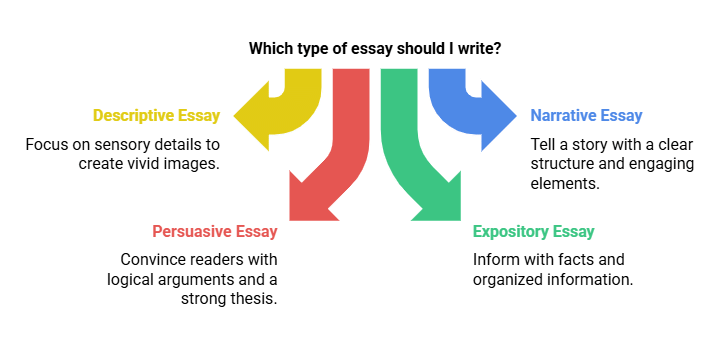
Descriptive Essay
- Describes a person, place, object, or experience in detail.
- Focuses on sensory details (sight, sound, taste, touch, and smell).
- Uses descriptive words and phrases to create vivid images in the reader's mind.
Narrative Essay
- Tells a story or shares a personal experience.
- Contains a clear beginning, middle, and end.
- Focuses on characters, setting, and plot.
- Uses dialogues, emotions, and vivid descriptions to engage readers.
Persuasive Essay
- Aims to persuade the reader to agree with the writer's point of view.
- Uses logical reasoning, facts, and examples to support the argument.
- Addresses counterarguments and refutes them.
- Includes a strong, clear thesis statement.
Expository Essay
- Explains or informs about a topic.
- Presents information in a logical and organized manner.
- Uses facts, examples, and statistics to support the main idea.
- Does not include personal opinions or emotions.
Steps of Essay Writing
A. Choose a Topic
- Pick a subject that interests you or is relevant to your studies.
- Consider your audience and purpose.
B. Research and Gather Information
- Use reliable sources like books, articles, and websites.
- Take notes and organize the information.
- Cite your sources to avoid plagiarism.
C. Create an Outline
- Write down the main ideas or points you want to discuss.
- Organize your ideas in a logical order.
- Divide your essay into an introduction, body paragraphs, and a conclusion.
D. Write the Essay
Introduction: Begin with a hook to grab the reader's attention. Provide some background information on the topic. End with a clear thesis statement that states the main idea or purpose of the essay.
Body Paragraphs: Begin each paragraph with a topic sentence that introduces the main idea. Add supporting details, examples, and explanations. Use transition words and phrases to connect your ideas.
Conclusion: Restate the thesis statement in a new way. Summarize the main points of your essay. Provide a closing thought or call to action.
E. Revise and Edit
- Check for grammar, punctuation, and spelling errors.
- Ensure that your essay is well-organized and flows smoothly.
- Make sure that your ideas are clear and concise.
- Ask a friend or teacher to read your essay and provide feedback.
Examples
Sample 1: My Favorite Season
My favorite season is winter. I love the cold weather, the snow, and the festive atmosphere during this time of the year. Winter is the perfect time to wear cozy sweaters, sip hot chocolate, and spend time with family and friends.
Winter brings with it the joy of Christmas and New Year celebrations. The excitement of decorating the Christmas tree, exchanging gifts, and singing carols fills the air with happiness.
I also enjoy winter sports like ice-skating and skiing. The snow-covered mountains and the beauty of nature during winter are breathtaking.
In conclusion, winter is my favorite season because of the celebrations, the cold weather, and the beautiful scenery.
Sample 2: My Dream Vacation
My dream vacation is to visit Switzerland. I have always been fascinated by the picturesque landscapes, snow-capped mountains, and the diverse culture of this beautiful country.
I would love to explore the Swiss Alps and experience the thrill of skiing on the snow-covered slopes. I would also like to visit the famous Swiss cities like Zurich, Geneva, and Bern and learn about their history and culture.
Switzerland is also known for its delicious chocolates and cheese. I would love to taste authentic Swiss chocolates and indulge in a cheese fondue.
In conclusion, visiting Switzerland has always been my dream, and I hope to make this dream a reality in the future.
Sample 3: An Essay on My Favourite Teacher
My favourite teacher is Mrs. Sharma, who teaches us English. She is a kind, hardworking, and knowledgeable person, and she always inspires her students to do their best in studies. Mrs. Sharma has a unique way of teaching, which helps us to understand the subject quickly and easily.
Mrs. Sharma is a tall and slim lady with a cheerful face. She always wears beautiful and elegant clothes. Her voice is soft and sweet, which makes her lectures interesting and enjoyable. She always starts her class with a smile and greets us with a warm "Good morning, students."
Mrs. Sharma has a deep knowledge of English literature and grammar. She explains each and every topic in detail and clears our doubts patiently. She often gives us examples from daily life to make the subject more meaningful and relevant to us. She uses various teaching aids like charts, posters, and audio-visual aids to make her lessons more interesting and engaging.
Apart from teaching, Mrs. Sharma also takes an active interest in extracurricular activities. She is the in-charge of the school's drama club and encourages students to participate in plays and skits. She also organizes workshops and seminars on creative writing and public speaking to help students improve their communication skills.
Mrs. Sharma is very approachable and understanding. She is always ready to listen to our problems and guide us in the right direction. She encourages us to share our ideas and opinions in class, and she appreciates our efforts, even if they are not perfect.
In conclusion, Mrs. Sharma is my favourite teacher because of her dedication to her profession, her friendly nature, and her ability to make learning enjoyable. She has not only helped me improve my English but has also shaped my personality and made me a better person. I am truly grateful to have her as my teacher.
Sample 4: An Essay on My Best Friend
A best friend is someone who is always there for you in times of need, shares your joys and sorrows, and understands you better than anyone else. My best friend, Ravi, is someone who possesses all these qualities and more. We have been friends for over five years now, and our bond has only grown stronger with time.
Ravi and I first met when we were in grade one. We were both new to the school and found ourselves sitting next to each other in class. Soon, we discovered that we had a lot in common, and our friendship began to blossom. Over the years, we have shared many memories and have been through many ups and downs together.
Ravi is a very caring and supportive friend. Whenever I am feeling low or going through a tough time, he is always there to lend a helping hand or offer a shoulder to cry on. He always knows how to cheer me up and make me feel better. Ravi is also very honest and trustworthy. He always tells me the truth, even if it might hurt my feelings, because he believes that honesty is the foundation of a strong friendship.
Apart from being a loyal friend, Ravi is also very intelligent and hardworking. He ranks among the top students in our class and is always eager to help others with their studies. His dedication to his academics has inspired me to work harder and achieve my own goals.
In our free time, Ravi and I love to play football, watch movies, and go on bike rides together. We also spend hours discussing our dreams and aspirations, and we always encourage each other to work towards achieving them.
In conclusion, Ravi is not just my best friend but also my confidant, my motivator, and my brother. His presence has enriched my life in many ways, and I am truly grateful for the bond we share.
Sample 5: An Essay on My Favourite Hobby: Reading
Reading has always been my favourite hobby, and I spend most of my free time with my nose buried in a book. I find reading to be a very enjoyable and relaxing activity that not only entertains me but also enriches my mind with knowledge and wisdom.
There are countless reasons why I love reading. Firstly, reading broadens my horizons and helps me learn about different cultures, lifestyles, and ideas. It helps me to understand the world better and to be more empathetic towards others. Moreover, reading improves my vocabulary and language skills, which is essential for effective communication.
Secondly, reading allows me to escape from the realities of life and immerse myself in the imaginary world of the characters in the book. It helps me to forget my worries and stress for a while and transports me to a place where anything is possible. I find this especially therapeutic after a long day at school or during holidays when I have more time to unwind.
Additionally, reading helps to develop my imagination and creativity. While reading a book, I create vivid images of the characters, settings, and events in my mind, which enhances my ability to think creatively and come up with new ideas.
There are many different genres of books that I enjoy reading, such as fiction, biographies, and scientific books. However, my favourite genre is mystery and detective novels. I love the thrill of trying to solve the puzzles and mysteries along with the protagonist, and I find it very satisfying when I can correctly guess the outcome.
In conclusion, reading is my favourite hobby because it offers me a form of relaxation, entertainment, and education. It has not only enriched my life but has also helped me grow as an individual. I firmly believe that everyone should develop the habit of reading, as it has countless benefits and can truly be a life-changing experience.
Sample 6: An Essay on The Importance of Discipline
Discipline is an essential aspect of our lives, as it helps us to develop good habits, maintain self-control, and achieve our goals. It is the foundation of success and happiness, both in our personal and professional lives. In this essay, we will explore the importance of discipline and how it contributes to our overall well-being.
Discipline is crucial in maintaining a healthy lifestyle. A disciplined person follows a strict routine that includes regular exercise, a balanced diet, and sufficient sleep. This not only keeps them physically fit but also improves their mental health and overall well-being. Moreover, discipline helps us to avoid temptations and distractions that can lead to unhealthy habits, such as excessive screen time, junk food consumption, and procrastination.
In the realm of academics, discipline plays a vital role in achieving success. A disciplined student follows a proper study schedule, completes assignments on time, and actively participates in class. This helps them to excel in their studies and secure good grades, which opens up opportunities for higher education and a successful career.
Discipline is also important in developing good moral values and a strong character. A disciplined person respects others, obeys rules and regulations, and takes responsibility for their actions. They are honest, punctual, and hardworking, which earns them the respect and admiration of others.
Furthermore, discipline is essential in maintaining social harmony and order. A disciplined society is one where people follow the law, respect the rights of others, and work together towards a common goal. This fosters a sense of unity, cooperation, and peace, which is essential for the overall progress and development of a nation.
In conclusion, discipline is a crucial aspect of our lives that ensures our personal growth, academic success, and social harmony. It helps us to develop good habits, maintain self-control, and achieve our goals, ultimately leading to a happy and fulfilling life.
Sample 7: An Essay on The Importance of Trees
Trees are an indispensable part of our planet, providing us with numerous benefits that are essential for our survival and well-being. They are the lungs of the Earth, purifying the air we breathe, and they play a vital role in maintaining the ecological balance. In this essay, we will discuss the importance of trees and why we must protect and preserve them for future generations.
One of the primary functions of trees is to produce oxygen and absorb carbon dioxide through the process of photosynthesis. This helps to regulate the levels of these gases in the atmosphere, thereby reducing air pollution and mitigating the effects of climate change. Moreover, trees act as natural air filters, trapping dust particles and harmful pollutants, which results in cleaner and healthier air for us to breathe.
Trees also play a crucial role in conserving water and preventing soil erosion. Their roots hold the soil together and prevent it from being washed away during heavy rains, while their leaves help to reduce water evaporation by providing shade. Trees also help to maintain the water cycle by absorbing rainwater and releasing it into the atmosphere through a process called transpiration.
In addition to their environmental benefits, trees also provide us with various resources, such as wood, fruits, nuts, and medicinal plants. They are a source of food, shelter, and livelihood for millions of people around the world, particularly those living in rural areas.
Trees also provide habitat for a wide variety of plants and animals, thereby preserving biodiversity and maintaining the ecological balance. Many species of birds, insects, and mammals depend on trees for their survival, either for food, nesting, or shelter.
Furthermore, trees have a positive impact on our mental health and well-being. Their presence in our surroundings creates a serene and calming atmosphere that helps to reduce stress and anxiety. Studies have shown that spending time in nature, particularly among trees, can improve our mood, boost our immune system, and enhance our cognitive abilities.
In conclusion, trees are an invaluable resource that plays a vital role in maintaining the health of our planet and its inhabitants. It is our responsibility to protect and preserve them for future generations, as their survival is crucial for our own well-being and that of the entire ecosystem.
Sample 8: An Essay On “Diwali”.
Diwali
Diwali, also known as Deepavali, is one of the most important and popular festivals celebrated in India. It is a five-day-long festival that marks the victory of light over darkness, knowledge over ignorance, and good over evil. It usually falls between October and November and is celebrated with great enthusiasm and fervor by people of different faiths and cultures across the nation.
Diwali is also known as the festival of lights as it involves the lighting of clay lamps (diyas) filled with oil to signify the triumph of light. The lighting of lamps is symbolic of dispelling the darkness and removing the negativity that surrounds us. People also decorate their homes with colorful rangoli patterns, flowers, and other decorative items to welcome Goddess Lakshmi, the deity of wealth and prosperity, into their lives.
During Diwali, people engage in various activities such as cleaning their homes, shopping for new clothes, and preparing special sweets and snacks called 'mithai' to share with family and friends. Fireworks and firecrackers are also an integral part of the Diwali celebration, which signifies the jubilation of the people and the victory of light.
Diwali is a time for family reunions, where people come together to celebrate their cultural heritage and strengthen their bonds. It is a time for reflection and introspection, where we evaluate our lives and work towards spiritual growth and enlightenment. People also exchange gifts and greetings with their loved ones during this festive occasion, which further strengthens their relationships.
In conclusion, Diwali is a vibrant and colorful festival that is celebrated with great joy and enthusiasm. It is a time of togetherness, happiness, and sharing, where people from different walks of life come together and rejoice in the spirit of unity and harmony. The festival is a powerful reminder that light will always triumph over darkness, and it encourages us to embrace the virtues of love, compassion, and forgiveness in our lives.
|
49 videos|349 docs|46 tests
|
FAQs on Essay Writing - English Grammar for Class 6
| 1. What are the main types of essays? |  |
| 2. How do I start an essay effectively? | |
| 3. What is the structure of a typical essay? | |
| 4. How can I improve my essay writing skills? | |
| 5. What common mistakes should I avoid in essay writing? | |




MCQs
,Exam
,Essay Writing | English Grammar for Class 6
,past year papers
,ppt
,Essay Writing | English Grammar for Class 6
,mock tests for examination
,shortcuts and tricks
,Sample Paper
,Previous Year Questions with Solutions
,study material
,Essay Writing | English Grammar for Class 6
,Summary
,video lectures
,Free
,Viva Questions
,practice quizzes
,Objective type Questions
,Semester Notes
,Extra Questions
,Important questions
;



Essay Writing Free PDF Download
Importance of Essay Writing
Essay Writing Notes
Essay Writing Class 6 Questions
Study Essay Writing on the App
|
© EduRev
|
Education Revolution
|


|




within 7 days!