Subject Verb Agreement Class 6 Worksheet English Grammar

Instructions
- Read the chapter thoroughly and answer the following questions.
- Attempt all questions.
- Marking scheme and word limit for each section will be provided at the beginning of the section.
- Detailed answers are provided at the end of the worksheet.
Section - A
Q.1. Choose the correct option to fill in the blank in each of the following sentences: (1 mark each, total 5 marks)
(i) Neither the teachers nor the principal _______ happy with the new schedule.
(a) is
(b) are
(c) was
(d) were
Correct Answer is Option (b)
(ii) The committee _______ decided to postpone the meeting.
(a) has
(b) have
(c) had
(d) None of the above
Correct Answer is Option (a)
(iii) The number of students in the class _______ increased.
(a) has
(b) have
(c) had
(d) were
Correct Answer is Option (a)
(iv) A pair of shoes _______ on the floor.
(a) was
(b) were
(c) has
(d) have
Correct Answer is Option (a)
(v) Some of the students _______ participating in the competition.
(a) is
(b) are
(c) were
(d) have
Correct Answer is Option (b)
Section - B
Q.2. Short Questions (2 marks each, total 10 marks, word limit: 30-40 words)
Answer the following questions:
(i) What is subject-verb agreement?
Subject-verb agreement is the rule that the verb in a sentence must agree with the subject in number, i.e., singular or plural.
(ii) Explain the rule for subject-verb agreement when the subjects are joined by 'and'.
When the subjects are joined by 'and', the verb is usually plural, as the subjects are considered together.
(iii) How does the subject-verb agreement change when the subjects are joined by 'or' or 'nor'?
When the subjects are joined by 'or' or 'nor', the verb agrees with the subject closer to it.
(iv) What is the subject-verb agreement rule for collective nouns?
For collective nouns, the verb can be singular or plural depending on whether the group is being considered as a unit or as individual members.
(v) Give an example of subject-verb agreement with an indefinite pronoun as the subject.
Example: Everyone in the class is excited about the trip.
Section - C
Q.3. Fill in the blanks with the correct form of the verb in brackets: (1 mark each, total 5 marks)
(i) The cat, along with her kittens, _______ (play) in the garden.
plays
(ii) The books and the pens _______ (be) on the table.
are
(iii) Neither the students nor the teacher _______ (want) to leave the class.
wants
(iv) The team _______ (work) hard to win the match.
is/are (depending on context)
(v) Some of the food _______ (taste) delicious.
tastes
Section - D
Q.4. Match the subjects in Column A with the correct verb forms in Column B: (1 mark each)
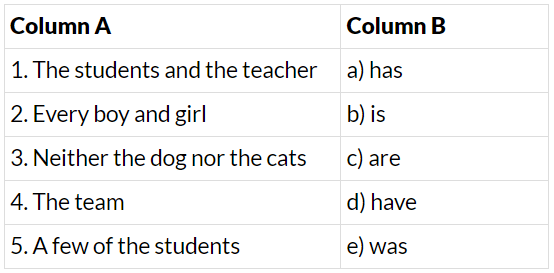
1. c) are
2. b) is
3. a) has
4. e) was
5. d) have
Section - E
Q.5. State whether the following statements are true or false: (1 mark each)
(i) The subject-verb agreement rules are the same for all types of subjects.
False
(ii) When two subjects are joined by 'and', the verb is usually plural.
True
(iii) When two subjects are joined by 'or' or 'nor', the verb agrees with the subject closer to it.
True
(iv) Collective nouns always take a singular verb.
False
(v) Indefinite pronouns usually take a singular verb.
True
Section - F
Q.6. Fill in the blanks with a verb form that agrees with the subject.
(i) Sita as well as her sister ___________ there. (was / were)
Sita as well as her sister was there.
(ii) The bunch of roses ___________ beautiful. (look / looks)
The bunch of roses looks beautiful. (Collective nouns are usually followed by a singular verb)
(iii) The poet and singer ___________ always very punctual. (is / are)
The poet and singer is always very punctual. (Here we use a singular verb because both nouns refer to the same person. Note that the article is used only once.)
(iv) The poet and the singer ___________ agreed to come. (has / have)
The poet and the singer have agreed to come. (Here we use a plural verb because the two nouns refer to two different people.)
(v) The boy along with his sister ___________ (was / were) going to school.
The boy along with his sister was going to school.
(vi) Neither Vikram nor his friends ___________ Interested in the programme. (seem / seems)
Neither Vikram nor his friends seem interested in the programme.
(vii) Mohit as well as his family ___________ always ready to help. (is / are)
Mohit as well as his family is always ready to help.
(viii) Either Jani or Sita ___________ (has / have) to go.
Either Jani or Sita has to go.
(ix) Both Seema and Nita ___________ gone to school. (has / have)
Both Seema and Nita have gone to school. (Use a plural verb after both…and..)
(x) There ___________ five pens in this box. (are / is)
There are five pens in this box. (Use a plural verb after there if the following noun is plural.)
(xi) There ___________ No water in the bottle. (is / are)
There is no water in the bottle.
(xii) Nobody ___________ how hard it is to get the first rank. (know / knows)
Nobody knows how hard it is to get the first rank. (Use a singular verb after nobody)
(xiii) The lady with six cats ___________ In the next house. (live / lives)
The lady with six cats lives in the next house.
(xiv) Either my father or my mother ___________ me to school every day. (take / takes)
Either my father or my mother takes me to school every day.
(xv) Anita as well as her brother ___________ the piano very well. (play / plays)
Anita as well as her brother plays the piano very well.
|
49 videos|349 docs|46 tests
|




Summary
,study material
,MCQs
,Previous Year Questions with Solutions
,Extra Questions
,Important questions
,mock tests for examination
,video lectures
,Subject Verb Agreement Class 6 Worksheet English Grammar
,Objective type Questions
,shortcuts and tricks
,ppt
,Subject Verb Agreement Class 6 Worksheet English Grammar
,Viva Questions
,Sample Paper
,Exam
,past year papers
,Semester Notes
,Free
,practice quizzes
,Subject Verb Agreement Class 6 Worksheet English Grammar
;




Worksheet Solutions: Subject Verb Agreement Free PDF Download
Importance of Worksheet Solutions: Subject Verb Agreement
Worksheet Solutions: Subject Verb Agreement Notes
Worksheet Solutions: Subject Verb Agreement Class 6 Questions
Study Worksheet Solutions: Subject Verb Agreement on the App
|
© EduRev
|
Education Revolution
|


|




