Worksheet Solutions: Animal Life - 1

Q1: Multiple Choice Questions (MCQs)
(i) Which of the following animals belong to the group of mammals?
(a) Fish
(b) Birds
(c) Reptiles
(d) Humans
Ans: (d)
Explanation: Humans are mammals. Mammals usually have hair or fur, give birth to live young and feed their young with milk produced by the mother. These features distinguish mammals from fish, birds and reptiles.
(ii) Which of the following animals is classified as an amphibious animal?
(a) Lion
(b) Frog
(c) Shark
(d) Eagle
Ans: (b)
Explanation: Frogs are amphibians, which means they can live both on land and in water during different stages of their life. Lions, sharks and eagles are adapted mainly to land, water or air respectively, not both land and water.
(iii) Which of the following animals lay eggs?
(a) Mammals
(b) Birds
(c) Fish
(d) Both b and c
Ans: (d)
Explanation: Both birds and fish lay eggs. Most mammals do not lay eggs; they give birth to live young (with a few exceptions among mammals).
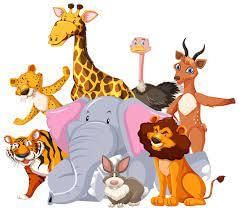
(iv) Which of these animals is a herbivore?
(a) Lion
(b) Tiger
(c) Elephant
(d) Shark
Ans: (c)
Explanation: Elephants are herbivores; they eat only plant material such as leaves, grass and bark. Their large, flat molars are shaped for grinding plant matter, unlike the sharp teeth that carnivores use to tear meat.
(v) Why do some animals migrate?
(a) To change their body covering
(b) To search for food and safe breeding places
(c) To compete with other animals
(d) To avoid sunlight
Ans: (b)
Explanation: Many animals migrate to find food and suitable places to breed when conditions at their usual home become unfavourable, for example during cold seasons or drought. Migration helps them survive by moving to areas with more resources.
Q2: Fill in the Blanks
(i) The smallest unit of living organisms is called ____________.
Ans: cell.
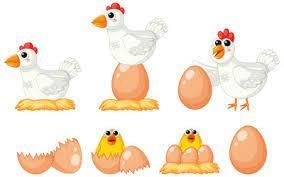
(ii) Animals that lay eggs are called ____________.
Ans: oviparous.
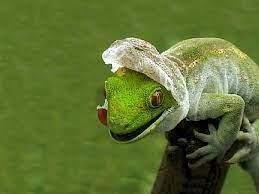
(iii) The process of shedding old skin in reptiles is known as ____________.
Ans: moulting.
(iv) The group of animals that have a backbone is called ____________.
Ans: vertebrates.
(v) Animals that cannot make their own food and depend on other organisms for food are called ____________.
Ans: heterotrophs.
Q3: Match the Following:
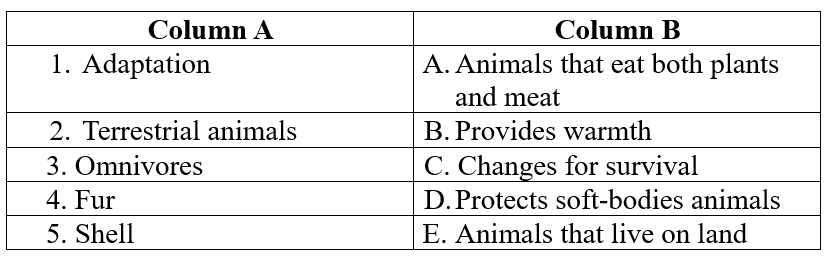
Ans:
1. Adaptation - C
2. Terrestrial animals - E
3. Omnivores - A
4. Fur - B
5. Shell - D
Q4: True or False
(i) All animals need air, water, and food to survive.
Ans: True
Explanation: Air, water and food are the basic needs for animals to carry out life processes such as breathing, digesting food and growing. Without these, animals cannot survive.
(ii) Fishes have lungs to breathe underwater.
Ans: False
Explanation: Fish do not have lungs; they have gills. Gills take oxygen dissolved in water as it passes over them, allowing fish to breathe underwater.
(iii) Herbivores eat plants for their nutrition.
Ans: True
Explanation: Herbivores obtain their nutrients by eating plant materials such as grass, leaves and fruit. Examples include cows, elephants and rabbits.
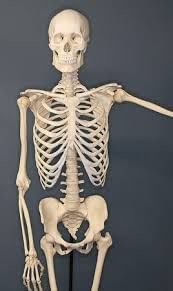
(iv) The skeleton inside the body is called an exoskeleton.
Ans: False
Explanation: An internal skeleton is called an endoskeleton. An exoskeleton is a hard outer covering found in animals like insects and crabs. The two are different types of support structures.
(v) The process of breaking down food into simpler substances is called digestion.
Ans: True
Explanation: Digestion breaks down food into smaller substances that the body can absorb and use for energy, growth and repair.
Q5: Give reasons:
(a) Birds like ostrich, emu, and penguin cannot fly.
Ans: These birds have heavy, large bodies and their wings are small or shaped for other functions. Ostriches and emus are adapted for running on land, while penguins have wings modified as flippers for swimming. Because of these body shapes and wing structures, they cannot fly.
(b) Ducks, fowls, and bears are called omnivores.
Ans: These animals eat both plants and animals. For example, ducks and fowls may eat grains, plants and insects, while bears eat fruits, plants and small animals. Because their diet includes both plant and animal food, they are called omnivores.
(c) Animals like cow, sheep, goat, zebra, and horse have sharp front teeth (incisors) and large flat back teeth (molars).
Ans: These animals are herbivores. Their sharp front teeth help them cut or bite off plant parts, and their large, flat molars at the back are used to grind and chew fibrous plant material so it can be digested.
Q6: Short Answer Questions
(i) What is the primary difference between mammals and birds?
Ans: Mammals have hair or fur, usually give birth to live young and feed their young with milk. Birds have feathers, lay hard-shelled eggs and do not produce milk.
(ii) Name two adaptations of animals that help them survive in their habitats.
Ans: Scales in reptiles help prevent water loss, and feathers in birds keep them warm and help them fly.
(iii) Why do some animals have camouflage?
Ans: Camouflage helps animals blend with their surroundings so they are less visible to predators or prey. This increases their chances of survival.
(iv) Name two animals that are carnivores and two animals that are herbivores.
Ans:
- Carnivores: Lion, Tiger
- Herbivores: Elephant, Cow
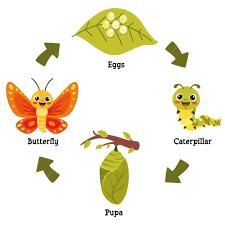
(v) Describe the life cycle of a butterfly.
Ans: The butterfly life cycle has four stages: egg, larva (caterpillar), pupa (chrysalis) and adult. The adult lays eggs on a host plant. Eggs hatch into caterpillars, which eat and grow. A caterpillar then forms a chrysalis, inside which it changes and finally emerges as an adult butterfly.
(vi) Name the body covering of the following animals.
Snail, Fish, Sheep, Polar Bear
Ans:
- Snail - Soft, slimy body; protected by a hard external shell.
- Fish - Covered with scales.
- Sheep - Covered with wool (fleece).
- Polar Bear - Covered with thick fur.
(vii) How do the following animals move?
Turtles, Penguins, Water Boatman
Ans:
- Turtles: Walk on land using their legs; in water they swim by paddling their legs.
- Penguins: Swim using their wings as flippers and use their feet for steering; on land they waddle or slide on their bellies.
- Water Boatman: Moves on the water surface by rowing with its long, oar-like legs which are adapted for swimming.
FAQs on Worksheet Solutions: Animal Life - 1
| 1. What are the different types of animal habitats and where do different animals live? |  |
| 2. How do animals adapt to their environment and what physical features help them survive? | |
| 3. What is the difference between herbivores, carnivores, and omnivores in animal classification? | |
| 4. Why do some animals migrate and what triggers this behaviour in different seasons? | |
| 5. What are the main characteristics that distinguish mammals, birds, reptiles, amphibians, and fish from each other? | |