CBSE Class 5 > Class 5 Notes > Science > Worksheet: Nervous System - 1
Worksheet: Nervous System - 1


Multiple Choice Questions (MCQs)
(i) Which part of the brain is responsible for thinking and learning?
(a) Cerebrum
(b) Cerebellum
(c) Brainstem
(d) Hypothalamus
(ii) Which part of the eye lets light into the eye?
(a) Eyelid
(b) Retina
(c) Pupil
(d) Iris
(iii) Which type of neuron carries messages from the brain to the muscles?
(a) Sensory neuron
(b) Mixed neuron
(c) Motor neuron
(d) None of the above
(iv) Which sense organ helps us maintain balance?
(a) Eyes
(b) Nose
(c) Tongue
(d) Ears
(v) Which part of the brain is responsible for involuntary actions like heartbeat and breathing?
(a) Cerebrum
(b) Medulla Oblongata
(c) Cerebellum
(d) Spinal Cord
Fill in the blanks
(i) The ________ system is responsible for controlling and coordinating the functions of the body.
(ii) The brain and the spinal cord make up the ________ nervous system.
(iii) Neurons are the basic functional units of the ________ system.
(iv) The ________ is the part of the brain responsible for higher cognitive functions.
(v) The __________ protects the brain by enclosing it in a bony structure.
Write the functions of these parts of your body.
(i) Cerebrum
(ii) Pupil
(iii) Eardrum
(iv) Medulla
(v) Cerebellum
(vi) Spinal cord
True or False
(i) The spinal cord is responsible for carrying messages between the brain and the body.
(ii) The cerebrum is responsible for controlling involuntary actions.
(iii) The mixed nerves only carry messages from the brain to the organs.
(iv) The medulla oblongata connects the brain to the spinal cord.
(v) Eyes, ears, tongue, nose, and skin are our sense organs.
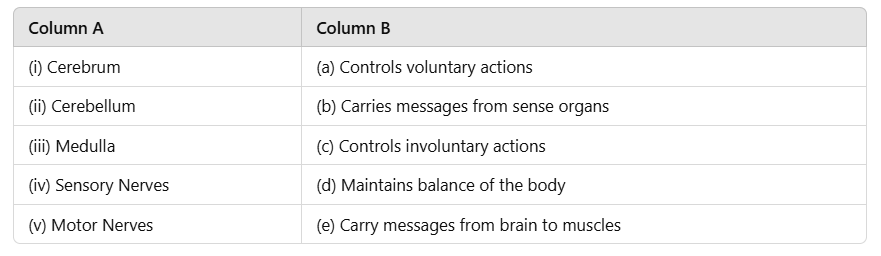
Match the following
Choose the odd one out
(a)

(b) 
Short Answer Questions.
(i) What is the main function of the nervous system?
(ii) What are the two main parts of the central nervous system?
(iii) Describe the function of a neuron.
(iv) How are the spinal cord and brain different in their functions?
(v) What is the difference between voluntary and involuntary actions?
(vi) Which nerve connects the eyes to the brain, and what is its function?
(vii) How do ears help us, apart from hearing?
You can access the solutions to this worksheet here.
The document Worksheet: Nervous System - 1 is a part of the Class 5 Course Science Class 5.
All you need of Class 5 at this link: Class 5
FAQs on Worksheet: Nervous System - 1
| 1. What are the main parts of the nervous system and what do they do? |  |
Ans. The nervous system has two main parts: the brain and spinal cord (central nervous system) and nerves throughout the body (peripheral nervous system). The brain controls thinking and decisions, the spinal cord relays messages, and nerves carry signals between the body and brain. Together, they help you sense, think, and move in response to your surroundings.
| 2. How do nerve cells or neurons work to send messages in the body? | |
Ans. Neurons transmit electrical and chemical signals along their length, passing messages from one cell to another through connections called synapses. Each neuron has a cell body, dendrites that receive signals, and an axon that sends them. This relay system allows your brain to communicate instantly with every part of your body for movement and sensation.
| 3. What's the difference between the brain, spinal cord, and nerves in CBSE Class 5 Science? | |
Ans. The brain is the control centre for all thoughts and actions, located in the skull. The spinal cord extends from the brain down the backbone, relaying messages between brain and body. Nerves are thin fibres branching throughout your entire body, carrying sensory information to the brain and motor commands back to muscles for responses.
| 4. Why do you pull your hand away from a hot object so quickly without thinking? | |
Ans. This reflex action happens because sensory neurons detect heat and send an immediate signal to the spinal cord, which instantly commands muscles to pull away-all without waiting for the brain to process. The spinal cord acts as a shortcut, protecting you from injury faster than conscious thought. This reflex arc keeps you safe automatically.
| 5. What are the functions of the brain and which part controls what? | |
Ans. The brain controls all body functions: the cerebrum manages thinking and voluntary movement, the cerebellum coordinates balance and posture, and the brainstem regulates breathing and heartbeat. Different brain regions specialise in memory, emotions, sight, hearing, and smell. Understanding brain lobes helps explain how nervous system coordination keeps your body functioning smoothly during daily activities.
About this Document

7.9K Views

4.84/5 Rating

Apr 19, 2026 Last updated
Document Description: Worksheet: Nervous System - 1 for Class 5 2026 is part of Science Class 5 preparation. The notes and questions for Worksheet: Nervous System - 1 have been prepared according to the Class 5 exam syllabus. Information about Worksheet: Nervous System - 1 covers topics like and Worksheet: Nervous System - 1 Example, for Class 5 2026 Exam. Find important definitions, questions, notes, meanings, examples, exercises and tests below for Worksheet: Nervous System - 1.
Introduction of Worksheet: Nervous System - 1 in English is available as part of our Science Class 5 for Class 5 & Worksheet: Nervous System - 1 in Hindi for Science Class 5 course. Download more important topics related with notes, lectures and mock test series for Class 5 Exam by signing up for free. Class 5: Worksheet: Nervous System - 1
Description
Worksheet: Nervous System of Science Class 5 - variety of important questions with solutions, helping you prepare for exam. Download free PDF from EduRev.
Information about Worksheet: Nervous System - 1
In this doc you can find the meaning of Worksheet: Nervous System - 1 defined & explained in the simplest way possible. Besides explaining types of Worksheet: Nervous System - 1 theory, EduRev gives you an ample number of questions to practice Worksheet: Nervous System - 1 tests, examples and also practice Class 5 tests



Related Searches
video lectures, Worksheet: Nervous System - 1, Viva Questions, MCQs, Exam, Free, past year papers, Extra Questions, ppt, Important questions, shortcuts and tricks, Objective type Questions, Semester Notes, Worksheet: Nervous System - 1, practice quizzes, Worksheet: Nervous System - 1, mock tests for examination, Previous Year Questions with Solutions, study material, Summary, pdf , Sample Paper;