CBSE Class 5  >  Class 5 Notes  >  Science   >  Worksheet: Light and Shadow - 1

Worksheet: Light and Shadow - 1

Q1: Multiple Choice Questions (MCQs).

(i) Which of the following is a natural source of light?
(a)
Torch
(b) 
Candle
(c)
Fireflies
(d) 
Electric bulb

(ii) Which of these is not a transparent object?
(a) 
Glass
(b) 
Air
(c) 
Wood
(d) 
Water

(iii) What do we call the dark area formed by an opaque object when light falls on it?
(a) 
Reflection
(b) 
Shadow
(c) 
Refraction
(d) 
Lens

(iv) What is the term used to describe how light travels in a straight line?
(a)
Reflection of light
(b)
Refraction of light
(c)
Rectilinear propagation of light
(d)
Dispersion of light

(v) Which of the following materials allows light to pass through it?
(a) 
Opaque
(b) 
Transparent
(c) 
Translucent
(d) 
Reflective

Q2: Fill in the blanks.

(i) Light travels in a straight line called a __________.

(ii) When an object blocks light, it forms a __________.

(iii) The size of the shadow depends on the __________ of the light source.

(iv) Shadows are the longest during the __________.

(v) Transparent materials allow __________ to pass through them.

Q3: Match the column.
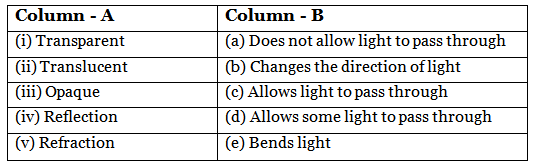
Q3: Match the column.

Q4: True or False.

(i) Shadows are formed when light is blocked by an object.

(ii) The size of the shadow depends on the distance of the object from the light source.

(iii) Transparent materials do not allow light to pass through them.

(iv) Mirrors are an example of a reflective surface.

(v) Shadows can change shape and size throughout the day.

Q5: Short Answer Questions.

(i) What is light?

(ii) Name any two sources of light.

(iii) What are the three types of materials based on their interaction with light?

(iv) Explain the difference between transparent, translucent, and opaque objects.

(v) How are shadows formed?
Q5: Short Answer Questions.


You can find Worksheets Solutions here: Worksheet Solutions: Light and Shadow - 1 

The document Worksheet: Light and Shadow - 1 is a part of the Class 5 Course Science Class 5.
All you need of Class 5 at this link: Class 5

FAQs on Worksheet: Light and Shadow - 1

1. What exactly is a shadow and how does it form when light hits an object?
Ans. A shadow forms when an opaque object blocks light rays from reaching a surface behind it. Light travels in straight lines, so when it encounters a solid object, it cannot pass through, creating a dark area or shadow on the opposite side. The shadow's shape matches the object's outline because light cannot bend around it.
2. Why do shadows change size and position throughout the day in real life?
Ans. Shadows change because the sun's position shifts across the sky from morning to evening. When sunlight hits an object at different angles, the shadow length and direction alter accordingly. During noon, the sun is directly overhead, making shadows shorter and directly beneath objects, while morning and evening shadows are longer and stretch sideways.
3. Can you get a shadow without sunlight, and what other light sources create shadows?
Ans. Shadows form with any light source, not just the sun. A torch, bulb, candle, or lamp all cast shadows because they emit light that travels in straight lines. The key requirement is a light source, an opaque object blocking that light, and a surface receiving the shadow. Different light sources create shadows of varying darkness and sharpness.
4. What's the difference between a sharp shadow and a blurry shadow, and when does each happen?
Ans. A sharp shadow forms when light comes from a single, focused point source close to an object. A blurry or soft shadow occurs with distant or diffused light sources, like sunlight scattered by clouds. The closer and smaller the light source, the sharper the shadow's edges; larger or farther sources create softer, less defined shadow boundaries.
5. How does the colour and transparency of an object affect whether it casts a shadow?
Ans. Only opaque objects cast distinct shadows because they completely block light. Transparent objects like clear glass don't cast shadows since light passes straight through them. Translucent materials, such as frosted glass, cast faint or soft shadows. An object's colour doesn't determine shadow formation-opacity does. Light must be blocked, not reflected or transmitted, to create a shadow.
Explore Courses for Class 5 exam
Get EduRev Notes directly in your Google search
Related Searches
Objective type Questions, shortcuts and tricks, Free, Worksheet: Light and Shadow - 1, Extra Questions, practice quizzes, Important questions, pdf , MCQs, Previous Year Questions with Solutions, past year papers, Worksheet: Light and Shadow - 1, Viva Questions, study material, Worksheet: Light and Shadow - 1, Sample Paper, Exam, Summary, mock tests for examination, Semester Notes, ppt, video lectures;