Worksheet Solutions: Light and Shadow - 1

Q1: Multiple Choice Questions (MCQs).
(i) Which of the following is a natural source of light?
(a) Torch
(b) Candle
(c) Fireflies
(d) Electric bulb
Ans: (c)
Explanation: Fireflies are a natural source of light because they produce their own light through a chemical process in their bodies. A torch, candle, and electric bulb are artificial sources created by humans and do not produce light naturally.
(ii) Which of these is not a transparent object?
(a) Glass
(b) Air
(c) Wood
(d) Water
Ans: (c)
Explanation: Wood is an opaque material and does not let light pass through, so we cannot see through it. Glass, air and water are transparent and allow light to pass through so that objects on the other side can be seen clearly.
(iii) What do we call the dark area formed by an opaque object when light falls on it?
(a) Reflection
(b) Shadow
(c) Refraction
(d) Lens
Ans: (b)
Explanation: A shadow is the dark region formed when an opaque object blocks the path of light. Reflection and refraction are different behaviours of light, and a lens is an object that bends light, not the dark area formed.
(iv) What is the term used to describe how light travels in a straight line?
(a) Reflection of light
(b) Refraction of light
(c) Rectilinear propagation of light
(d) Dispersion of light
Ans: (c)
Explanation: The term rectilinear propagation of light describes the fact that light rays travel in straight lines in a uniform medium. This property helps form sharp shadows and allows us to draw straight rays when studying simple light paths.
(v) Which of the following materials allows light to pass through it?
(a) Opaque
(b) Transparent
(c) Translucent
(d) Reflective
Ans: (b)
Explanation: Transparent materials allow most of the light to pass through them so that we can clearly see objects on the other side. Translucent materials let some light through but scatter it, and opaque materials block light. Reflective describes a surface that bounces back light.
Q2: Fill in the blanks.
(i) Light travels in a straight line called a __________.
Ans: Light travels in a straight line called a ray.
(ii) When an object blocks light, it forms a __________.
Ans: When an object blocks light, it forms a shadow.
(iii) The size of the shadow depends on the __________ of the light source.
Ans: The size of the shadow depends on the angle of the light source.
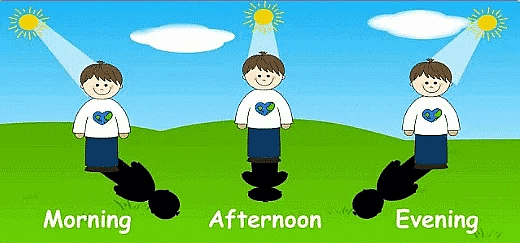
(iv) Shadows are the longest during the __________.
Ans: Shadows are the longest during the morning and evening.
(v) Transparent materials allow __________ to pass through them.
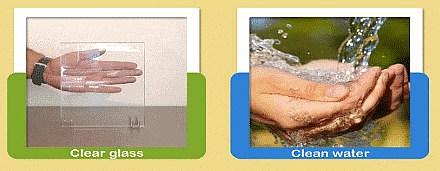
Ans: Transparent materials allow light to pass through them.
Q3: Match the column.
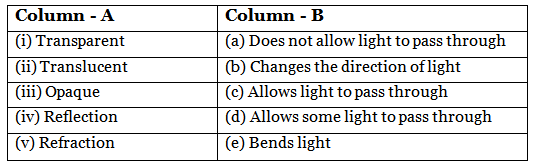
Ans: (i) Transparent - (c) Allows light to pass through
(ii) Translucent - (d) Allows some light to pass through
(iii) Opaque - (a) Does not allow light to pass through
(iv) Reflection - (b) Changes the direction of light
(v) Refraction - (e) Bends light
Q4: True or False.
(i) Shadows are formed when light is blocked by an object.
Ans: True
Explanation: When an object blocks the path between a light source and a surface, it prevents light from reaching that area and a shadow appears behind the object.
(ii) The size of the shadow depends on the distance of the object from the light source.
Ans: True
Explanation: If the object is moved closer to the light source, the shadow becomes larger and less sharp. If the object is moved farther away from the light source, the shadow becomes smaller and sharper.
(iii) Transparent materials do not allow light to pass through them.
Ans: False
Explanation: Transparent materials do allow light to pass through them without much scattering, which is why we can see clearly through glass or clean water.
(iv) Mirrors are an example of a reflective surface.
Ans: True
Explanation: Mirrors have a shiny coated surface that reflects most of the light falling on them, producing clear reflected images.
(v) Shadows can change shape and size throughout the day.
Ans: True
Explanation: As the Sun moves across the sky, the angle and direction of its light change. This makes the length and shape of shadows change during the day.
Q5: Short Answer Questions.
(i) What is light?
Ans: Light is a form of energy that makes objects visible. It travels in straight lines and can change direction when it is reflected or refracted.
(ii) Name any two sources of light.
Ans: Two sources of light are the Sun (a natural source) and a torch (an artificial source).
(iii) What are the three types of materials based on their interaction with light?
Ans: The three types of materials based on how they interact with light are transparent, translucent and opaque.
(iv) Explain the difference between transparent, translucent, and opaque objects.
Ans:
- Transparent objects allow light to pass through them so we can see objects clearly through them.
- Translucent objects allow some light to pass through but scatter it, so we cannot see clearly through them.
- Opaque objects do not allow light to pass through, so we cannot see through them at all.
(v) How are shadows formed?
Ans: Shadows are formed when an opaque object blocks the path of light. The region behind the object where the light cannot reach appears dark and is called the shadow.
FAQs on Worksheet Solutions: Light and Shadow - 1
| 1. How do shadows form when light hits an object? |  |
| 2. Why does my shadow change size and direction throughout the day? | |
| 3. What's the difference between a real shadow and a blurry shadow? | |
| 4. Can transparent objects like glass create shadows? | |
| 5. How can I tell if something is opaque, transparent, or translucent by looking at shadows? | |