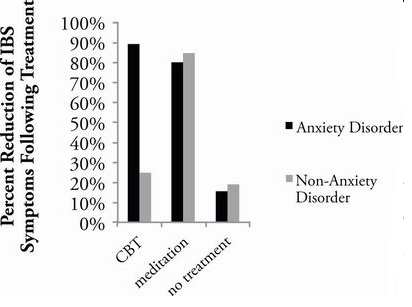
Researchers conducted a six-month study to compare the effectiveness of cognitive behavior therapy (CBT) and guided meditation in treating female patients with Irritable Bowel Syndrome (IBS). IBS is a disorder characterized by abdominal discomfort and irregular bowel movements, often triggered by psychological factors such as anxiety and stress. The study included participants who had experienced IBS symptoms for at least three months in the past year. The participants were divided into three groups: a CBT group, a guided meditation group, and a no-treatment group. The study aimed to determine the percent reduction of IBS symptoms after treatment. Approximately 65% of the participants had an anxiety disorder, and this was evenly distributed among the three groups.
MULTIPLE CHOICE QUESTION
Try yourself: What is the primary characteristic of Irritable Bowel Syndrome (IBS)?
A
Physical abnormalities in the bowels
B
Psychological triggers causing physical symptoms
C
Severe abdominal pain and cramping
D
Alternating pattern of constipation and diarrhea
Correct Answer: B
The passage states that IBS is a disorder where there are no physical abnormalities in the bowels, and instead, the disorder appears to be the physical manifestation of psychological triggers. This means that psychological factors play a primary role in causing the physical symptoms of IBS.
Report a problem
MULTIPLE CHOICE QUESTION
Try yourself: What is the current standard non-pharmacologic treatment for IBS?
A
Guided meditation
B
Cognitive behavior therapy (CBT)
C
Deep-breathing exercises
D
Hypnotherapy
Correct Answer: B
The passage mentions that CBT is the current standard non-pharmacologic treatment for IBS. It is a structured therapy that focuses on identifying and addressing the emotional and psychological triggers that cause IBS symptoms.
Report a problem
MULTIPLE CHOICE QUESTION
Try yourself: What percentage of participants in the study had an anxiety disorder?
A
35%
B
50%
C
65%
D
80%
Correct Answer: C
The passage states that approximately 65% of the participants in the study had an anxiety disorder. This information is provided to highlight the comorbidity of anxiety disorders with IBS.
Report a problem
MULTIPLE CHOICE QUESTION
Try yourself: How were the participants in the study assigned to different groups?
A
Based on their age and gender
B
Based on the severity of their IBS symptoms
C
Randomly assigned
D
Self-selected
Correct Answer: C
The passage mentions that the participants in the study were randomly assigned to one of three groups: a CBT group, a guided meditation group, and a no-treatment group. Random assignment helps ensure that the groups are comparable and any observed differences in outcomes are due to the treatment received.
Report a problem
MULTIPLE CHOICE QUESTION
Try yourself: What was the primary outcome measure in the study?
A
Reduction of anxiety symptoms
B
Improvement in overall well-being
C
Increase in heart and respiration rates
D
Percent reduction of IBS symptoms after treatment
Correct Answer: D
The passage states that the study aimed to determine the percent reduction of IBS symptoms after treatment. This was the primary outcome measure used to compare the effectiveness of cognitive behavior therapy (CBT) and guided meditation in treating IBS.
practice quizzes, MCQs, Exam, Previous Year Questions with Solutions, Important questions, Practice Passage Test - 3, mock tests for examination, ppt, video lectures, shortcuts and tricks, past year papers, study material, Practice Passage Test - 3, Viva Questions, Extra Questions, Summary, Objective type Questions, Semester Notes, pdf , Practice Passage Test - 3, Sample Paper, Free;