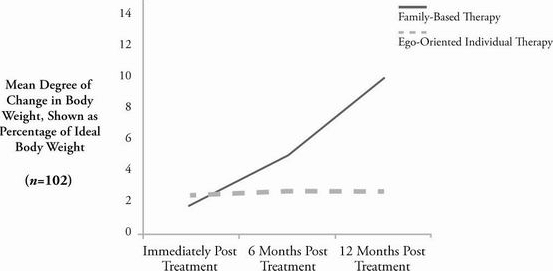
Psychiatrist William Gull, in the late 1800s, described a patient suffering from a "perversion of the will" resulting in "simple starvation." Today, this patient would likely be diagnosed with anorexia nervosa (AN), characterized by distorted body image and dangerously low weight achieved through extreme means. AN has the highest mortality rate among mental illnesses due to severe health consequences. Different theories propose sociocultural, intrapersonal, family dynamics, or addiction perspectives to explain the causes of AN. Studies have compared various treatment approaches for AN, but no particular approach has been found significantly superior to others, according to the National Institute for Clinical Excellence (NICE) study in the UK.
MULTIPLE CHOICE QUESTION
Try yourself: According to the passage, what did psychiatrist William Gull describe in the late 1800s?
A
A patient suffering from anorexia nervosa
B
A patient suffering from bulimia nervosa
C
A patient suffering from obsessive-compulsive disorder
D
A patient suffering from schizophrenia
Correct Answer: A
The passage states that psychiatrist William Gull described one of his patients suffering from a "perversion of the will" resulting in "simple starvation," which is indicative of anorexia nervosa.
Report a problem
MULTIPLE CHOICE QUESTION
Try yourself: What is the primary characteristic of anorexia nervosa (AN)?
A
Excessive exercise and strict dieting
B
Binge eating followed by purging
C
Fear of social situations and public speaking
D
Compulsive handwashing and cleanliness rituals
Correct Answer: A
The passage describes anorexia nervosa as a disorder characterized by distorted body image and dangerously low weight achieved through food restriction, excessive exercise, or other extreme means.
Report a problem
MULTIPLE CHOICE QUESTION
Try yourself: What is the main reason for the high mortality rate associated with anorexia nervosa?
A
Cardiovascular stress and gastrointestinal dysfunction
B
Excessive exercise and overexertion
C
Complications from binge eating and purging
D
Social isolation and lack of support
Correct Answer: A
The passage mentions that severe health consequences associated with anorexia nervosa include cardiovascular stress, gastrointestinal dysfunction, and malnutrition, which contribute to the disorder's high mortality rate.
Report a problem
MULTIPLE CHOICE QUESTION
Try yourself: According to the National Institute for Clinical Excellence (NICE) study, what did the review of AN treatment interventions in the UK conclude?
A
Psychoanalytic therapy is the most effective approach for AN.
B
Cognitive behavioral therapy (CBT) is superior to all other approaches.
C
No particular treatment approach is significantly superior to others.
D
Inpatient interventions are more effective than outpatient interventions.
Correct Answer: C
The passage mentions that the NICE study concluded that no specific treatment approach for AN was significantly superior to any other approach in terms of treatment outcome.
Report a problem
MULTIPLE CHOICE QUESTION
Try yourself: What are the different theories proposed to explain the etiology or risk factors of AN?
A
Sociocultural, intrapersonal, family dynamics, and addiction perspectives
B
Biological, genetic, and neurological factors
C
Trauma, childhood abuse, and neglect
D
Personality disorders and mood disturbances
Correct Answer: A
The passage states that various theories propose sociocultural, intrapersonal personality traits, family dynamics, or addiction perspectives to explain the causes of anorexia nervosa (AN).
past year papers, Viva Questions, mock tests for examination, pdf , Free, Exam, Previous Year Questions with Solutions, Extra Questions, Objective type Questions, study material, video lectures, Practice Passage Test - 5, Practice Passage Test - 5, practice quizzes, Practice Passage Test - 5, ppt, Sample Paper, shortcuts and tricks, Summary, MCQs, Important questions, Semester Notes;