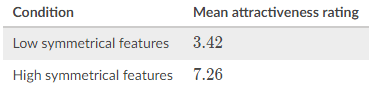
The way we perceive the world is influenced by our ability to make assumptions and interpretations about the stimuli we encounter. These assumptions help us recognize meaningful patterns and focus on new stimuli, which in turn enhance our understanding of the world. Gestalt psychology is a branch of psychology that explores how we organize our perceptions. It suggests that humans perceive objects and events as a whole, rather than focusing on individual features. When it comes to judging the attractiveness of a person's face, the principles of Gestalt theory propose that we evaluate the overall arrangement of facial features rather than individual traits like eye color or nose shape. According to this theory, a person with symmetrical facial features may be considered more attractive because their face appears proportional and cohesive. To investigate the influence of facial symmetry on attractiveness ratings, a researcher manipulates a photo of a man and a woman, creating two versions: one with high symmetrical features and the other with low symmetrical features. These photos are shown to 400 undergraduate participants who are asked to rate the attractiveness of the individuals depicted on a scale of 1 to 10. The mean attractiveness ratings for the images are summarized in Table 1. Now, let's discuss the Gestalt Law of Continuity.
MULTIPLE CHOICE QUESTION
Try yourself: What is the main focus of Gestalt psychology?
A
Evaluating individual facial features
B
Understanding perceptual organization
C
Analyzing facial symmetry
D
Investigating the attractiveness of faces
Correct Answer: B
Gestalt psychology aims to comprehend how we organize and interpret our perceptions as a whole, rather than focusing on individual elements or features.
Report a problem
MULTIPLE CHOICE QUESTION
Try yourself: According to Gestalt theory, how are facial attractiveness ratings determined?
A
By evaluating individual facial traits
B
By considering the overall arrangement of facial features
C
By comparing faces with symmetrical and asymmetrical traits
D
By assessing eye color, nose shape, and lips separately
Correct Answer: B
Gestalt theory suggests that judgments of facial attractiveness are based on the collective features of the face as a whole, rather than evaluating specific parts or traits independently.
Report a problem
MULTIPLE CHOICE QUESTION
Try yourself: What does the researcher do to investigate the influence of facial symmetry on attractiveness ratings?
A
Shows photos to 400 undergraduates
B
Asks participants to rate the attractiveness of photos
C
Creates two images with high and low symmetrical features
D
Analyzes the mean attractiveness ratings for the images
Correct Answer: C
The researcher alters a photo to create two versions—one with high symmetrical features and another with low symmetrical features— to examine how facial symmetry impacts attractiveness ratings.
Report a problem
MULTIPLE CHOICE QUESTION
Try yourself: Why might a person with symmetrical facial traits be considered more attractive?
A
Because their individual features are more appealing
B
Because they have a unique combination of traits
C
Because their face appears proportional and cohesive
D
Because they possess attractive eye color, nose shape, and lips
Correct Answer: C
According to Gestalt theory, symmetrical facial traits contribute to an overall appearance of proportionality and cohesion, leading to higher attractiveness ratings.
Report a problem
MULTIPLE CHOICE QUESTION
Try yourself: What scale is used by the participants to rate attractiveness?
A
Scale of 1 to 5
B
Scale of 1 to 20
C
Scale of 1 to 10
D
Scale of 1 to 100
Correct Answer: C
The participants are asked to rate the attractiveness of the individuals depicted in the photos on a scale of 1 to 10.
past year papers, Objective type Questions, Extra Questions, MCQs, study material, Practice Passage Test - 15, shortcuts and tricks, Summary, pdf , Exam, ppt, video lectures, Semester Notes, Sample Paper, mock tests for examination, Important questions, Free, practice quizzes, Practice Passage Test - 15, Previous Year Questions with Solutions, Practice Passage Test - 15, Viva Questions;