Angular Acceleration

Introduction
Angular acceleration can be defined as the time rate of change of angular velocity. It quantifies the change in angular velocity per unit time and is commonly expressed in radians per second per second. This type of acceleration is also known as rotational acceleration and is crucial in studying the motion of rotating objects like wheels, fans, and even the Earth. It is worth noting that angular acceleration is a pseudoscalar, and its sign depends on the direction of angular speed changes. When the angular speed increases counterclockwise, the angular acceleration is considered positive, while a clockwise increase in angular speed leads to a negative angular acceleration.
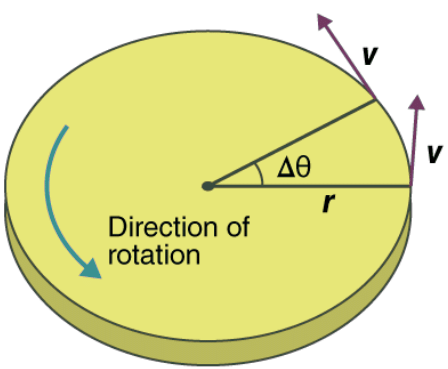
Angular Acceleration Unit
The vector direction of angular acceleration is perpendicular to the plane where the rotation occurs. If the angular velocity increases in a clockwise direction, the angular acceleration vector points away from the observer. Conversely, if the angular velocity increases counterclockwise, the vector of angular acceleration points toward the viewer. In the International System of Units (SI), angular acceleration is measured in radians per second squared (rad/s²) and is commonly denoted by the Greek letter alpha (α).
Angular Acceleration Formula
Angular velocity represents the rate of change of angular position in a rotating body. It can be calculated using the following formula:
ω = θ / t
Where:
- ω is the angular velocity
- θ is the angle rotated
- t is the time taken
When the angular velocity remains constant, the angular acceleration is zero. However, if the velocity is not constant, we can define a constant α as:
α = Δω / Δt
In cases where the angular acceleration is not constant and varies with time, we use the following formula:
α = dω / dt
Solved Examples
Ex.1. If a rotating disc changes its angular speed at a rate of 60 rad/s over a period of 10 seconds, what is its angular acceleration during this time?
Solution: Given Δω = 60 rad/s and Δt = 10 s. Substituting the values into the angular acceleration formula, we can calculate as follows:
α = Δω / Δt
= 60 rad/s / 10 s
= 6 rad/s²
Hence, the angular acceleration of the rotating disc during this time is 6 rad/s².
Ex.2. If the rear wheel of a bicycle has an angular acceleration of 20 rad/s², what can be said about its angular velocity after 1 second?
Solution: Given α = 20 rad/s² and t = 1 s. Rearranging the angular acceleration formula, we have:
Δω = α * Δt
= 20 rad/s² * 1 s
= 20 rad/s
Therefore, the angular velocity of the rear wheel after 1 second is 20 rad/s.