Symmetric & Skew Symmetric Matrix

Introduction
In order to determine if a matrix is symmetric, it is crucial to comprehend the concept of matrix transpose and its calculation. The transpose of a matrix is obtained by interchanging its rows and columns, resulting in a new matrix with dimensions n × m when the original matrix has dimensions m × n. The characteristics of a given matrix can be classified into two scenarios:
- If the number of rows (m) is equal to the number of columns (n), the matrix is considered square.
- If the number of rows (m) is not equal to the number of columns (n), the matrix is considered rectangular.
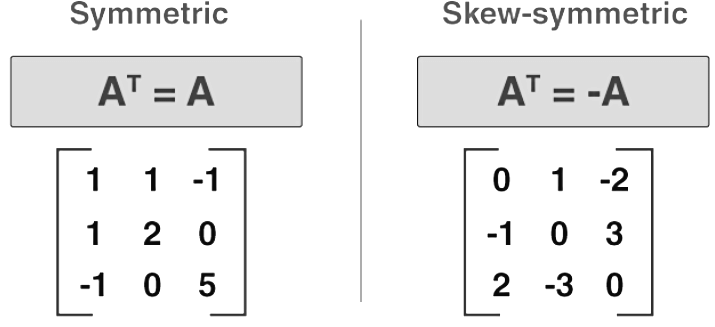
For the second case, the transpose of a matrix can never be equal to it. This is because, for equality, the order of the matrices should be the same. Hence, the only case where the transpose of a matrix can be equal to it, is when the matrix is square. But this is only the first condition. Even if the matrix is square, its transpose may or may not be equal to it. For example: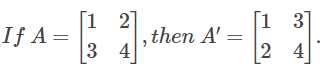
Here, we can see that A ≠ A'.
Let us take another example.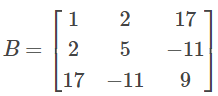
If we take the transpose of this matrix, we will get: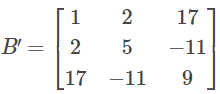
We see that B = B'. Whenever this happens for any matrix, that is whenever transpose of a matrix is equal to it, the matrix is known as a symmetric matrix. But how can we find whether a matrix is symmetric or not without finding its transpose? We know that:
So, if for a matrix A, aij = aji (for all the values of i and j) and m = n, then its transpose is equal to itself. A symmetric matrix will hence always be square. Some examples of symmetric matrices are: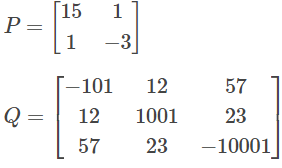
Properties of Symmetric Matrix
- The addition and subtraction of two symmetric matrices always result in a symmetric matrix.
- If matrices A and B are both symmetric and satisfy the commutative property (AB = BA), then their product is also symmetric.
- If matrix A is symmetric, then An (where n is an integer) is also symmetric.
- If A is a symmetric matrix, its inverse A-1 is also symmetric.
Skew Symmetric Matrix
A matrix can only be skew symmetric if it is square. A matrix is considered skew symmetric if its transpose is equal to the negative of itself (A' = -A). In a skew symmetric matrix, the elements satisfy the condition aji = -aij for all values of i and j.
The diagonal elements of a skew symmetric matrix are always zero. This can be proven using a general formula.
aij , where i = j
If i = j, then aij = aii = ajj
If A is skew symmetric, then
aji = - aji
⇒ aii = - aii
⇒ 2.aii = 0
⇒ aii = 0
So, aij = 0 , when i = j (for all the values of i and j)
Some examples of skew symmetric matrices are: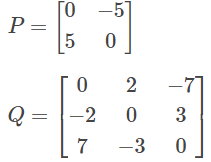
Properties of Skew-Symmetric Matrix
- The addition of two skew-symmetric matrices results in another skew-symmetric matrix.
- The scalar product of a skew-symmetric matrix with a scalar is also a skew-symmetric matrix.
- The diagonal elements of a skew-symmetric matrix are always zero, leading to a zero sum along the main diagonal.
- When an identity matrix is added to a skew-symmetric matrix, the resulting matrix is invertible.
- The determinant of a skew-symmetric matrix is non-negative.
Determinant of Skew-Symmetric Matrix
- If A is a square skew-symmetric matrix, then the determinant of A satisfies the following condition:
- Det(AT) = det(-A) = (-1)n det(A)
- The inverse of a skew-symmetric matrix does not exist when the matrix has an odd order since its determinant is zero, making it singular.
Eigenvalues of Skew-Symmetric Matrix
- For a real skew-symmetric matrix A, the eigenvalue will be zero. Alternatively, we can state that the non-zero eigenvalues of A are non-real.
