Digit sums, casting out 9’s and 9’ check method


Introduction
The word digit means a single figure number. The ten digits are 0, 1, 2, 3, 4, 5, 6, 7, 8, 9. Large numbers can be reduced to a single digit by repeatedly adding their digits. This process and its uses are useful for quick mental calculation and for checking arithmetic work.
Digit sums
Digit sum (also called the digital sum or digital root when reduced to one digit) is the sum of all the digits of a number. If that sum is more than 9, add the digits of the result again and repeat until a single digit is obtained.
Examples:
- The digit sum of 35 is 3 + 5 = 8.
- The digit sum of 142 is 1 + 4 + 2 = 7.
- The digit sum of 57 is 5 + 7 = 12, and 1 + 2 = 3, so the digit sum (digital root) is 3.
- The digit sum of 687 is 6 + 8 + 7 = 21, and 2 + 1 = 3, so the digit sum is 3.

Key points to remember:
- Keep adding the digits of the result until you get a single digit.
- In the sense of modulo 9, the digits 0 and 9 play a special role: a number divisible by 9 has a digital root of 9, and in congruence terms 9 ≡ 0 (mod 9). For practical checks, sometimes 9 may be treated as 0 depending on the method used; when giving a single-digit digital root we usually write 9 for multiples of 9 (unless the number is 0).
More examples:
- 18: 1 + 8 = 9, so the digit sum is 9.
- 234: 2 + 3 + 4 = 9, so the digit sum is 9.
Some quick conversions (number → digit sum):
- 15 → 6
- 12 → 3
- 42 → 6
- 17 → 8
- 21 → 3
- 45 → 9
- 300 → 3
- 1412 → 1 + 4 + 1 + 2 = 8
- 23 → 5
- 22 → 4
Sometimes two steps are needed: for example, 29 → 2 + 9 = 11 → 1 + 1 = 2, so the digit sum is 2. Similarly, 49 → 4 + 9 = 13 → 1 + 3 = 4.

Cast out nine
Cast out nine is a quick technique that uses the properties of digit sums to simplify calculations. Adding or removing any multiple of 9 from a number does not change its remainder when divided by 9, and therefore does not change its digit sum in the modulo-9 sense.
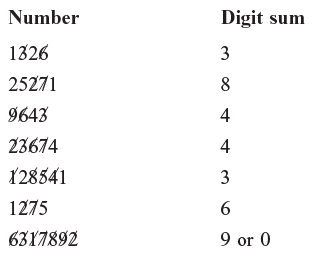
For example, numbers such as 5, 59, 95, 959 all leave the same remainder modulo 9 and have the same digital behaviour; their digit sums reduce to the same single-digit value (in normal digital-root form 59 → 5 + 9 = 14 → 1 + 4 = 5, 95 → 9 + 5 = 14 → 5, and so on).
Using casting out nines to find a digit sum:
- When a digit (or pair of digits) sums to 9, those digits can be 'cast out' (removed) for the purpose of finding the final digital root because they contribute 9, a multiple that does not change the remainder modulo 9.
- Example: to find the digit sum of 4 9 3 9, remove the two 9s and add 4 + 3 = 7; the full sum 4 + 9 + 3 + 9 = 25 → 2 + 5 = 7 gives the same result more slowly.
There is a traditional Vedic expression associated with this idea: when the samuccaya (combined total) is the same, it is zero; in other words, quantities that together make 9 can be removed without changing the remainder modulo 9. This is a helpful mental rule when simplifying sums and when cancelling common 9s in arithmetic.
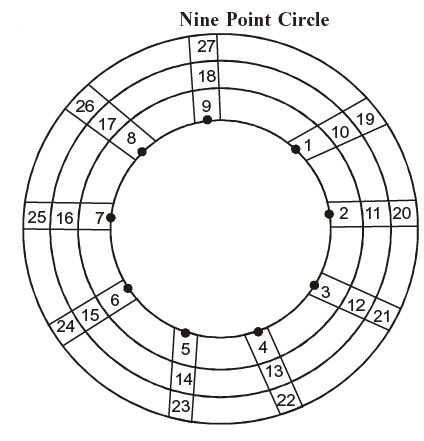
When numbers are arranged around a circle showing residues modulo 9, numbers that are congruent modulo 9 lie at the same positions on the circle. Casting out 9s allows faster mental calculation of digit sums and remainders.
Check method using digit sums
The digit-sum method can be used to check whether an addition or subtraction is likely correct. It compares the digital root (or residue modulo 9) of the calculated result with the digital root obtained by combining the digital roots of the parts.
Simple example: Check 23 + 21.
Compute the digit sums:
23 has digit sum 2 + 3 = 5.
21 has digit sum 2 + 1 = 3.
Add the numbers: 23 + 21 = 44.
44 has digit sum 4 + 4 = 8.
Add the digit sums: 5 + 3 = 8.
Since the digit sum of the computed answer (8) equals the sum of the digit sums (8), the calculation is probably correct (it passes the mod 9 check).
Steps to use the digit-sum check:
- Do the calculation (for example, perform the addition).
- Find and write the digit sums (digital roots) of the numbers used in the calculation.
- Combine those digit sums in the same operation (for addition, add them; for subtraction, subtract them; for multiplication, multiply them), and reduce to a single digit if necessary.
- Find the digit sum of the final answer and compare it with the result from step 3. If they match (in digital-root form), the answer passes the check; if not, there is definitely an error.
Example with steps (addition): Add 278 and 119 and check the answer.

Work and check:
Compute the sum.
\(278 + 119 = 397\)
Find the digit sums of the addends.
\(2 + 7 + 8 = 17\)
\(1 + 7 = 8\)
\(1 + 1 + 9 = 11\)
\(1 + 1 = 2\)
Add the digit sums of the addends and reduce to one digit.
\(8 + 2 = 10\)
\(1 + 0 = 1\)
Find the digit sum of the result.
\(3 + 9 + 7 = 19\)
\(1 + 9 = 10\)
\(1 + 0 = 1\)
Both methods give the same single digit, 1, so the calculated sum 397 passes the digit-sum check.
Caution and limitations of the digit-sum check
Caution: The digit-sum check detects many errors but not all. It is a check modulo 9, so any mistake that changes the result by a multiple of 9 will not be detected by this method.
Illustrative example:

Suppose by mistake you write 400 instead of 490 (an error of 90). The difference 90 is a multiple of 9 (90 = 9 × 10), so the digit sums of 400 and 490 are the same. The digit-sum check will show no discrepancy even though the answer is wrong. Therefore, always use a rough estimation or another checking method (for example, the 11-check for certain kinds of errors, or full recalculation) when accuracy is essential.
Note: Errors that differ by multiples of 9 remain invisible to the cast-out-nines check. Use additional checks or reasonableness tests (size of the answer, place-value estimates) when necessary.
Examples and short exercises
Worked example 1 - digit sum and cast out nines:
Find the digit sum of 4939 by casting out nines.
Remove the 9s and add the remaining digits.
\(4 + 3 = 7\)
Therefore the digit sum of 4939 is 7. Checking by full addition of digits:
\(4 + 9 + 3 + 9 = 25\)
\(2 + 5 = 7\)
Worked example 2 - checking subtraction:
Check whether 725 - 148 = 577 using digit sums.
Find digit sums of the numbers.
\(7 + 2 + 5 = 14\)
\(1 + 4 = 5\)
\(1 + 4 + 8 = 13\)
\(1 + 3 = 4\)
Perform the operation on digit sums (subtraction):
\(5 - 4 = 1\)
Find digit sum of the result 577.
\(5 + 7 + 7 = 19\)
\(1 + 9 = 10\)
\(1 + 0 = 1\)
The digit-sum check agrees, so the result 577 passes the mod-9 check.
Practice problems (try these):
- Find the digital root of 8674.
- Check 134 + 289 = 423 using digit sums.
- Find the digit sum of 99999 by casting out nines.
- Explain why digit-sum checking cannot detect the error if a result is changed by +9 or -18.
Suggested answers:
- 8674 → 8 + 6 + 7 + 4 = 25 → 2 + 5 = 7.
- 134 → 1 + 3 + 4 = 8; 289 → 2 + 8 + 9 = 19 → 1 + 9 = 10 → 1 + 0 = 1; Sum of digit sums = 8 + 1 = 9; 423 → 4 + 2 + 3 = 9, so check passes.
- 99999 → each 9 can be cast out; remaining sum 0, digital root 9 (or 0 in mod-9 sense). For digital root we give 9.
- Adding or subtracting a multiple of 9 does not change the residue modulo 9, so the digit sums remain the same and the check cannot detect such errors.
Summary
The digit sum (digital root) is a simple, useful tool: compute by adding digits and repeating until a single digit remains. The cast-out-nines rule speeds this up by removing groups of digits that sum to 9. The digit-sum method provides a quick check on arithmetic work because it compares residues modulo 9, but be aware of its limitation: mistakes that change the result by a multiple of 9 will not be detected. Use digit-sum checks together with estimation and other methods for reliable verification.
FAQs on Digit sums, casting out 9’s and 9’ check method
| 1. What are digit sums and how are they calculated? |  |
| 2. What is the method of casting out nines? | |
| 3. How do you perform a check using digit sums? | |
| 4. What are the cautions and limitations of the digit-sum check method? | |
| 5. Can you provide examples of using digit sums and casting out nines? | |