Mnemonics: Breathing & exchange of Gases


Breathing and exchange of gases involves complex anatomical pathways, numerical values, and physiological processes. Mnemonics are memory aids that help you quickly recall sequences, structures, and facts. Below are easy, relevant, and relatable mnemonics created strictly from your NCERT textbook content, following the same order as the chapter.
1. Definition: Breathing vs Respiration
Mnemonic: "Breathe Outside, Respire Inside"
- Breathing: Exchange of O₂ and CO₂ between atmosphere and alveoli (external process)
- Respiration: Includes breathing + gas transport + cellular respiration (complete process)
2. Respiratory Organs in Different Animals
2.1 Lower Invertebrates
Mnemonic: "Some Cute Flat Snakes Diffuse"
- Sponges
- Coelenterates
- Flatworms
- Use simple Diffusion over entire body surface
2.2 Other Organisms
Mnemonic: "Earth's Moist Cuticle, Insects Track Air"
- Earthworms: Moist cuticle for respiration
- Insects: Tracheal tubes transport atmospheric air
2.3 Aquatic vs Terrestrial
Mnemonic: "Gills for Bills (aquatic), Lungs for Land"
- Aquatic arthropods and molluscs: Gills (branchial respiration)
- Terrestrial forms: Lungs (pulmonary respiration)
2.4 Vertebrates
Mnemonic: "Fish Get All Lungs"
- Fishes: Gills
- Amphibians, Reptiles, Birds, Mammals: Lungs
- Bonus: Frogs also use Cutaneous respiration (skin breathing)
3. Human Respiratory System Pathway
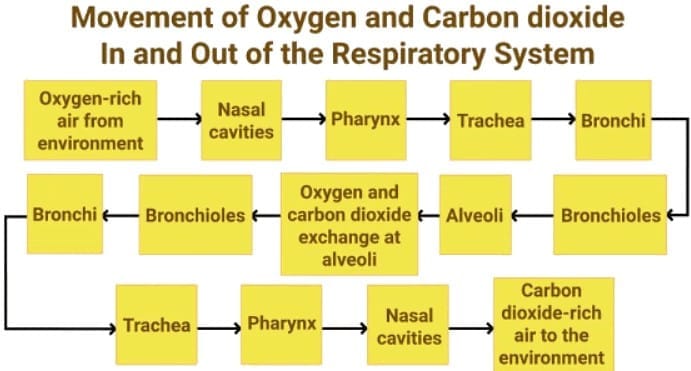
3.1 Complete Pathway Sequence
Mnemonic: "Nose Needs Proper Light To Bring Better Air"
- Nostrils (external)
- Nasal chamber
- Pharynx
- Larynx
- Trachea
- Bronchi (primary, secondary, tertiary)
- Bronchioles (terminal)
- Alveoli
3.2 Trachea Division Point
Mnemonic: "Take Five to divide"
- Trachea divides at 5th thoracic vertebra into right and left primary bronchi
4. Key Structures in Respiratory System
4.1 Larynx and Epiglottis
Mnemonic: "Larry's Sound Box has Epi's Flap Guard"
- Larynx: Sound box (cartilaginous box for sound production)
- Epiglottis: Elastic flap that covers glottis during swallowing (prevents food entry)
4.2 Thoracic Chamber Boundaries
Mnemonic: "Vertebrae (back), Sternum (front), Ribs (sides), Diaphragm (Down)" or "VSRD"
- Dorsally: Vertebral column
- Ventrally: Sternum
- Laterally: Ribs
- Lower side: Dome-shaped Diaphragm
4.3 Pleura
Mnemonic: "Pleura's Double Layer Lubricates Lungs"
- Double layered membrane: Covers lungs
- Pleural fluid: Between layers, reduces friction
4.4 Conducting vs Respiratory Part
Mnemonic: "Conducting Transports, Respiratory Exchanges"
- Conducting part: Nostrils to terminal bronchioles (transports, clears, humidifies, warms air)
- Respiratory part: Alveoli and ducts (actual gas exchange site)
5. Five Steps of Respiration
Mnemonic: "Big Dogs Dance To Utilize"
- Breathing (pulmonary ventilation)
- Diffusion of gases across alveolar membrane
- Distribution = Transport of gases by blood
- Tissue diffusion (between blood and tissues)
- Utilisation of O₂ by cells (cellular respiration)
6. Mechanism of Breathing
6.1 Inspiration vs Expiration
Mnemonic: "Inspire when pressure is Less, Expire when pressure is More"
- Inspiration: Intra-pulmonary pressure < atmospheric="" pressure="" (negative="">
- Expiration: Intra-pulmonary pressure > Atmospheric pressure
6.2 Muscles Involved
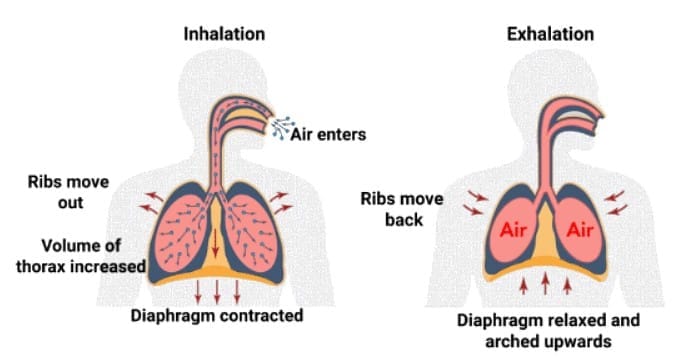
Mnemonic: "DEED" - Diaphragm and External (inspiration), Expiration (passive + internal intercostals)
- Inspiration: Diaphragm contracts + External intercostals contract
- Expiration: Diaphragm relaxes + Internal intercostals (for forced expiration)
6.3 Breathing Rate
Mnemonic: "12 to 16, healthy and clean"
- Normal breathing rate: 12-16 breaths per minute
7. Respiratory Volumes
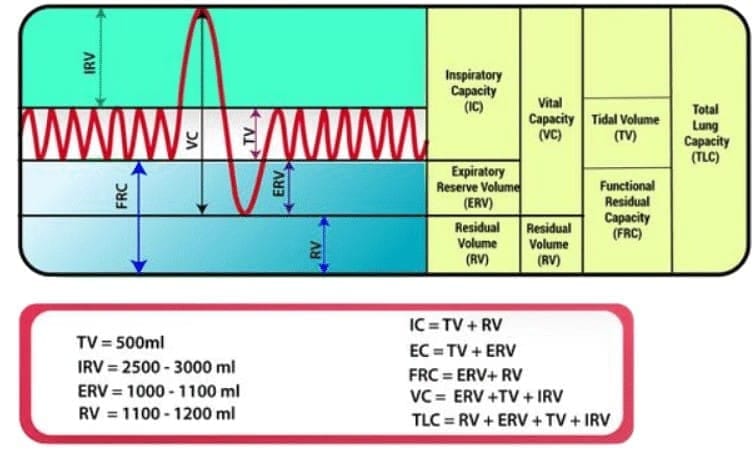
Mnemonic for sequence: "TIRE" - TV, IRV, RV, ERV (order of importance)
7.1 Tidal Volume (TV)
Mnemonic: "TV shows 500"
- TV ≈ 500 mL: Normal inspiration or expiration volume
7.2 Inspiratory Reserve Volume (IRV)
Mnemonic: "IRV = I Reserve 2500-3000"
- IRV ≈ 2500-3000 mL: Extra air inspired forcefully after normal inspiration
7.3 Expiratory Reserve Volume (ERV)
Mnemonic: "ERV = Expire 1000-1100"
- ERV ≈ 1000-1100 mL: Extra air expired forcefully after normal expiration
7.4 Residual Volume (RV)
Mnemonic: "RV = Remains 1100-1200"
- RV ≈ 1100-1200 mL: Air remaining in lungs even after forceful expiration
7.5 Quick Number Recall
Visual Mnemonic: "500 → 2500 → 1000 → 1100" (TV → IRV → ERV → RV)
- Think: 500 is smallest, IRV is largest (2500-3000), ERV and RV are similar (~1000-1200)
8. Respiratory Capacities
Mnemonic: "I Eat Five Very Tasty Laddoos" - IC, EC, FRC, VC, TLC
8.1 Inspiratory Capacity (IC)
Mnemonic: "IC = TV + IRV"
- Total air inspired after normal expiration
8.2 Expiratory Capacity (EC)
Mnemonic: "EC = TV + ERV"
- Total air expired after normal inspiration
8.3 Functional Residual Capacity (FRC)
Mnemonic: "FRC = ERV + RV (Function of Reserves)"
- Air remaining after normal expiration
8.4 Vital Capacity (VC)
Mnemonic: "VC is VITAL = ERV + TV + IRV (all except RV)"
- Maximum air breathed in after forced expiration OR out after forced inspiration
8.5 Total Lung Capacity (TLC)
Mnemonic: "TLC = EVERYTHING = VC + RV"
- Total air in lungs after forced inspiration
8.6 Formula Summary Table
Visual Mnemonic: Use this table for quick revision:
- IC: TV + IRV
- EC: TV + ERV
- FRC: ERV + RV
- VC: ERV + TV + IRV
- TLC: RV + ERV + TV + IRV (or VC + RV)
9. Exchange of Gases - Key Factors
9.1 Three Main Factors
Mnemonic: "PST" - Pressure gradient, Solubility, Thickness
- Partial pressure gradient (pO₂ and pCO₂)
- Solubility of gases
- Thickness of diffusion membrane
9.2 CO₂ Solubility
Mnemonic: "CO₂ is 20-25 times more soluble (think: CO₂ dissolves in soft drinks easily)"
- CO₂ solubility is 20-25× higher than O₂
9.3 Diffusion Membrane Layers
Mnemonic: "SAB" - Squamous epithelium, Alveolar capillary endothelium, Basement membrane
- Squamous epithelium of alveoli
- Alveolar capillary endothelium
- Basement substance/membrane (between the two)
- Total thickness: Less than 1 mm
9.4 Partial Pressure Gradients
Mnemonic: "Alveoli Always Offers Oxygen" (A-A-O-O)
- O₂ gradient: Alveoli (104) → Blood → Tissues (40) [O₂ flows from alveoli to tissues]
- CO₂ gradient: Tissues (45) → Blood → Alveoli (40) [CO₂ flows from tissues to alveoli]
10. Transport of Oxygen
10.1 O₂ Transport Percentages
Mnemonic: "97 Red, 3 Pale" (RBCs carry most, plasma carries little)
- 97% by RBCs (as oxyhaemoglobin)
- 3% dissolved in plasma
10.2 Haemoglobin Binding
Mnemonic: "Haemoglobin Has 4 Friends (O₂)"
- Each haemoglobin molecule binds maximum 4 O₂ molecules
10.3 Factors Affecting O₂ Binding
Mnemonic: "PCHT" - pO₂, pCO₂, H⁺, Temperature
- Partial pressure of O₂ (primary factor)
- pCO₂
- H⁺ ion concentration
- Temperature
10.4 Oxygen Dissociation Curve
Mnemonic: "S for Sigmoid curve, S for Saturation"
- Graph is S-shaped (sigmoid)
- Shows % saturation of Hb with O₂ vs pO₂
10.5 O₂ Delivery
Mnemonic: "Five ml per hundred" (5/100)
- 5 mL O₂ delivered to tissues per 100 mL oxygenated blood
11. Transport of Carbon Dioxide
11.1 CO₂ Transport Percentages
Mnemonic: "70 Bicarb, 20 RBC, 7 Plasma" or "7-2-7 Rule" (70%, 20-25%, 7%)
- 70% as bicarbonate (HCO₃⁻) in plasma
- 20-25% by RBCs (as carbamino-haemoglobin)
- 7% dissolved in plasma
11.2 Carbonic Anhydrase Enzyme
Mnemonic: "CA Creates Bicarbonate"
- Carbonic anhydrase: Present in high concentration in RBCs
- Facilitates: CO₂ + H₂O ⇌ H₂CO₃ ⇌ HCO₃⁻ + H⁺
11.3 CO₂ Delivery
Mnemonic: "Four ml per hundred" (4/100)
- 4 mL CO₂ delivered to alveoli per 100 mL deoxygenated blood
11.4 Comparison: O₂ vs CO₂ Delivery
Mnemonic: "O₂ gives 5, CO₂ takes 4"
- O₂ delivery: 5 mL/100 mL blood
- CO₂ removal: 4 mL/100 mL blood
12. Regulation of Respiration
12.1 Main Control Centers
Mnemonic: "My Rhythm, Pons Moderates" (M-R-P-M)
- Medulla: Respiratory rhythm centre (primary control)
- Pons: Pneumotaxic centre (moderates rhythm, reduces inspiration duration)
12.2 Chemosensitive Area
Mnemonic: "Chemo Senses CO₂ and H⁺"
- Located adjacent to rhythm centre
- Highly sensitive to CO₂ and H⁺ ions
- Activates rhythm centre when these increase
12.3 Peripheral Receptors
Mnemonic: "Aorta and Carotid Catch Changes"
- Aortic arch receptors
- Carotid artery receptors
- Recognize changes in CO₂ and H⁺ concentration
12.4 O₂ Role
Mnemonic: "O₂'s role is Insignificant in regulation"
- Oxygen has insignificant role in respiratory rhythm regulation
13. Disorders of Respiratory System
13.1 Three Main Disorders
Mnemonic: "A-E-O" - Asthma, Emphysema, Occupational
13.2 Asthma
Mnemonic: "Asthma = Airways Inflamed, Wheezing"
- Inflammation of bronchi and bronchioles
- Symptoms: Difficulty breathing, wheezing
13.3 Emphysema
Mnemonic: "Emphysema = Alveoli Damaged, Surface Reduced (Smoking!)"
- Chronic disorder
- Alveolar walls damaged
- Respiratory surface decreased
- Major cause: Cigarette smoking
13.4 Occupational Disorders
Mnemonic: "Dust → Inflammation → Fibrosis (wear masks!)"
- Industries: grinding, stone-breaking (high dust exposure)
- Process: Inflammation → Fibrosis (fibrous tissue proliferation)
- Prevention: Protective masks
14. Quick Revision - Important Numbers
Mnemonic Table: "Numbers Never Fail"
- Breathing rate: 12-16/min
- TV: 500 mL
- IRV: 2500-3000 mL
- ERV: 1000-1100 mL
- RV: 1100-1200 mL
- O₂ transport: 97% RBC, 3% plasma
- CO₂ transport: 70% bicarbonate, 20-25% RBC, 7% plasma
- O₂ delivery: 5 mL/100 mL blood
- CO₂ delivery: 4 mL/100 mL blood
- Haemoglobin capacity: 4 O₂ molecules
- CO₂ solubility: 20-25× O₂
- Diffusion membrane: 3 layers, <1 mm="">
- Trachea division: 5th thoracic vertebra
These mnemonics are designed to match the exact sequence and content of your NCERT chapter. Use them during revision to quickly recall pathways, sequences, numerical values, and key concepts. Regular practice with these memory hooks will significantly improve your retention for NEET Biology preparation.
FAQs on Mnemonics: Breathing & exchange of Gases
| 1. What is the difference between breathing and respiration? |  |
| 2. What are the respiratory organs found in different animals? | |
| 3. What is the pathway of air through the human respiratory system? | |
| 4. What are the key structures of the respiratory system? | |
| 5. What are the five steps of respiration? | |