Mnemonics: Respiration in Plants


Respiration in Plants involves complex biochemical pathways with multiple intermediates, enzymes, and products. For NEET preparation, memorizing the exact sequence of steps in Glycolysis, TCA Cycle, and Electron Transport System (ETS) is crucial. Mnemonics serve as memory aids to recall long sequences, enzyme names, and ATP yields accurately under exam pressure. This section provides high-yield, exam-focused mnemonics covering all major aspects of plant respiration from NCERT Class 11 Chapter 12.
1. Glycolysis Pathway Mnemonics
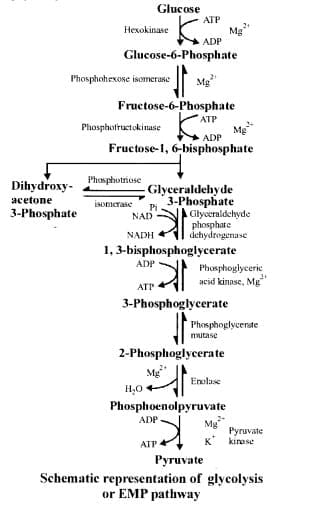
Glycolysis is the breakdown of glucose (6C) into two molecules of pyruvate (3C) in the cytoplasm. It consists of 10 enzymatic steps. The pathway has two phases: Investment Phase (steps 1-5, consumes 2 ATP) and Payoff Phase (steps 6-10, produces 4 ATP and 2 NADH). Net gain: 2 ATP + 2 NADH per glucose.
1.1 Ten Steps Sequence Mnemonic
Mnemonic: "Good Gracious, Father Franklin Found Boys Bringing Pretty Pink Pears"
- Good → Glucose (6C)
- Gracious → Glucose-6-Phosphate (G6P, 6C)
- Father → Fructose-6-Phosphate (F6P, 6C)
- Franklin → Fructose-1,6-Bisphosphate (F1,6BP, 6C)
- Found → DHAP and G3P (3C each) [splits here]
- Boys → 1,3-Bisphosphoglycerate (1,3-BPG, 3C) × 2
- Bringing → 3-Phosphoglycerate (3-PG, 3C) × 2
- Pretty → 2-Phosphoglycerate (2-PG, 3C) × 2
- Pink → Phosphoenolpyruvate (PEP, 3C) × 2
- Pears → Pyruvate (3C) × 2
1.2 ATP and NADH Formation Points
ATP Investment Phase (Steps 1-5):
- Step 1: Glucose → G6P (1 ATP consumed, enzyme: Hexokinase)
- Step 3: F6P → F1,6BP (1 ATP consumed, enzyme: Phosphofructokinase)
- Total ATP used: 2 ATP
ATP Payoff Phase (Steps 6-10):
- Step 6: G3P → 1,3-BPG (NADH + H⁺ produced × 2, enzyme: G3P dehydrogenase)
- Step 7: 1,3-BPG → 3-PG (ATP produced × 2, enzyme: Phosphoglycerate kinase)
- Step 10: PEP → Pyruvate (ATP produced × 2, enzyme: Pyruvate kinase)
- Total ATP produced: 4 ATP
- Total NADH produced: 2 NADH
Net Gain Mnemonic: "Two ATP, Two NADH, Two Pyruvate" (2-2-2 rule)
1.3 Key Regulatory Enzymes
Mnemonic: "Happy People Play" (HPP)
- H → Hexokinase (Step 1, phosphorylates glucose)
- P → Phosphofructokinase (Step 3, rate-limiting enzyme)
- P → Pyruvate kinase (Step 10, final ATP generation)
2. Fermentation Pathway Mnemonics
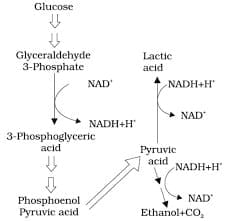
Under anaerobic conditions, pyruvate is converted to either lactic acid or ethanol + CO₂ to regenerate NAD⁺ for glycolysis continuation. No additional ATP is produced during fermentation.
2.1 Types of Fermentation
Mnemonic: "Lazy Animals Eat Yeast" (LAEY)
- Lazy Animals → Lactic Acid fermentation (in muscle cells, some bacteria)
- Eat Yeast → Ethanol fermentation (in yeast, some microbes)
2.2 Enzyme Remembrance
Lactic Acid Fermentation:
- Pyruvate → Lactate
- Enzyme: Lactate dehydrogenase
- Mnemonic: "Lactate Deserves Help" (LDH)
Alcoholic Fermentation (Two-step):
- Pyruvate → Acetaldehyde + CO₂ (Enzyme: Pyruvate decarboxylase)
- Acetaldehyde → Ethanol (Enzyme: Alcohol dehydrogenase)
Mnemonic: "Party Drinks Are Delicious" (PDAD)
- Pyruvate → Decarboxylase → Acetaldehyde → Dehydrogenase → Ethanol
3. TCA Cycle (Krebs Cycle) Mnemonics
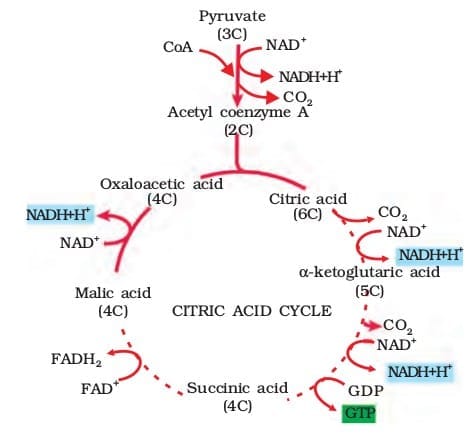
The TCA cycle occurs in the mitochondrial matrix. Each Acetyl CoA (2C) enters the cycle and is completely oxidized to 2 CO₂. Since one glucose produces 2 pyruvate → 2 Acetyl CoA, the cycle runs twice per glucose. The cycle regenerates oxaloacetate (OAA) to continue.
3.1 Eight Intermediates Sequence
Classic Mnemonic: "Can I Keep Selling Seashells For Money, Officer?"
- Can → Citrate (6C)
- I → Isocitrate (6C)
- Keep → α-Ketoglutarate (5C, CO₂ released)
- Selling → Succinyl CoA (4C, CO₂ released)
- Seashells → Succinate (4C)
- For → Fumarate (4C)
- Money → Malate (4C)
- Officer → Oxaloacetate (4C, cycle restarts)
Alternative Mnemonic: "Citrate Is Krebs' Starting Substrate For Making Oxaloacetate"
3.2 Carbon Count Tracking
Mnemonic: "6-6-5-4-4-4-4-4" (Carbon counts)
- Acetyl CoA (2C) + OAA (4C) → Citrate (6C)
- Citrate → Isocitrate (6C)
- Isocitrate → α-Ketoglutarate (5C) [1st CO₂ released]
- α-Ketoglutarate → Succinyl CoA (4C) [2nd CO₂ released]
- Succinyl CoA → Succinate → Fumarate → Malate → OAA (all 4C)
CO₂ Release Points: "I Know Students Confuse" (IKSC)
- Isocitrate → Ketoglutarate (1st CO₂)
- Succinyl CoA formation (2nd CO₂)
3.3 NADH, FADH₂, and GTP Formation Points
Energy Yield Mnemonic: "3 NADH, 1 FADH₂, 1 GTP" (per Acetyl CoA)
NADH Formation (3 points): "I Know My Needs" (IKMN)
- Isocitrate → α-Ketoglutarate (NADH #1)
- α-Ketoglutarate → Succinyl CoA (NADH #2)
- Malate → Oxaloacetate (NADH #3)
FADH₂ Formation (1 point):
- Succinate → Fumarate (FADH₂ formed)
- Mnemonic: "Success Fades" (SF)
GTP/ATP Formation (1 point):
- Succinyl CoA → Succinate (GTP formed, substrate-level phosphorylation)
- Mnemonic: "Substrate Gives True Power" (GTP at substrate level)
3.4 Key Enzymes
- Citrate Synthase: Acetyl CoA + OAA → Citrate (first step)
- Isocitrate Dehydrogenase: Isocitrate → α-Ketoglutarate (rate-limiting)
- α-Ketoglutarate Dehydrogenase: α-Ketoglutarate → Succinyl CoA
- Succinate Dehydrogenase: Succinate → Fumarate (also part of ETS Complex II)
4. Electron Transport System (ETS) Mnemonics
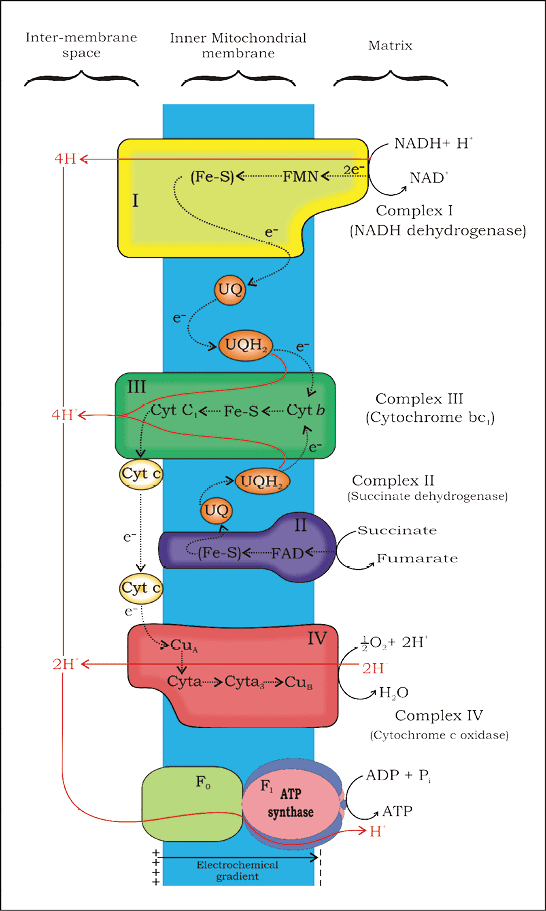
ETS is located on the inner mitochondrial membrane. It consists of 5 protein complexes (I-V) that transfer electrons from NADH and FADH₂ to O₂, creating a proton gradient for ATP synthesis via oxidative phosphorylation.
4.1 Complex Sequence (I to V)
Mnemonic: "No Uncle Can Cook Apples" (NUCCA)
- No → Complex I: NADH dehydrogenase (accepts electrons from NADH)
- Uncle → Ubiquinone (Coenzyme Q) (mobile carrier)
- Can → Complex III: Cytochrome bc₁ complex
- Cook → Cytochrome c (mobile carrier)
- Apples → Complex IV: Cytochrome c oxidase (contains Cytochrome a, a₃; final electron acceptor O₂)
Complex II Entry Point:
- Complex II: Succinate dehydrogenase (accepts electrons from FADH₂ via succinate)
- Mnemonic: "FAD Fails to Start at One" (FADH₂ enters at Complex II, not I)
Complex V (ATP Synthase):
- Structure: F₀ (membrane channel) + F₁ (catalytic head)
- Mnemonic: "F-Zero For Flow, F-One For Formation"
- F₀: Proton channel (allows H⁺ flow from intermembrane space to matrix)
- F₁: ATP synthesis site (ADP + Pi → ATP)
4.2 Proton Pumping Complexes
Mnemonic: "1-3-4 Pump Protons" (Complexes I, III, IV pump H⁺; Complex II does NOT)
- Complex I: Pumps 4 H⁺
- Complex III: Pumps 4 H⁺
- Complex IV: Pumps 2 H⁺
- Total: ~10 H⁺ pumped per NADH oxidized
4.3 Electron Flow Summary
From NADH: NADH → Complex I → Ubiquinone → Complex III → Cytochrome c → Complex IV → O₂ → H₂O
From FADH₂: FADH₂ → Complex II → Ubiquinone → Complex III → Cytochrome c → Complex IV → O₂ → H₂O
Mnemonic: "NADH Needs All Complexes (I-III-IV); FADH₂ Forgets First (II-III-IV)"
5. ATP Yield Calculation Mnemonics
Total theoretical ATP from complete aerobic oxidation of 1 glucose = 38 ATP (or 36 ATP if NADH from glycolysis yields 2 ATP each instead of 3).
5.1 Stage-wise ATP Yield
Mnemonic Table: "Glycolysis-2, Link-2, Krebs-24, Total-38"
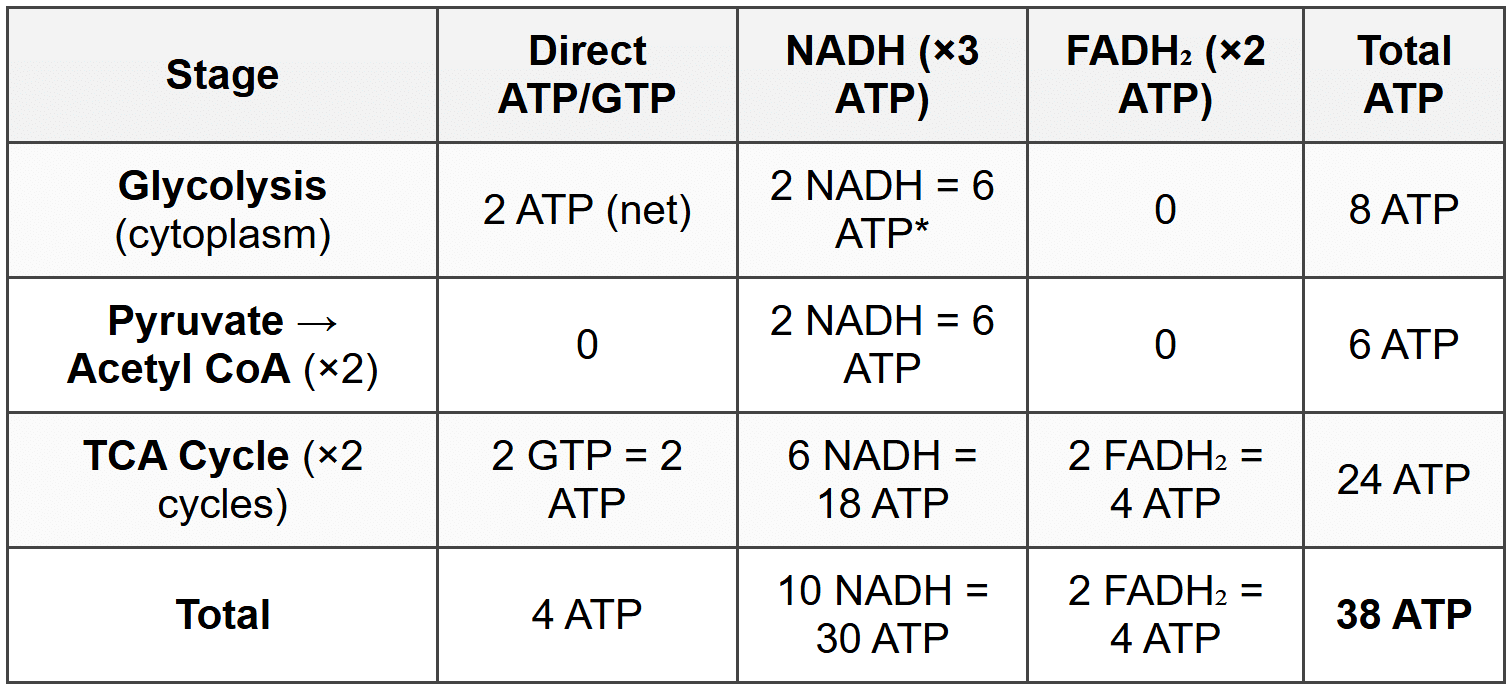
*Note: Cytoplasmic NADH from glycolysis may yield only 2 ATP each (total 4 ATP) if shuttle system is used, making total = 36 ATP. NEET typically expects 38 ATP as the answer.
5.2 NADH vs FADH₂ ATP Yield
Mnemonic: "NADH = 3, FADH₂ = 2" (N-3, F-2)
- NADH: Enters ETS at Complex I → pumps more H⁺ → 3 ATP
- FADH₂: Enters ETS at Complex II → bypasses Complex I → 2 ATP
5.3 Substrate-level vs Oxidative Phosphorylation
Substrate-level Phosphorylation: Direct ATP/GTP formation from substrate
- Glycolysis: Step 7 (1,3-BPG → 3-PG) and Step 10 (PEP → Pyruvate) = 2 ATP
- TCA Cycle: Succinyl CoA → Succinate = 1 GTP (×2 cycles = 2 GTP)
- Total substrate-level: 4 ATP
Oxidative Phosphorylation: ATP from ETS using NADH/FADH₂ = 34 ATP
Mnemonic: "Substrate = 4, Oxidative = 34"
6. Respiratory Quotient (RQ) Mnemonics
RQ = Volume of CO₂ evolved / Volume of O₂ consumed. It depends on the respiratory substrate.
6.1 RQ Values for Different Substrates
Mnemonic: "Carbs = 1, Fats = 0.7, Proteins = 0.9" (CFP = 1-0.7-0.9)
- Carbohydrates: RQ = 1.0
- Example: C₆H₁₂O₆ + 6O₂ → 6CO₂ + 6H₂O
- RQ = 6CO₂/6O₂ = 1.0
- Mnemonic: "Carbs are Complete (1.0)"
- Fats (Lipids): RQ = 0.7
- Example: Tripalmitin (C₅₁H₉₈O₆) + 145O₂ → 102CO₂ + 98H₂O
- RQ = 102/145 ≈ 0.7
- Mnemonic: "Fats Fall Below (0.7)"
- Proteins: RQ ≈ 0.9
- Intermediate value
- Mnemonic: "Proteins are Pretty Close (0.9)"
6.2 RQ Interpretation
- RQ = 1: Pure carbohydrate respiration
- RQ <> Fat or protein respiration (less CO₂ produced per O₂)
- RQ > 1: Anaerobic respiration or organic acid respiration (e.g., succulent plants)
Exam Trap: RQ > 1 does NOT mean more energy; it indicates incomplete oxidation or fermentation.
7. Amphibolic Pathway Mnemonics
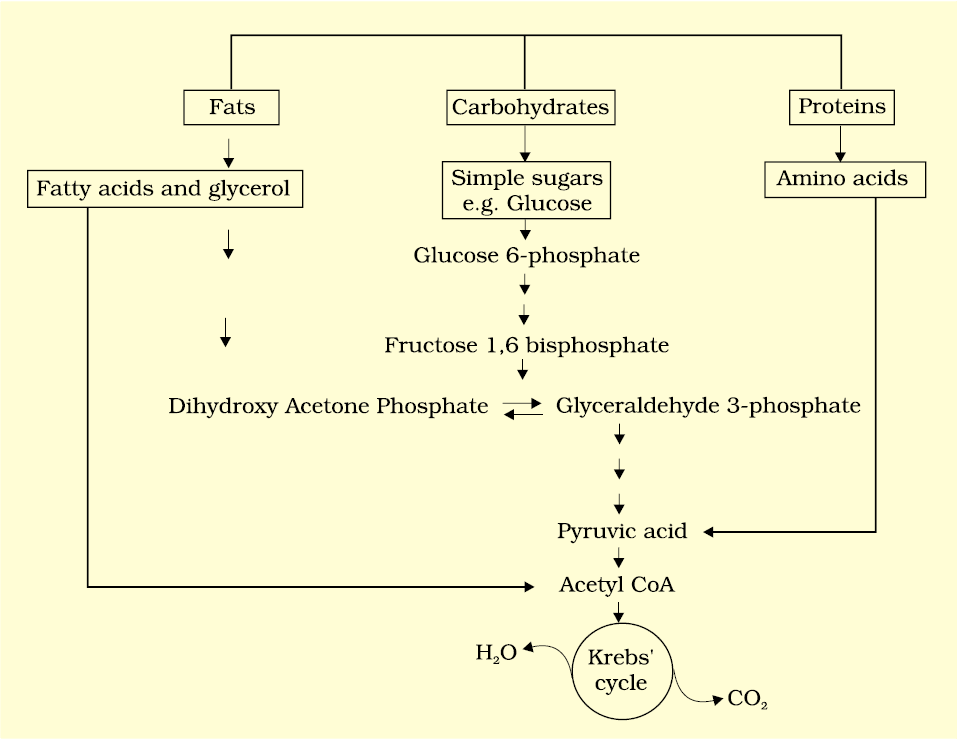
The respiratory pathway is amphibolic (both catabolic and anabolic). Intermediates can be withdrawn for biosynthesis or added from breakdown of other macromolecules.
7.1 Entry Points of Different Substrates
Mnemonic: "Carbs → Glucose, Fats → Acetyl CoA, Proteins → Many Points" (CGF-AM)
- Carbohydrates: Enter as Glucose (start of glycolysis)
- Fats:
- Glycerol → enters as PGAL (3-carbon intermediate in glycolysis)
- Fatty acids → broken to Acetyl CoA (enters TCA cycle)
- Proteins:
- Broken to amino acids → after deamination, enter at various points:
- Some → Pyruvate
- Some → Acetyl CoA
- Some → TCA intermediates (α-Ketoglutarate, Succinyl CoA, OAA)
7.2 Withdrawal Points for Biosynthesis
- Acetyl CoA: Withdrawn for fatty acid synthesis, cholesterol synthesis
- α-Ketoglutarate: Withdrawn for amino acid synthesis (glutamate family)
- OAA: Withdrawn for amino acid synthesis (aspartate family)
Mnemonic: "Acetyl for Fats, Keto for Amino" (AFK-A)
8. Common Traps and Exam Tips
8.1 Substrate-level vs Oxidative Phosphorylation
Trap: Students confuse where ATP is directly synthesized vs via ETS.
- Substrate-level: ATP/GTP formed directly in glycolysis (steps 7, 10) and TCA (Succinyl CoA → Succinate)
- Oxidative: ATP formed via ETS and ATP synthase using NADH/FADH₂
Exam Tip: If question asks "direct ATP," count only substrate-level = 4 ATP. If "total ATP," count all 38 ATP.
8.2 Net vs Gross ATP in Glycolysis
Trap: Forgetting ATP investment phase.
- Gross ATP: 4 ATP produced (steps 7, 10 each ×2)
- ATP consumed: 2 ATP (steps 1, 3)
- Net ATP: 4 - 2 = 2 ATP
Mnemonic: "Four Made, Two Paid, Net = Two"
8.3 Cytoplasmic vs Mitochondrial NADH
Trap: NADH from glycolysis is formed in cytoplasm, not mitochondria.
- Must be transported into mitochondria via shuttle systems (malate-aspartate or glycerol-3-phosphate shuttle)
- May yield 2 or 3 ATP depending on shuttle type
- NEET typically assumes 3 ATP per NADH (total 38 ATP)
8.4 EMP vs TCA vs ETS Location
Location Mnemonic: "Glycolysis in Cytoplasm, TCA in Matrix, ETS on Inner Membrane" (GCT-MIE)
- Glycolysis (EMP pathway): Cytoplasm
- Pyruvate → Acetyl CoA: Mitochondrial matrix
- TCA Cycle: Mitochondrial matrix
- ETS: Inner mitochondrial membrane
8.5 Aerobic vs Anaerobic Respiration
Trap: Thinking glycolysis requires O₂.
- Glycolysis: Occurs in both aerobic and anaerobic conditions
- Fermentation: Strictly anaerobic
- TCA and ETS: Strictly aerobic (require O₂)
Mnemonic: "Glycolysis = Always, Fermentation = Never O₂, TCA/ETS = Must Have O₂"
8.6 RQ Confusion
Trap: Assuming higher RQ = more energy.
- RQ only indicates type of substrate, NOT energy yield
- Fats (RQ = 0.7) give more ATP per gram than carbohydrates (RQ = 1.0)
8.7 Complex II Exception
Trap: Thinking all ETS complexes pump protons.
- Complex II does NOT pump H⁺
- Only receives electrons from FADH₂ and passes to ubiquinone
- Proton pumps: Complexes I, III, IV only
Mnemonic: "Complex II = Inactive in Pumping"
8.8 Acetyl CoA Carbon Count
Trap: Confusing Pyruvate (3C) with Acetyl CoA (2C).
- Pyruvate (3C) → Acetyl CoA (2C) + CO₂
- Enzyme: Pyruvate dehydrogenase complex
- This step is irreversible (important for understanding why fats cannot be converted back to carbohydrates in animals)
8.9 GTP vs ATP in TCA
Trap: Writing ATP instead of GTP at Succinyl CoA step.
- TCA cycle produces 1 GTP (not ATP) at substrate level
- GTP is readily converted to ATP (GTP + ADP ⇌ GDP + ATP)
- For calculations, count GTP = ATP
8.10 Complete Oxidation Requirement
Trap: Thinking respiration = only CO₂ release.
- Complete oxidation requires O₂ as final electron acceptor in ETS
- Without O₂, TCA and ETS stop (NAD⁺ and FAD⁺ not regenerated)
- Anaerobic organisms use only glycolysis + fermentation (incomplete oxidation, low ATP yield)
These mnemonics and tips will help you recall complex pathways, enzyme names, and ATP calculations accurately during NEET. Practice writing out the sequences using mnemonics repeatedly to reinforce memory. Always cross-check carbon counts, ATP yields, and locations to avoid common exam traps.
FAQs on Mnemonics: Respiration in Plants
| 1. What is the glycolysis pathway and what are its key steps? |  |
| 2. What role does fermentation play in cellular respiration? | |
| 3. What is the TCA cycle and what are its main functions? | |
| 4. How does the electron transport system (ETS) contribute to ATP production? | |
| 5. What is the respiratory quotient (RQ) and how is it calculated? | |