Mnemonics: Principles of Inheritance & Variation


Mnemonics are memory aids that help students quickly recall complex concepts, lists, and facts. In Principles of Inheritance and Variation, understanding Mendel's laws, genetic disorders, sex determination mechanisms, and chromosomal aberrations is crucial for NEET. This section provides easy, relevant, and relatable mnemonics that bridge the gap between understanding and rapid recall during exams. Each mnemonic is designed to be simple yet comprehensive, covering high-yield facts that frequently appear in competitive exams.
1. Mendel's Experiments and Laws
1.1 Seven Contrasting Traits in Pea Plant
Mendel studied 7 pairs of contrasting traits in garden pea (Pisum sativum). Remembering these traits is essential as questions often ask about specific characters.
Mnemonic: "Some Friends Play Pranks, So Seriously Silly"
- Stem height - Tall/Dwarf
- Flower color - Violet/White
- Pod shape - Inflated/Constricted
- Pod color - Green/Yellow
- Seed shape - Round/Wrinkled
- Seed color - Yellow/Green
- Seed/Flower position - Axial/Terminal (flower position)
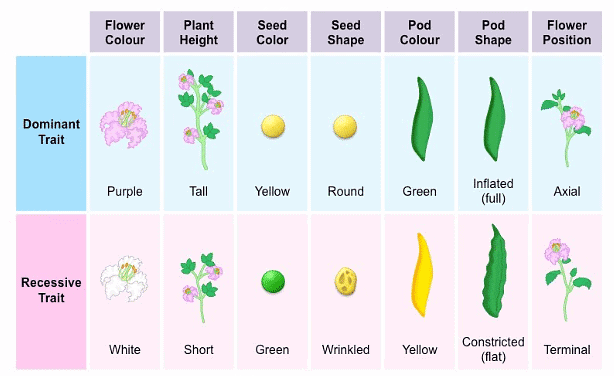
Alternative Mnemonic: "Tall Flowers Positioned Properly, Seeds Shaped Correctly"
- Tall/Dwarf (stem height)
- Flower color (violet/white)
- Position (axial/terminal)
- Pod shape (inflated/constricted)
- Seed color (yellow/green)
- Seed shape (round/wrinkled)
- Color of pod (green/yellow)
1.2 Mendel's Three Laws
Mnemonic: "DiS (Dominance, Segregation, Independent assortment)"
- Dominance - One allele dominates over the other in F₁
- Segregation - Alleles separate during gamete formation
- Independent Assortment - Different gene pairs segregate independently
For Law of Dominance: "Dominant Factors Rule" - In F₁ generation, only dominant trait appears.
For Law of Segregation: "Separate Equally" - Alleles of a pair segregate equally (50:50) into gametes.
For Law of Independent Assortment: "Independent Inheritance" - Applies only to genes on different chromosomes or far apart on same chromosome.
1.3 Genetic Ratios
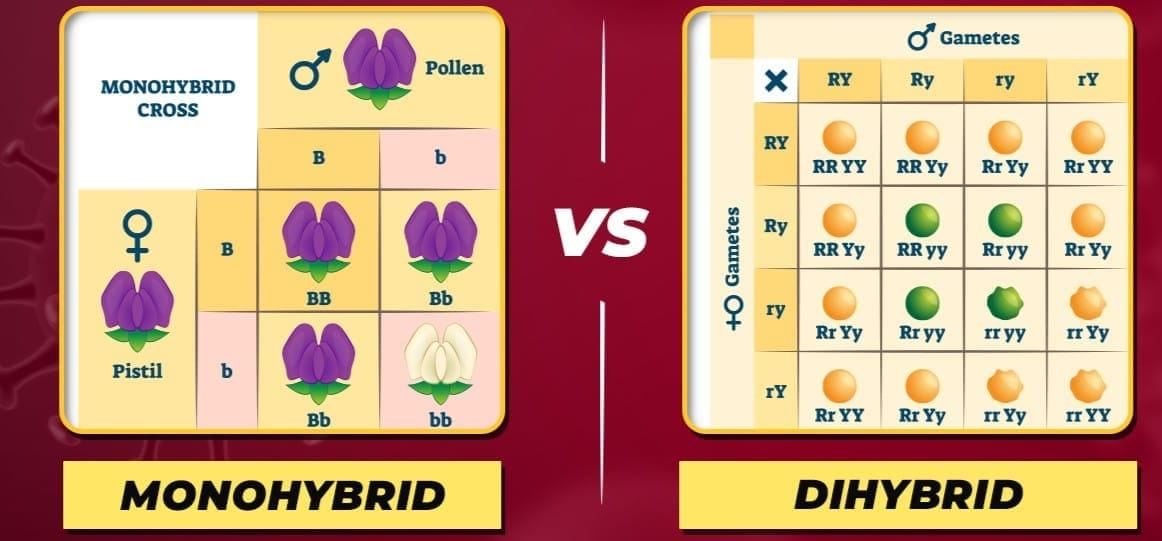
Monohybrid Cross Ratios:
Mnemonic: "3-1 Phenotype, 1-2-1 Genotype"
- F₂ Phenotypic ratio = 3:1 (Dominant:Recessive)
- F₂ Genotypic ratio = 1:2:1 (TT:Tt:tt)
Dihybrid Cross Ratio:
Mnemonic: "9-3-3-1 is Divine for Dihybrid"
- F₂ Phenotypic ratio = 9:3:3:1
- 9 = Both dominant traits
- 3 = First dominant, second recessive
- 3 = First recessive, second dominant
- 1 = Both recessive traits
Test Cross:
Mnemonic: "Test with Recessive Homozygote"
- Test cross = Crossing organism with unknown genotype with homozygous recessive
- Ratio obtained: 1:1 (if heterozygous) or All dominant (if homozygous dominant)
2. Deviations from Mendelian Genetics
2.1 Types of Dominance
Mnemonic: "CIP - Complete, Incomplete, Parity (Co-dominance)"
- Complete Dominance - Normal Mendelian (e.g., Tall/Dwarf in pea)
- Incomplete Dominance - Blending in F₁ (e.g., Pink snapdragon from Red × White)
- Parity/Co-dominance - Both alleles express equally (e.g., AB blood group)
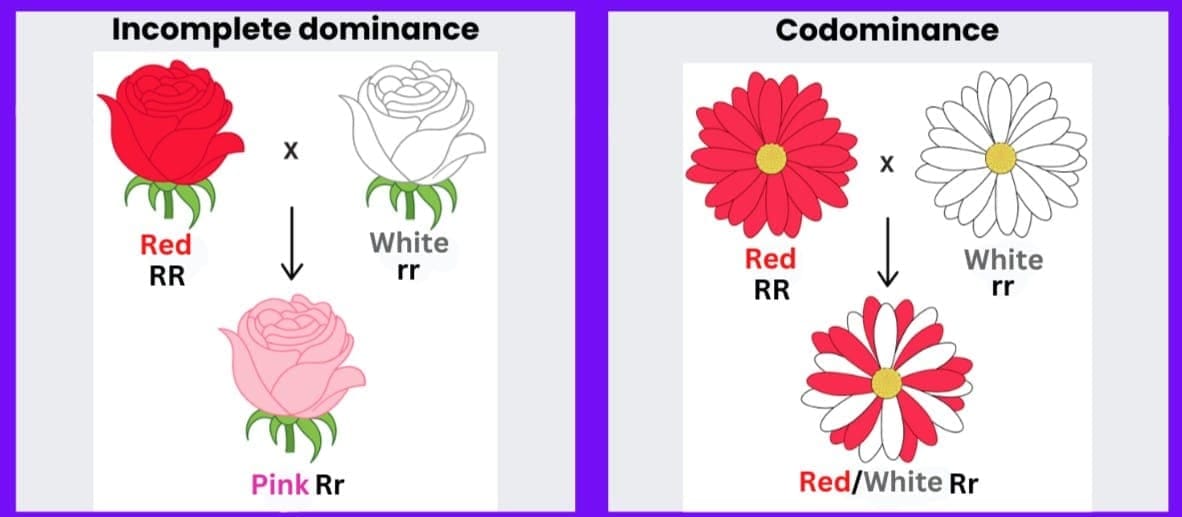
For Incomplete Dominance:
Mnemonic: "Pink Snapdragon 1:2:1"
- Example: Snapdragon (Antirrhinum)
- RR (Red) × rr (White) → Rr (Pink)
- F₂ ratio: 1 Red : 2 Pink : 1 White (both phenotypic and genotypic)
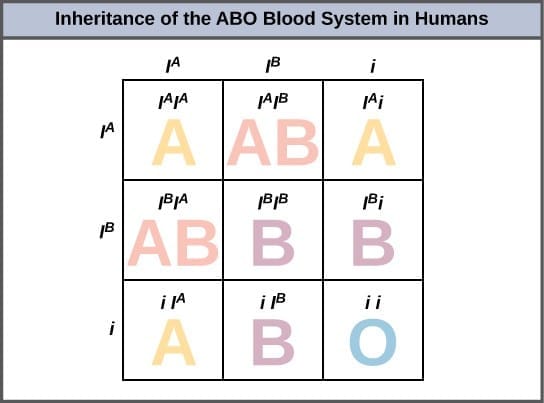
2.2 ABO Blood Groups (Co-dominance and Multiple Alleles)
Mnemonic: "I Am Blood" for gene symbol I
For 6 Genotypes:
Mnemonic: "AAA, BBB, OOO, ABO, AOB, BOA"
- IAIA → A
- IBIB → B
- ii → O
- IAIB → AB (co-dominance)
- IAi → A
- IBi → B
Key Points:
- IA and IB are co-dominant
- IA and IB are completely dominant over i
- Total 3 alleles (multiple alleles)
- Total 6 genotypes, 4 phenotypes (A, B, AB, O)
2.3 Pleiotropy
Mnemonic: "One Gene, Multiple Effects = Pleiotropy"
- Example: Phenylketonuria (PKU)
- Single gene mutation → Mental retardation + Reduced pigmentation
2.4 Polygenic Inheritance
Mnemonic: "Many Genes, One Trait = Polygenic"
- Example: Human skin color (controlled by 3 genes A, B, C)
- AABBCC = Darkest skin
- aabbcc = Lightest skin
- Shows continuous variation
3. Chromosomal Theory of Inheritance
Mnemonic: "Sutton-Boveri Saw Chromosomes = Genes"
- Sutton and Boveri (1902) - Proposed chromosomal theory
- Chromosomes and genes both occur in pairs
- Both segregate during gamete formation
- Independent pairs segregate independently
3.1 Linkage and Recombination (Morgan's Work)
Mnemonic: "Morgan's Drosophila Linked Genes"
- Thomas Hunt Morgan - Worked with Drosophila melanogaster
- Linkage - Genes on same chromosome
- Recombination - Non-parental gene combinations
- Tightly linked genes → Low recombination frequency
- Loosely linked genes → High recombination frequency
Key Example:
- White and Yellow genes: 1.3% recombination (tightly linked)
- White and Miniature wing: 37.2% recombination (loosely linked)
4. Sex Determination Mechanisms
Mnemonic: "XO-XY-ZW-HD" (for 4 types)
4.1 XO Type (Male Heterogamety)
Mnemonic: "Grasshopper has XO Male"
- Example: Grasshopper
- Males: XO (one X chromosome only)
- Females: XX
- Male produces two types of gametes (X or O)
4.2 XY Type (Male Heterogamety)
Mnemonic: "Humans and Drosophila - XY Male"
- Examples: Humans, Drosophila
- Males: XY (heterogametic)
- Females: XX (homogametic)
- Human males: 44 + XY
- Human females: 44 + XX
Trap Alert: The sperm (not egg) determines sex of child in humans. Women are NOT responsible for child's sex.
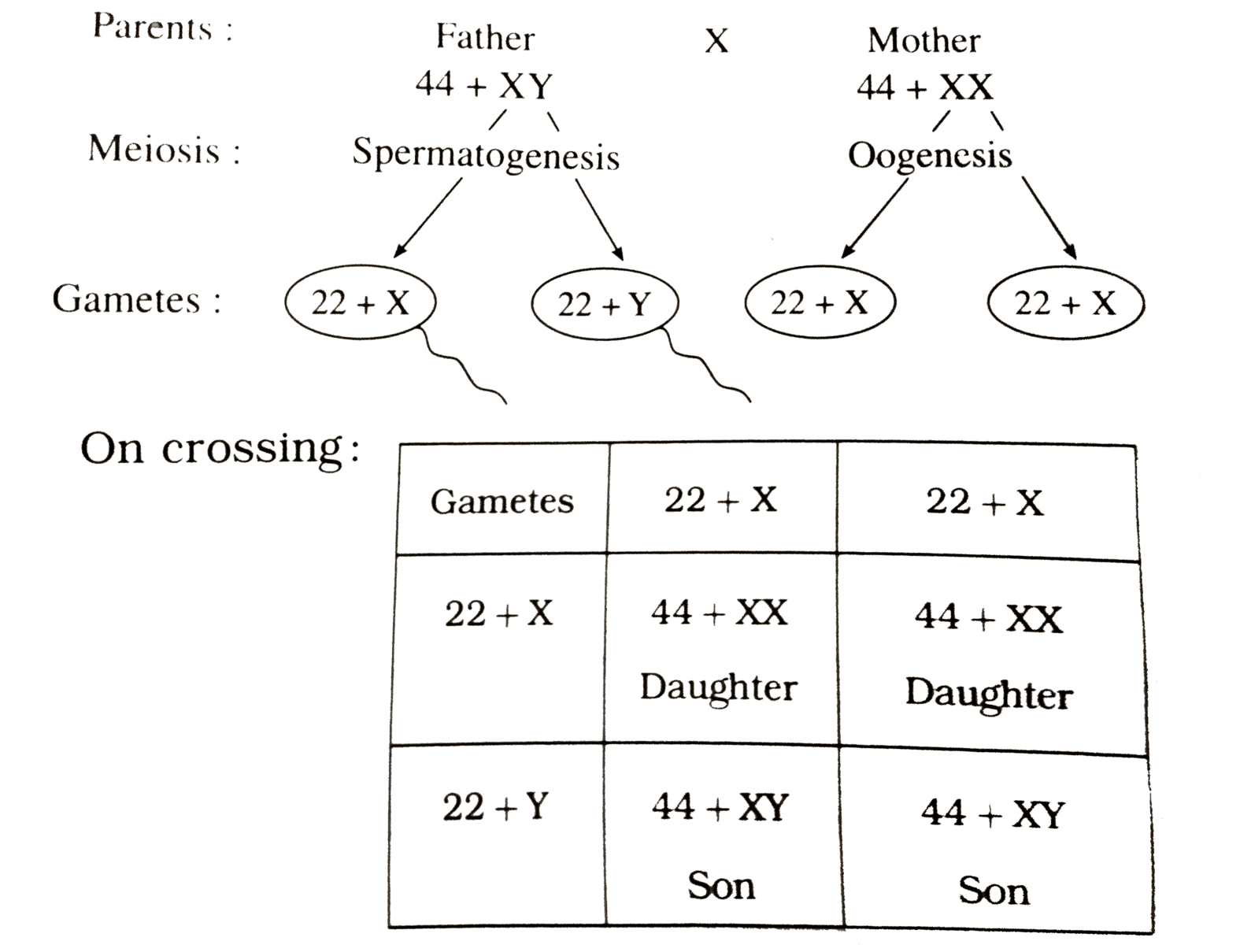 Sex Determination in Humans
4.3 ZW Type (Female Heterogamety)
Mnemonic: "Birds have ZW Females"
- Examples: Birds, some butterflies
- Females: ZW (heterogametic)
- Males: ZZ (homogametic)
- Female produces two types of gametes (Z or W)
4.4 Haplodiploid Type
Mnemonic: "Honey Bee - Half Males (16), Full Females (32)"
- Example: Honey bee
- Females (queen/worker): Diploid (32 chromosomes) - from fertilized egg
- Males (drones): Haploid (16 chromosomes) - from unfertilized egg (parthenogenesis)
- Males have no father but have grandfather
- Males produce sperm by mitosis (not meiosis)
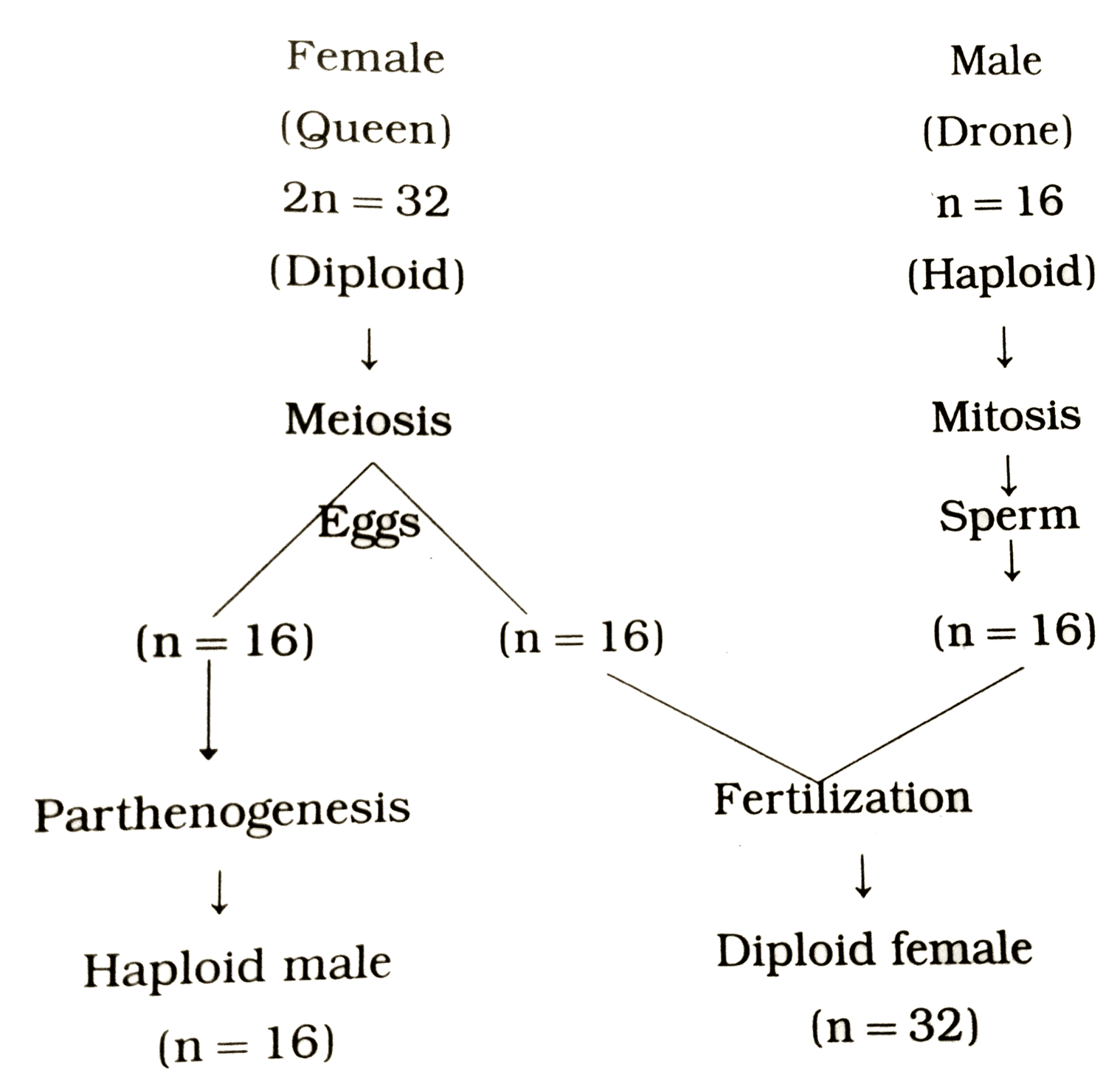 Sex Determination in Honey bees
5. Genetic Disorders
5.1 Classification of Genetic Disorders
Mnemonic: "MC - Mendelian and Chromosomal"
- Mendelian Disorders - Single gene mutations
- Chromosomal Disorders - Abnormal chromosome number or structure
5.2 Mendelian Disorders
Mnemonic for Autosomal Recessive: "SickPhenylThal is AutoRecessive"
- Sickle cell anemia
- Phenylketonuria (PKU)
- Thalassemia
- Cystic fibrosis
Mnemonic for X-linked Recessive: "HemoColo XY cannot see blood"
- Hemophilia
- Color blindness
5.3 Specific Features of Disorders
Hemophilia:
Mnemonic: "Queen Victoria's X-linked Bleeding Disorder"
- X-linked recessive
- Blood clotting protein defect
- Affects males mainly (XY)
- Carrier females (XX) transmit to sons
- Queen Victoria was a famous carrier
Color Blindness:
Mnemonic: "8% Males, 0.4% Females - Red-Green X-linked"
- X-linked recessive
- Affects 8% males, 0.4% females
- Cannot distinguish red and green colors
- Defect in cone cells of eye
Sickle Cell Anemia:
Mnemonic: "6th GAG to GUG = Glu to Val = Sickle"
- Autosomal recessive
- Gene: HbS (mutant), HbA (normal)
- Affected genotype: HbS HbS
- Mutation at 6th position of β-globin chain
- Codon change: GAG → GUG
- Amino acid change: Glutamic acid (Glu) → Valine (Val)
- RBC shape: Biconcave disc → Sickle-shaped
- Occurs under low oxygen tension
Trap Alert: Heterozygous (HbA HbS) individuals are carriers and show sickle-cell trait but not full disease.
Phenylketonuria (PKU):
Mnemonic: "Phenyl Accumulates, Mental Retardation"
- Autosomal recessive
- Enzyme defect: Cannot convert Phenylalanine → Tyrosine
- Accumulation of phenylalanine and phenylpyruvic acid
- Symptoms: Mental retardation
- Excreted in urine
Thalassemia:
Mnemonic: "Alpha on 16, Beta on 11 - Reduced Globin Chain"
- Autosomal recessive
- Reduced synthesis of globin chains (α or β)
- α-Thalassemia: Genes HBA1 and HBA2 on chromosome 16
- β-Thalassemia: Gene HBB on chromosome 11
- Results in anemia
- Quantitative defect (vs. sickle cell which is qualitative)
5.4 Chromosomal Disorders
Mnemonic: "DTK - Down 21, Turner 45X, Klinefelter 47XXY"
Down's Syndrome:
Mnemonic: "Trisomy 21 = Short Stature, Furrowed Tongue, Mentally Retarded"
- Karyotype: 47, Trisomy 21
- Extra copy of chromosome 21
- Features: Short stature, round head, furrowed tongue, partially open mouth, broad palm with characteristic crease, mental retardation
- First described by Langdon Down (1866)
Turner's Syndrome:
Mnemonic: "45 XO = Female Sterile, No Ovaries"
- Karyotype: 45, X0 (monosomy of X)
- Affects females only
- Features: Sterile, rudimentary ovaries, lack of secondary sexual characters
Klinefelter's Syndrome:
Mnemonic: "47 XXY = Male with Breasts (Gynaecomastia), Sterile"
- Karyotype: 47, XXY (extra X chromosome)
- Affects males only
- Features: Overall masculine development, gynaecomastia (breast development), sterile
5.5 Summary Table for Chromosomal Disorders
Mnemonic for Karyotypes: "Down 47+, Turner 45-, Klinefelter 47XXY"
- Down's: 47 chromosomes (extra chromosome 21) - Both sexes
- Turner's: 45 chromosomes (missing one X) - Females only
- Klinefelter's: 47 chromosomes (extra X) - Males only
6. Pedigree Analysis
Mnemonic: "Square Males, Circle Females, Shaded Affected"
- Square (□) = Male
- Circle (○) = Female
- Shaded/Filled = Affected individual
- Half-shaded = Carrier (heterozygous)
- Horizontal line = Mating/Marriage
- Vertical line = Offspring
Identifying Pattern:
Mnemonic: "Auto Recessive = Skips Generations, X-linked = Male to Male Never"
- Autosomal Recessive: Trait skips generations, consanguineous marriages increase risk
- Autosomal Dominant: Appears in every generation, affected parent has 50% chance of affected child
- X-linked Recessive: Carrier mother → affected sons, affected males cannot have affected sons (no male-to-male transmission)
Trap Alert - Common Mistakes:
- Law of Independent Assortment applies only to genes on different chromosomes or far apart on same chromosome - NOT to linked genes
- Incomplete dominance shows 1:2:1 ratio for both phenotype AND genotype (not 3:1)
- Co-dominance (AB blood group) is different from incomplete dominance - both alleles fully express, no blending
- Test cross ratio: 1:1 if heterozygous, All dominant if homozygous dominant
- Honey bee males are haploid (16), develop from unfertilized eggs
- Thalassemia = quantitative defect (less globin); Sickle cell = qualitative defect (abnormal globin)
- Turner's affects females (45, X0); Klinefelter's affects males (47, XXY)
- Sickle cell mutation: 6th position, GAG → GUG, Glu → Val on β-globin chain
Frequently Asked Numbers:
- Mendel studied pea for 7 years (1856-1863)
- Mendel studied 7 pairs of contrasting traits
- Human chromosomes: 46 total (23 pairs)
- Honey bee: Females 32, Males 16
- Down's syndrome: Trisomy 21 (47 chromosomes)
- Color blindness: 8% males, 0.4% females
- Sutton-Boveri: 1902
- Chromosomal theory rediscovery: 1900 (de Vries, Correns, von Tschermak)
FAQs on Mnemonics: Principles of Inheritance & Variation
| 1. What are Mendel's laws of inheritance? |  |
| 2. What are some examples of deviations from Mendelian genetics? | |
| 3. What is the chromosomal theory of inheritance? | |
| 4. How does sex determination occur in different organisms? | |
| 5. What are some common genetic disorders and their causes? | |





