Worksheet Solutions: Mensuration

Multiple Choice Questions
Q1: The area of a parallelogram whose base is 9cm and altitude is 6cm
(a) 45cm2
(b) 54cm2
(c) 48cm2
(d) 84cm2
Ans: (b)
Sol: Area of a parallelogram = base × altitude
= 9 cm × 6 cm
= 54 cm2
Hence the correct option is (b).
Q2: The volume of a cube whose edge is 6a is
(a) 25a3
(b) 216a3
(c) 125a3
(d) None of these
Ans: (b)
Sol: Volume of a cube = (edge)3
= (6a)3
= 6 × 6 × 6 × a3 = 216a3
Therefore the correct option is (b).
Q3: The sum of the areas of all six faces of a cuboid is the _____ of the cuboid.
(a) Volume
(b) Surface area
(c) Area
(d) Curved surface area
Ans: (b)
Sol: The sum of the areas of all six faces of a cuboid gives its total surface area.
Formula: Surface area = 2(lb + bh + hl).
Therefore the correct option is (b).
Q4: The area of a Rhombus is 240 cm2 and one of the diagonals is 16 cm Then other diagonal is
(a) 25cm
(b) 30cm
(c) 18cm
(d) 35cm
Ans: (b)
Sol: Area of a rhombus = (1/2) × d1 × d2, where d1 and d2 are the diagonals.
Given area = 240 cm2, d1 = 16 cm.
So 240 = (1/2) × 16 × d2.
Multiply both sides by 2: 480 = 16 × d2.
d2 = 480 / 16 = 30 cm.
Therefore the correct option is (b).
Q5: The volume of water tank is 3m3. Its capacity in litres is
(a) 30
(b) 300
(c) 3000
(d) None of these
Ans: (c)
Sol: 1 m3 = 1000 litres.
So 3 m3 = 3 × 1000 = 3000 litres.
Therefore the correct option is (c).
Fill in The Blanks
Q1: 10000 m2 = ________ hectare.
Ans: 1 hectare.
Q2: 1 m2 = ________ cm2.
Ans: 10,000 cm2
Q3: Perimeter of a regular polygon = length of one side × ________.
Ans: number of sides
Q4: The distance around a circle is its ________.
Ans: circumference
Q5: If a wire in the shape of the square is rebent into a rectangle, then the ________ of both shapes remain same, but ________ may vary.
Ans: perimeter, area
True(T) or False(F)
Q1: All the triangles that are equal in area are congruent.
Ans: False
Explanation: Two triangles can have the same area but different shapes and side lengths. Equal area does not guarantee identical sides or angles, so they need not be congruent.
Q2: All congruent triangles are equal in area.
Ans: True
Explanation: Congruent triangles are identical in shape and size; hence their areas are equal.
Q3: Ratio of the circumference and the diameter of a circle is more than 3.
Ans: True
Explanation: The ratio equals π, which is approximately 3.1416, so it is greater than 3.
Q4: If the area of rectangle increases from 2 cm2 to 4 cm2, then perimeter will remains same.
Ans: False
Explanation: Perimeter depends on the side lengths. If area changes, side lengths normally change and so does the perimeter, unless specific dimensions change in a way that keeps perimeter constant (rare).
Answer the following Questions
Q1: Find the area of a square, the length of the diagonal is 2√2 m
Ans:
Let diagonal = d = 2√2 m.
For a square, Area = (d2)/2.
d2 = (2√2)2 = 4 × 2 = 8.
Area = 8 / 2 = 4 m2.
Q2: If the parallel sides of a parallelogram are 2cm apart and their sum is 12cm then find its area.
Ans: Distance between the parallel sides (height) = 2 cm
Sum of the parallel sides = 12 cm
Area of a parallelogram = height × sum of parallel sides
Area = 2 × 12 = 24 cm2
Q3: The length, breadth and height of a cuboid are 20cm, 15cm and 10cm respectively. Find its total surface area.
Ans:
L = 20 cm, B = 15 cm, H = 10 cm.
Surface area = 2(lb + bh + hl).
= 2(20×15 + 15×10 + 10×20) cm2.
= 2(300 + 150 + 200) cm2 = 2(650) cm2 = 1300 cm2.
Q4: Volume of Cube is 8000cm3. Find its surface area.
Ans:
V = l3 = 8000 cm3.
So edge l = ∛8000 = 20 cm.
Surface area = 6l2 = 6 × (20)2 = 6 × 400 = 2400 cm2.
Q5: Find the ratio of the areas of two circles whose radii is 7cm and 14cm.
Ans:
r1 = 7 cm ⇒ A1 = π(7)2 = 49π.
r2 = 14 cm ⇒ A2 = π(14)2 = 196π.
Ratio A1:A2 = 49π : 196π = 49 : 196 = 1 : 4.
Q6: Find the diameter of the circle whose circumference is 230m.
Ans:
Circumference C = 230 m.
C = 2πr ⇒ r = C / (2π) = 230 / (2π).
Using π = 22/7, r = 230 × 7 / (2 × 22) = 1610 / 44 ≈ 36.5909 m.
Diameter d = 2r ≈ 73.1818 m ≈ 73.18 m.
Q7: Find the area of the figure if the upper portion is a semicircle
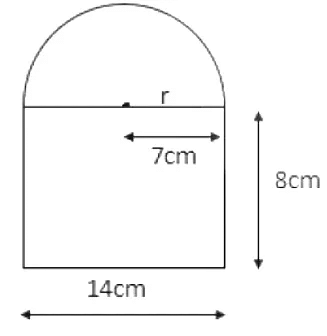
Ans:
Total area = Area of semicircle + Area of rectangle.
Semicircle radius r = 7 cm (since diameter matches rectangle width 14 cm).
Area of semicircle = (1/2)πr2 = (1/2)π(7)2 = (1/2)π×49 = 49π/2.
Using π = 22/7: 49π/2 = 49×22/(7×2) = 77 cm2.
Area of rectangle = length × breadth = 14 × 8 = 112 cm2.
Total area = 77 + 112 = 189 cm2.
Q8: A goat is tied to one corner of a square field of side 8m by a rope 3m long. Find the area it can graze? Also find the area the goat cannot graze.
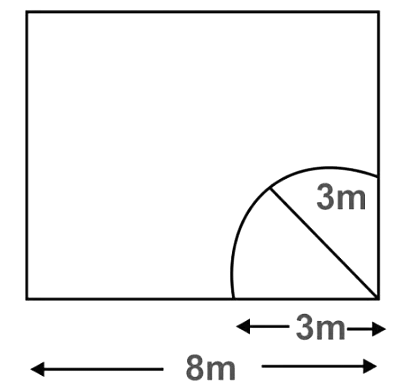
Ans:
Side of square = 8 m ⇒ Area of square = 8 × 8 = 64 m2.
Rope length = 3 m = radius r of grazing circle sector inside the square.
When tied at a corner, the goat can graze one quarter of a full circle of radius 3 m inside the square.
Area grazed = (1/4)πr2 = (1/4)π(3)2 = (9π)/4.
Using π = 22/7: (9π)/4 = 9×22/(7×4) ≈ 7.07 m2.
Area the goat cannot graze = Area of square - Area grazed = 64 - (9π)/4 ≈ 64 - 7.07 = 56.93 m2.
Q9: If x units are added to the length of the radius of a circle, what is the number of units by which the circumference of the circle is increased?
Ans:
Let original radius = r, original circumference = 2πr.
New radius = r + x, new circumference = 2π(r + x) = 2πr + 2πx.
Increase in circumference = 2πx units.
Q10: Find the area of the shaded portion if diameter of circle is 16cm and ABCD is a square.
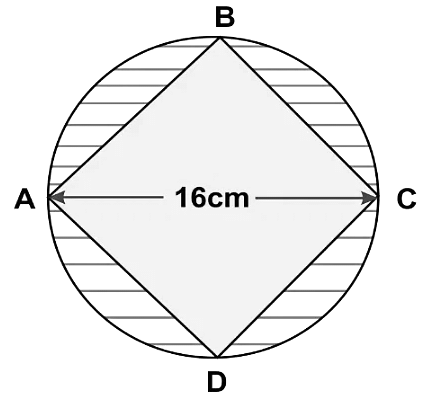
Ans:
Radius of circle = 16/2 = 8 cm ⇒ Area of circle = πr2 = π(8)2 = 64π.
Square ABCD has diagonal = 16 cm. Area of a square = (diagonal)2 / 2 = 162 / 2 = 256 / 2 = 128 cm2.
Area of shaded portion = Area of circle - Area of square = 64π - 128.
Using π = 22/7 gives approximate value: 64π ≈ 201.14, so shaded area ≈ 201.14 - 128 = 73.14 cm2 (approx). Exact value: 64π - 128 cm2.
Q11: How many cm3 of juice can be poured in a cuboidal can whose dimensions are 15cm × 10cm × 25cm. How many cubical packs of 25cm3 volume can be made?
Ans:
Volume of cuboid = Length × Breadth × Height = 15 cm × 10 cm × 25 cm = 3750 cm3.
Each cubical packet has volume = 25 cm3.
Number of such packets = 3750 ÷ 25 = 150 packets.
Q12: A rectangular piece of paper66 cm long and10cm broad is rolled along the length to form a cylinder. What is the radius of the base and calculate volume of cylinder?
Ans:
When rolled along the length, the length 66 cm becomes the circumference of the base of the cylinder.
Circumference C = 66 cm = 2πr ⇒ r = 66 / (2π) = 33 / π.
Using π = 22/7, r = 33 × 7 / 22 = 10.5 cm.
Height of cylinder h = breadth = 10 cm.
Volume of cylinder = πr2h = π × (10.5)2 × 10.
(10.5)2 = 110.25, so
Volume = π × 110.25 × 10 = 1102.5π cm3.
Using π = 22/7, Volume = 1102.5 × 22 / 7 = 3465 cm3.
FAQs on Worksheet Solutions: Mensuration
| 1. How do I calculate the surface area of a cube and cuboid in mensuration? |  |
| 2. What's the difference between curved surface area and total surface area for cylinders? | |
| 3. How do I find the volume of different shapes like cubes, cuboids, and cylinders? | |
| 4. Why do I keep getting the wrong answer when calculating areas of composite shapes? | |
| 5. What formulas do I need to memorise for the lateral surface area of pyramids and cones? | |