Worksheet Solutions: Circles

Multiple Choice Question
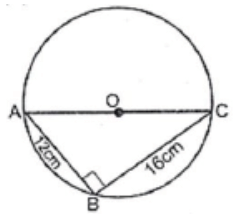
Q1: If AB = 12 cm, BC = 16 cm and AB is perpendicular to BC, then the radius of the circle passing through the points A, B and C is:
(a) 6 cm
(b) 8 cm
(c) 10 cm
(d) 12 cm
Ans: (c)
Sol:
AB ⟂ BC, so ΔABC is right-angled at B.
Hypotenuse AC = √(AB² + BC²) = √(12² + 16²) = √(144 + 256) = √400 = 20 cm.
Radius of circumcircle of a right triangle = 1/2 × hypotenuse = 20 ÷ 2 = 10 cm.
Hence, option (c) is correct.
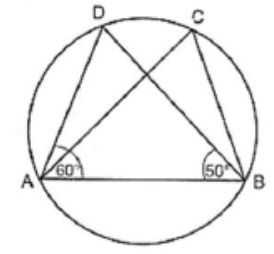
Q2: In Fig, if ∠DAB = 60º, ∠ABD = 50º, then ∠ACB is equal to:
(a) 60º
(b) 50º
(c) 70º
(d) 80º
Ans: (c)
Explanation: In ΔADB,
∠A + ∠B + ∠D = 180º ⇒ 60º + 50º + ∠D = 180º ⇒ ∠D = 180º - 110º = 70º.
Thus ∠ADB = 70º. Angle ∠ACB is an angle in the same segment as ∠ADB, so ∠ACB = ∠ADB = 70º.
Hence, option (c) is correct.
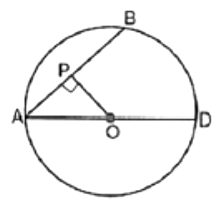
Q3: AD is a diameter of a circle and AB is a chord. If AD = 34 cm, AB = 30 cm, the distance of AB from the centre of the circle is:
(a) 17 cm
(b) 15 cm
(c) 4 cm
(d) 8 cm
Ans: (d)
Sol:
Radius of the circle, R = AD ÷ 2 = 34 ÷ 2 = 17 cm.
Perpendicular from centre O to chord AB bisects AB, so half-chord = AB ÷ 2 = 30 ÷ 2 = 15 cm.
Distance OP from centre to chord = √(R² - (half-chord)²) = √(17² - 15²) = √(289 - 225) = √64 = 8 cm.
Hence, option (d) is correct.
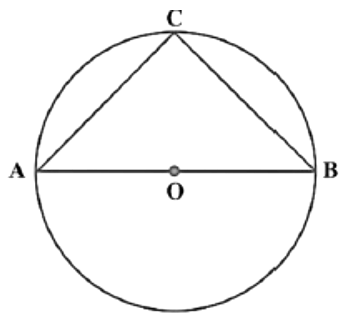
Q4: In Fig, if AOB is a diameter of the circle and AC = BC, then ∠CAB is equal to:
(a) 30º
(b) 60º
(c) 90º
(d) 45º
Ans: (d)
Explanation: Since AOB is a diameter, angle at C on the circle (∠ACB) is 90º [angle in a semicircle.
Given AC = BC, so ∠A = ∠B (angles opposite equal sides).
In ΔABC, ∠A + ∠B + ∠C = 180º ⇒ 2∠A + 90º = 180º ⇒ 2∠A = 90º ⇒ ∠A = 45º.
Thus ∠CAB = 45º and option (d) is correct.
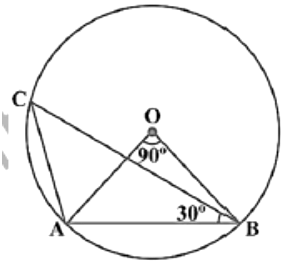
Q5: In Fig, ∠AOB = 90º and ∠ABC = 30º, then ∠CAO is equal to:
(a) 30º
(b) 45º
(c) 90º
(d) 60º
Ans: (d)
Explanation: Angle ∠ABC subtends arc AC, so central angle ∠AOC = 2 × ∠ABC = 2 × 30º = 60º.
In ΔAOC, OA = OC (radii), so base angles ∠CAO = ∠ACO = (180º - 60º) ÷ 2 = 60º.
Therefore ∠CAO = 60º and option (d) is correct.
True or False
Q6: Through three collinear points a circle can be drawn.
Ans: False
Explanation: Three collinear points lie on a straight line. A circle passing through three distinct non-collinear points is uniquely determined. There is no circle that passes through three distinct collinear points, so the statement is false.
Q7: If A, B, C, D are four points such that ∠BAC = 30° and ∠BDC = 60°, then D is the centre of the circle through A, B and C.
Ans: False
Explanation: The fact that ∠BDC = 60° alone does not ensure that D is equidistant from A, B and C (which is required for D to be the centre). Many points can give an angle of 60° at D for the same chord or arc, but those points need not be the circle's centre. Hence the statement is false.
Q8: Two chords AB and AC of a circle with centre O are on the opposite sides of OA.
Then ∠OAB = ∠OAC.
Ans: False
Explanation: Angles ∠OAB and ∠OAC depend on the lengths of chords AB and AC. They are equal only when AB = AC. If the chords are different, the two angles need not be equal. Thus the statement is false unless AB = AC.
Q9. If AOB is a diameter of a circle and C is a point on the circle, then AC2 + BC2 = AB2
Ans: True
Explanation: Since AOB is a diameter, ∠ACB = 90º (angle in a semicircle). In right-angled ΔABC, by Pythagoras theorem AC2 + BC2 = AB2. Therefore the statement is true.
FAQs on Worksheet Solutions: Circles
| 1. What is a circle in geometry? |  |
| 2. How is the circumference of a circle calculated? | |
| 3. What is the area of a circle and how is it determined? | |
| 4. What is the relationship between diameter and radius in a circle? | |
| 5. Can you explain the term 'chord' in the context of circles? | |





