Multiple Choice Questions
Q1: A bucket is in the form of a frustum of a cone ad holds 28.490 liters of water. The radii of the top and bottom are 28cm and 21cm respectively. Find the height of the bucket.
(a) 20 cm
(b) 15 cm
(c) 10 cm
(d) None of the above
Ans: (b)
Capacity of the frustum shaped bucket = 28.490 l = 28490 cm3
r1 = radius of the top of the frustum = 28cm
r2 = radius of the bottom of the frustum = 21cm
we know that volume of a frustum = 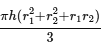

h = 15 cm
Hence Answer (b)
Q2: Lead spheres of diameter 6cm are dropped into a cylindrical beaker containing some water and are fully submerged. If the diameter of the beaker is 18cm and water rises by 40cm. find the no. of lead sphere dropped in the water.
(a) 90
(b) 150
(c) 100
(d) 80
Ans: Here Total Volume of Sphere = Cylinderical volume of water rised Radius of cylinder(R)= 9 cm
Height of cylinder(H) = 40 cm
Radius of Sphere(r) = 3 cm
So, Number of Lead sphere(n) = Volume of Cylinder/Volume of sphere

Substituting the values n = 90
hence the Answer (a).
Short Answer Questions
Q3: A cone, a hemisphere and a cylinder stand on equal bases and have the same height. Show that their volumes are in the ratio 1: 2: 3.
Ans: The volume of cone is given by formula
V = 1/3 πR2h
Volume of the hemisphere = 2/3 πR3
Volume of the cylinder = πR2h
Now Height(H)= Radius (R) as they have height
Volume of Cone= 1/3 πR3
Volume of the hemisphere = 2/3 πR3
Volume of the cylinder = πR3
Ratio will be 1:2:3 Hence the Answer (c)
Q4: Prove that the surface area of a sphere is equal to the curved surface area of the circumscribed cylinder.
Ans:
Let the radius of the sphere = r
Surface area of the sphere = 4πr2
Radius of the cylinder circumscribed over the sphere = r
Height of the cylinder circumscribed over the sphere (h) = 2r
Curved surface area of the cylinder = 2 π r h
= 2πr(2r) = 4πr2
Therefore, the curved surface area of the circumscribed cylinder over a sphere is equal to the surface area of the sphere.
Q5: 500 persons are taking a dip into a cuboidal pond which is 80 m long and 50 m broad. What is the rise of water level in the pond, if the average displacement of the water by a person is 0.04m3?
Ans: The volume of one person = 0.04 m3
Now The amount of water displaced is equal to the volume of the person.
500 people take dip at the same time, then water displaced = 500 * 0.04 = 20 m3
Let h be the height of water raised,then Volume of the water rises will be
= Base X Height = 80 × 50 h = 4000h m2
Now Volume of Water rises = Volume of water displaced by 500 people
4000h = 20
h = 1/200 m = 0.005 m = 5 millimeters
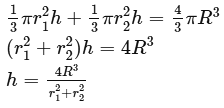
Q6: The radii of the basses of two right circular solid cones of same height are r1 and r2 respectively. The cones are melted and recast into a solid sphere of radius R. Show that the height of each cone is given by

Ans: Volume of first cone = 
Volume of second cone = 
According to the question, the 2 cones are melted and recast to form a sphere of radius R.
Therefore, volume of first cone + volume of second cone = volume of sphere.
Q7: The slant height of the frustum of a cone is 4cm, and the perimeter of its circular bases is 18cm and 6cm respectively. Find the curved surface area of the frustum ?
Ans: Given 2πr1 = 18
πr1 = 9
2πr2 = 6
πr2 = 3
l = 4 cm
curved surface area = (πr1 + πr2)l = (9+3)4 = 48 cm2
Q8: A bucket of height 8cm and made up of copper sheet is in the form of frustum of a right circular cone with radii of its lower and upper ends as 3cm and 9m respectively.
Calculate -
(a) the height of cone of which the bucket is a part.
(b) the volume of water which can be filled in the bucket.
(c) the area of copper shut required to make the bucket.
Ans: Let h be the height, l the slant height and r1 and r2 the radii of the circular bases of a frustum of a cone.
We have, h = 8 cm, r1 = 9 cm and r2 = 3 cm
(a) Let H be the height of the cone of which the bucket is part. Then
H = hr1/ r1 - r2
Substituting values: H = (9 × 8) / (9 - 3) = 72 / 6 = 12 cm.
(b) Volume of the water which can be filled in the bucket
Compute r12 = 81, r1r2 = 27, r22 = 9 ⇒ sum = 117.
Volume = (1/3)π × 8 × 117 = (8 × 117 / 3)π = 312π cm3 ≈ 979.0 cm3.
(c) Area of the copper sheet required to make the bucket






