CBSE Class 7 > Class 7 Notes > Know Your Aptitude Class 6 To 8 > Worksheet: Rotation of Objects - 2
Worksheet: Rotation of Objects - 2

Rotate the Point
Q: Graph the new position of each point after rotating it about the origin.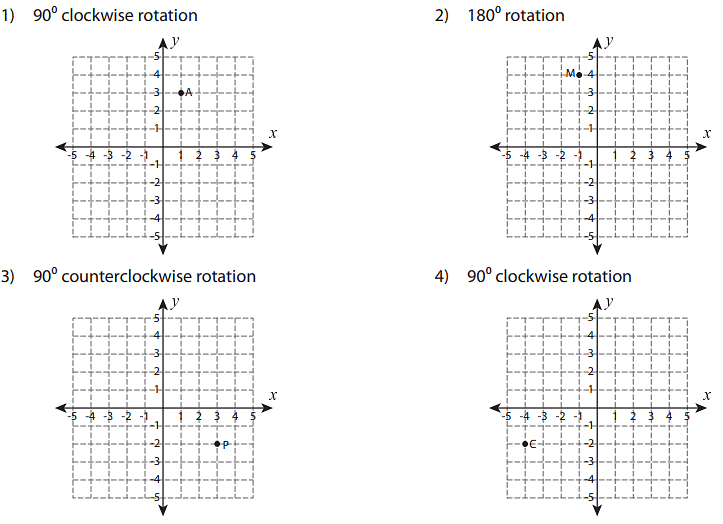
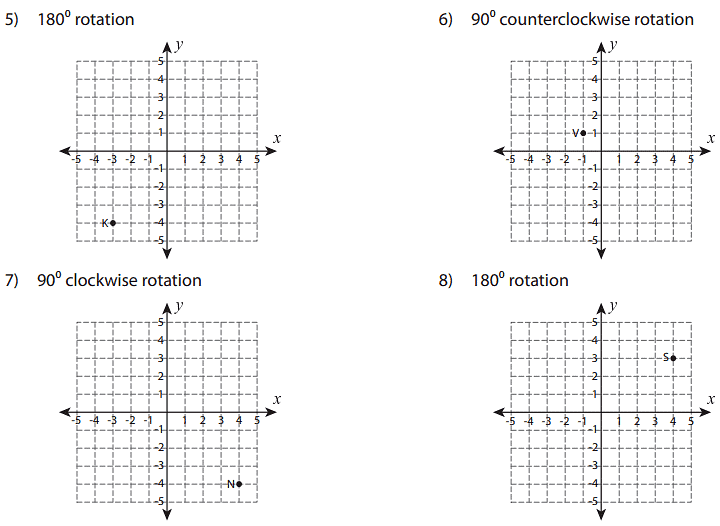
You can access the solutions to this worksheet here.
The document Worksheet: Rotation of Objects - 2 is a part of the Class 7 Course Know Your Aptitude Class 6 To 8.
All you need of Class 7 at this link: Class 7
FAQs on Worksheet: Rotation of Objects - 2
| 1. What is the concept of rotating a point in a coordinate system? |  |
Ans.Rotating a point in a coordinate system involves changing its position based on a specified angle around a fixed point, usually the origin. This is often calculated using trigonometric functions, where the new coordinates (x', y') can be found using the rotation formulas: x' = x * cos(θ) - y * sin(θ) and y' = x * sin(θ) + y * cos(θ), where θ is the angle of rotation.
| 2. How do you rotate a point 90 degrees counterclockwise? | |
Ans.To rotate a point 90 degrees counterclockwise, you can use the rotation formulas. For a point (x, y), the new coordinates will be (-y, x). This means that if you have a point at (3, 2), after a 90-degree counterclockwise rotation, the new coordinates will be (-2, 3).
| 3. What are the steps to rotate multiple points around a center point? | |
Ans.To rotate multiple points around a center point, follow these steps: 1. Translate each point so that the center point is at the origin by subtracting the center point's coordinates from each point. 2. Apply the rotation formulas to each translated point. 3. Translate the points back by adding the center point's coordinates to the rotated points.
| 4. Can you explain the difference between clockwise and counterclockwise rotations? | |
Ans.Clockwise rotation moves points in the same direction as the hands of a clock, while counterclockwise rotation moves points in the opposite direction. When using rotation angles, positive angles typically represent counterclockwise rotations, whereas negative angles indicate clockwise rotations.
| 5. What applications do point rotations have in real life? | |
Ans.Point rotations have various applications in real life, including computer graphics for rendering images, robotics for path planning, and in navigation systems for determining directions. They are also essential in architecture and engineering for designing and visualizing structures.
About this Document

4.87/5 Rating

Apr 30, 2026 Last updated
Document Description: Worksheet: Rotation of Objects - 2 for Class 7 2026 is part of Know Your Aptitude Class 6 To 8 preparation. The notes and questions for Worksheet: Rotation of Objects - 2 have been prepared according to the Class 7 exam syllabus. Information about Worksheet: Rotation of Objects - 2 covers topics like and Worksheet: Rotation of Objects - 2 Example, for Class 7 2026 Exam. Find important definitions, questions, notes, meanings, examples, exercises and tests below for Worksheet: Rotation of Objects - 2.
Introduction of Worksheet: Rotation of Objects - 2 in English is available as part of our Know Your Aptitude Class 6 To 8 for Class 7 & Worksheet: Rotation of Objects - 2 in Hindi for Know Your Aptitude Class 6 To 8 course. Download more important topics related with notes, lectures and mock test series for Class 7 Exam by signing up for free. Class 7: Worksheet: Rotation of Objects - 2
Description
Worksheet: Rotation of Objects of Know Your Aptitude Class 6 To 8 - variety of important questions with solutions, helping you prepare for exam. Download free PDF from EduRev.
Information about Worksheet: Rotation of Objects - 2
In this doc you can find the meaning of Worksheet: Rotation of Objects - 2 defined & explained in the simplest way possible. Besides explaining types of Worksheet: Rotation of Objects - 2 theory, EduRev gives you an ample number of questions to practice Worksheet: Rotation of Objects - 2 tests, examples and also practice Class 7 tests



Related Searches
study material, past year papers, practice quizzes, Previous Year Questions with Solutions, pdf , Sample Paper, video lectures, MCQs, Free, Semester Notes, ppt, Objective type Questions, Viva Questions, Exam, Worksheet: Rotation of Objects - 2, shortcuts and tricks, Worksheet: Rotation of Objects - 2, Important questions, Worksheet: Rotation of Objects - 2, mock tests for examination, Summary, Extra Questions;