Q1: Prove that the line segment joining the points of contact of two parallel tangents of a circle, passes through its centre.
Ans:
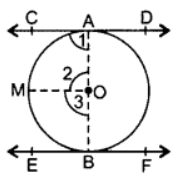 Given: CD and EF are two C parallel tangents at points A and B of a circle with centre O.
To prove: AB passes through centre O or AOB is diameter of the circle.
Const.: Join OA and OB. Draw OM || CD.
Proof: ∠1 = 90° ... (i)
...[∵ Tangent is I to the radius through the point of contact
OM || CD
∴ ∠1 + ∠2 = 180° ...(Co-interior angles
90° + ∠2 = 180° ...[From (i)
∠2 = 180° - 90o = 90°
Similarly, ∠3 = 90°
∠2 + ∠3 = 90° + 90° = 180°
∴ AOB is a straight line.
Hence AOB is a diameter of the circle with centre O.
∴ AB passes through centre 0.
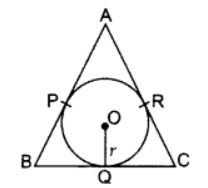
Q2: In the figure, the sides AB, BC and CA of triangle ABC touch a circle with centre o and radius r at P, Q and R. respectively.
Prove that:
(i) AB + CQ = AC + BQ
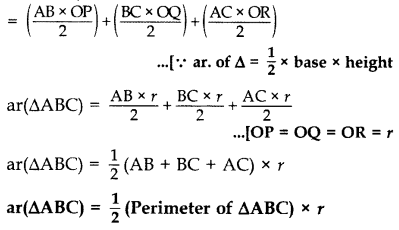
(ii) Area (AABC) = 1/2 (Perimeter of ∆ABC ) × r
Ans:
 Part I:
Proof: AP = AR ...(i)
BP = BQ ... (ii)
CQ = CR ... (iii)
Adding (i), (ii) & (iii)
AP + BP + CQ
= AR + BQ + CR
AB + CQ = AC + BQ
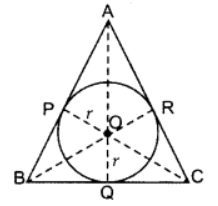
Part II: Join OP, OR, OQ, OA, OB and OC
Proof: OQ ⊥ BC; OR ⊥ AC; OP ⊥ AB
ar(∆ABC) = ar(∆AOB) + ar(∆BOC) + ar (∆AOC)
Area of (∆ABC)
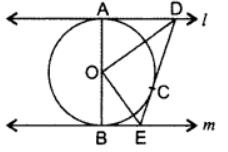
Q3: In the figure, l and m are two parallel tangents to a circle with centre O, touching the circle at A and B respectively. Another tangent at C intersects the line I at D and m at E. Prove that ∠DOE = 90°.
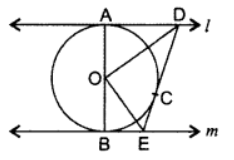 Ans: Proof: Let I be XY and m be XY'
∠XDE + ∠X'ED = 180° ... [Consecutive interior angles]
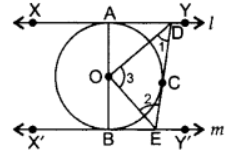
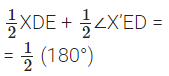
= ∠1 + ∠2 = 90° ...[OD is equally inclined to the tangents
In ∆DOE, ∠1 + ∠2 + 23 = 180° ...[Angle-sum-property of a ∆
90° + 23 = 180°
⇒ ∠3 = 180° - 90o = 90°
∴ ∠DOE = 90° ...(proved)
Q4: In the figure, l and m are two parallel tangents to a circle with centre O, touching the circle at A and B respectively. Another tangent at C intersects the line I at D and m at E. Prove that ∠DOE = 90°.
 Ans: Proof: Let I be XY and m be XY'
∠XDE + ∠X'ED = 180° ... [Consecutive interior angles]
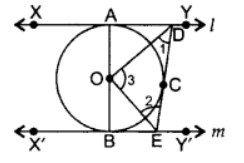
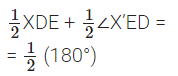
= ∠1 + ∠2 = 90° ...[OD is equally inclined to the tangents
In ∆DOE, ∠1 + ∠2 + 23 = 180° ...[Angle-sum-property of a ∆
90° + 23 = 180°
⇒ ∠3 = 180° - 90o = 90°
∴ ∠DOE = 90° ...(proved)
Q5: Prove that the tangent drawn at the mid-point of an arc of a circle is parallel to the chord joining the end points of the arc.
Ans:
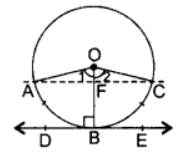 B is the mid point of arc (ABC)
OA = OC ...[Radius
OF = OF ...[Common
∴ ∠1 = ∠2 ...[Equal angles opposite equal sides
∴ ∆OAF = ∆OCF (SAS)
∴ ∠AFO = ∠CFO = 90° ...[c.p.c.t
⇒ ∠AFO = ∠DBO = 90° ...[Tangent is ⊥to the radius through the point of contact
But these are corresponding angles,
∴ AC || DE
Q6: Prove that the lengths of tangents drawn from an external point to a circle are equal.
Ans: Given: PT and PS are tangents from an external point P to the circle with centre O.
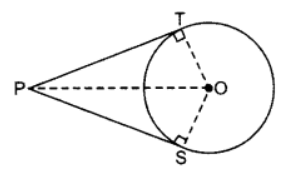 To prove: PT = PS
Const.: Join O to P,
T & S
Proof: In ∆OTP and
∆OSP,
OT = OS ...[radii of same circle
OP = OP ...[circle
∠OTP - ∠OSP ...[Each 90°]
∴ AOTP = AOSP ...[R.H.S]
PT = PS ...[c.p.c.t]
Q7: Prove that the tangent at any point of a circle is perpendicular to the radius through the point of contact.
Ans:
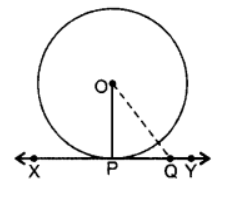 Given: XY is a tangent at point P to the circle with centre O.
To prove: OP ⊥ XY
Const.: Take a point Q on XY other than P and join to OQuestion
Proof: If point Q lies inside the circle, then XY will become a secant and not a tangent to the circle.
∴ OQ > OP
This happens with every point on the line XY except the point P.
OP is the shortest of all the distances of the point O to the points of XY
∴ OP ⊥ XY ... [Shortest side is ⊥]
Q8:
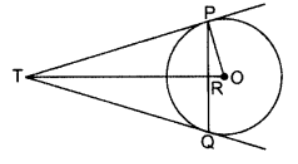 In the above figure, PQ is a chord of length 16 cm, of a circle of radius 10 cm. The tangents at P and Q intersect at a point T. Find the length of TP.
Ans:
TP = TQuestion .. [Tangents drawn from an external point]
∆TPQ is an isosceles ∆ and TO is the bisector of ∠PTQ ,
OT ⊥ PQ ...[Tangent is ⊥ to the radius through the point of contact
∴ OT bisects PQ
∴ PR = RQ = 16 = 8 cm ...[Given]
In rt. ∆PRO,
PR2 + RO2 = PO2 ... [Pythagoras' theorem]
82 + RO2 = (10)2
RO2 = 100 - 64 = 36
∴ RO = 6 cm
Let TP = x cm and TR = y cm
Then OT = (y + 6) cm
In rt. ∆PRT, x2 = y2 + 82 ...(i) ...[Pythagoras' theorem]
In rt. ∆OPT,
OT2 = TP2 + PO2 ...(Pythagoras' theorem]
(y + 6)2 = x2 + 102
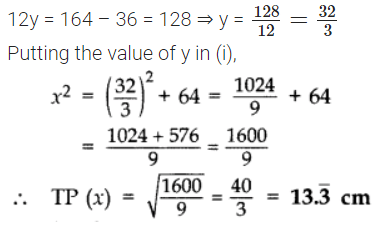
y2 + 12y + 36 = y2 +64 + 100 ...[From (i)]
Q9: In the figure, tangents PQ and PR are drawn from an external point P to a circle with centre O, such that ∠RPQ = 30°. A chord RS is drawn parallel to the tangent PQuestion Find ∠RQS.
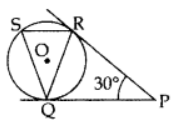 Ans:
Ans:
PR = PO ...[∵ Tangents drawn from an external point are equal
⇒ ∠PRQ = ∠PQR ...[∵ Angles opposite equal sides are equal
In ∆PQR,
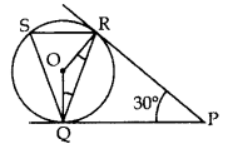 ⇒ ∠PRQ + ∠RPQ + ∠POR = 180°...[∆ Rule]
⇒ 30° + 2∠PQR = 180°
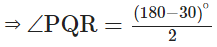
= 75°
⇒ SR || QP and QR is a transversal
∵ ∠SRQ = ∠PQR ... [Alternate interior angle
∴ ∠SRO = 75° .....[Tangent is I to the radius through the point of contact
⇒ ∠ORP = 90°
∴ ∠ORP = ∠ORQ + ∠QRP
90° = ∠ORQ + 75°
∠ORQ = 90° - 75o = 150
Similarly, ∠RQO = 15°
In ∆QOR,
∠QOR + ∠QRO + ∠OQR = 180° ...[∆ Rule
∴∠QOR + 15° + 15° = 180°
∠QOR = 180° - 30° = 150°

In ARSQ, ∠RSQ + ∠QRS + ∠RQS = 180° ... [∆ Rule]
∴ 75° + 75° + ∠RQS = 180°
∠RQS = 180° - 150° = 30°
Q10: In the figure, O is the centre of a circle of radius 5 cm. T is a point such that OT = 13 cm and OT intersects circle at E. If AB is a tangent to the circle at E, find the length of AB, where TP and TQ are two tangents to the circle.
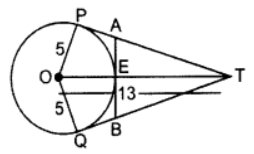 Ans:
Ans:
∠OPT = 90° ...[Tangent is ⊥ to the radius through the point of contact
We have, OP = 5 cm, OT = 13 cm
In rt. ∆OPT,
OP2 + PT2 = OT? ...[Pythagoras' theorem
⇒ (5)2 + PT2 = (13)2
⇒ PT2 = 169 - 25 = 144 cm
⇒ PT = √144144---√
= 12 cm
OP = OQ = OE = 5 cm ... [Radius of the circle
ET = OT - OE
= 13 - 5 = 8 cm
Let, PA = x cm, then AT = (12 - x) cm
PA = AE = x cm ...[Tangent drawn from an external point
In rt. ∆AET,
AE2 + ET2 = AT2 ...(Pythagoras' theorem
⇒ x2 + (8)2 = (12 - x)2
⇒ x2 + 64 = 144 + x2 - 24x
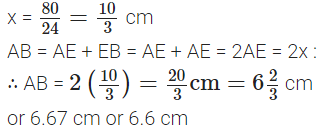
⇒ 24x = 144 - 64