Practice Questions with Solutions: Lines and Angle

Q1: Draw a line segment AB of 4 cm in length. Draw a line perpendicular to AB through A and B, respectively. Are these lines parallel? (True/False)
Ans: True
Explanation: Both lines are perpendicular to the same line AB. If two lines are each perpendicular to a common line, they are parallel to each other. Therefore, the statement is true and the required entry is 1.
Q2: Can two acute angles be complement to each other always? (True/False)
Ans: False
Explanation: An acute angle is greater than 0º and less than 90º. Two acute angles can be complementary (for example, 40º and 50º) but they need not be. For example, 70º and 30º are both acute but sum to 100º, not 90º. Hence the statement is false and the correct entry is 0.
Q3: Can two obtuse angles be adjacent angles? (True/False)
Ans: True
Explanation: An obtuse angle is greater than 90º and less than 180º. The sum of two obtuse angles is less than 360º, so it is possible to place two obtuse angles next to each other with a common side and common vertex without overlapping. Thus two obtuse angles can be adjacent, so the answer is 1.
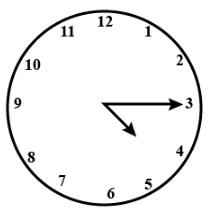
Q4: At 4:15, the angle formed between the two hands of a clock is:
(a) acute
(b) obtuse
(c) right angle
(d) none of these
Ans: (a)
Sol:
Minute hand angle = 15 × 6° = 90°.
Hour hand angle = 4 × 30° + (15 × 0.5°) = 120° + 7.5° = 127.5°.
Required angle = |127.5° - 90°| = 37.5°, which is less than 90°.
Therefore the angle is acute and option (a) is correct.
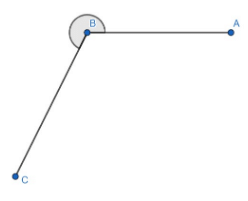
Q5: ∠ABC in the following figure is a / an:
(a) acute angle
(b) obtuse angle
(c) reflex angle
(d) straight angle
Ans: (c)
Sol:
A reflex angle is an angle greater than 180º but less than 360º.
In the figure ∠ABC is greater than 180º and less than 360º. Hence it is a reflex angle.
Therefore option (c) is correct.
Q6: Two supplementary angles are in the ratio 4 : 5. The angles are
(a) 90º , 90º
(b) 80º , 100º
(c) 30º , 150º
(d) 45º , 45º
Ans: (b)
Sol:
Let the angles be 4x and 5x.
Since they are supplementary, 4x + 5x = 180º ⇒ 9x = 180º ⇒ x = 20º.
So the angles are 4×20º = 80º and 5×20º = 100º.
Therefore option (b) is correct.
Q7: The complement of (90º - a) is :
(a) -a
(b) 90º + a
(c) 90º - a
(d) a
Ans: (d)
Sol:
Let the complement be y.
Complementary angles sum to 90º, so (90º - a) + y = 90º ⇒ y = a.
Hence option (d) is correct.
Q8: Measure of an angle is given below. Find the measure of it's complementary angle: 58º.
Ans:
Sol:
Complementary angles add to 90º.
Other angle = 90º - 58º = 32º.
Hence the complementary angle measures 32º.
Q9: Measures of some angles are given below. Find the measures of their supplementary angles.
108º
Ans:
Sol:
Supplementary angles add to 180º.
Other angle = 180º - 108º = 72º.
Thus the supplementary angle of 108º is 72º.
Q10: Measures of some angles are given below. Find the measure of their complementary angle: 56º
Ans:
Sol:
Let the complement be xº. Then x + 56º = 90º ⇒ x = 90º - 56º = 34º.
Hence the complement measures 34º.
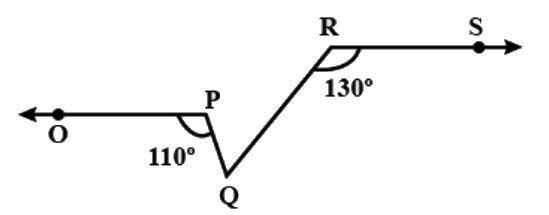
Q11: In the figure, if OP||RS, ∠OPQ = 110º and∠QRS = 130º , then ∠PQR is equal to
(a) 40º
(b) 50º
(c) 60º
(d) 70º
Ans: (c)
Sol:
Since ∠OPQ = 110º, its supplement is 180º - 110º = 70º.
Since ∠QRS = 130º, its supplement is 180º - 130º = 50º.
At point Q the three adjacent angles along the straight line add to 180º, so ∠PQR = 180º - 70º - 50º = 60º.
Therefore option (c) is correct.
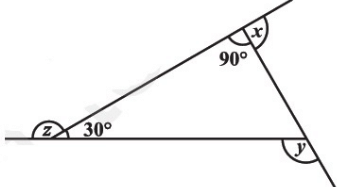
Q12: Find x + y + z
(a) x + y + z = 180º
(b) x + y + z = 360º
(c) x + y + z = 480º
(d) x + y + z = 540º
Ans: (b)
Sol:
∠y is an exterior angle and equals the sum of the two opposite interior angles: ∠y = 90º + 30º = 120º.
From the straight-line relation, ∠z + 30º = 180º ⇒ ∠z = 150º.
Also, ∠x + 90º = 180º ⇒ ∠x = 90º.
Therefore x + y + z = 90º + 120º + 150º = 360º, so option (b) is correct.
Q13: In the given figure, ∠QPB is,
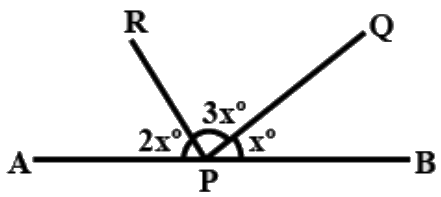
(a) 60º
(b) 45º
(c) 30º
(d) 15º
Ans: (c)
Sol:
Given ∠APR + ∠RPQ + ∠QPB = 180º and these angles are 2x, 3x and x respectively.
So 2x + 3x + x = 180º ⇒ 6x = 180º ⇒ x = 30º.
Thus ∠QPB = x = 30º and option (c) is correct.
Q14: If two supplementary angles are in the ratio 2 : 7, then the angles are :
(a) 35º , 145º
(b) 70º , 110º
(c) 40º, 140º
(d) 50º, 130º
Ans: (c)
Sol:
Let the angles be 2x and 7x. Since they are supplementary, 2x + 7x = 180º ⇒ 9x = 180º ⇒ x = 20º.
So the angles are 2×20º = 40º and 7×20º = 140º.
Hence option (c) is correct.
Q15: Two angles are called adjacent if
(a) they have a common vertex
(b) they have a ray in common
(c) their other arms lie on the opposite sides of the common arm
(d) all the above
Ans: (d)
Explanation: Adjacent angles share a common vertex and a common side (ray), and their other sides lie on opposite sides of the common side so that they do not overlap. Each of the statements (a), (b) and (c) describes part of this definition, so all are correct. Therefore option (d) is correct.
Q16: In the adjacent figure, BA and BC are produced to meet CD and AD produced in E and F. Then ∠AED + ∠CFD is ________.
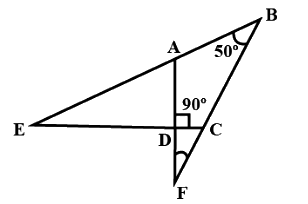
(a) 80o
(b) 50o
(c) 40o
(d) 160o
Ans: (c)
Sol:
In triangle AED, angles satisfy ∠AED + ∠EAD + 90º = 180º, so ∠EAD = 90º - ∠AED. (1)
By the exterior-angle property, ∠EAD = 50º + ∠AFB. (2)
Equating (1) and (2): 50º + ∠AFB = 90º - ∠AED ⇒ ∠AFB + ∠AED = 40º.
Since ∠AFB = ∠CFD (given figure shows these as equal), we get ∠AED + ∠CFD = 40º.
Therefore option (c) is correct.
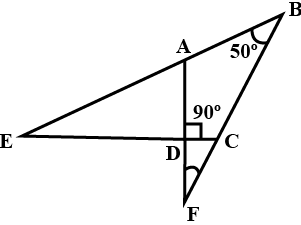
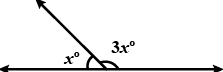
Q17: In the given figure, magnitude of angles are ..........
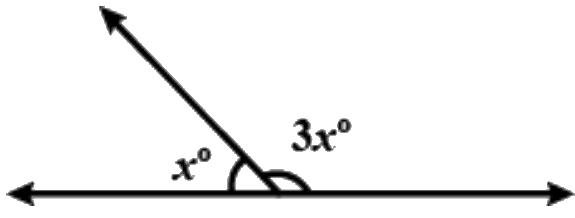
(a) 40º, 120º
(b) 30º, 90º
(c) 45º, 135º
(d) 50º, 150º
Ans: (c)
Sol:
Given that the two angles on a straight line add to 180º and they are x and 3x.
So x + 3x = 180º ⇒ 4x = 180º ⇒ x = 45º.
Therefore the angles are 45º and 3×45º = 135º. Option (c) is correct.
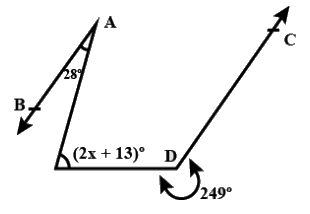
Q18: Mark the correct alternative of the following.
In figure, if AB∣∣CD, then x=?
(a) 62
(b) 42
(c) 52
(d) 31
Ans: (b)
Sol:
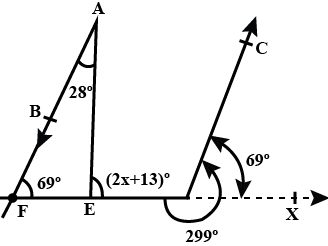
From the construction given, the obtuse angle ∠CDE is 249º, so its interior equivalent is 360º - 249º = 111º.
Then ∠CDX = 180º - 111º = 69º, which equals the corresponding angle ∠AFE.
Using the exterior-angle relation at E, ∠AED = ∠A + ∠AFE. Substituting the given measures leads to 2x + 13 = 28 + 69.
Simplify: 2x + 13 = 97 ⇒ 2x = 84 ⇒ x = 42º.
Therefore option (b) is correct.
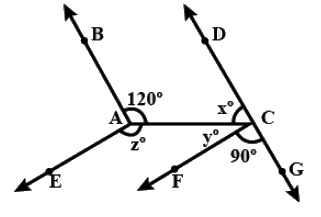
Q19: In figure, AB∣∣CD and AE∣∣CF, ∠FCG = 90º and ∠BAC = 120º. Find the values of x, y and z.
Ans:
Sol:
Since AB ∥ CD, ∠BAC and ∠ACD are supplementary: ∠BAC + x = 180º ⇒ 120º + x = 180º ⇒ x = 60º.
In triangle with points D, C, A and line CF, ∠DCA + ∠ACF + ∠FCG = 180º ⇒ x + y + 90º = 180º.
Substituting x = 60º gives 60º + y + 90º = 180º ⇒ y = 30º.
Since AE ∥ CF, ∠EAC and ∠ACF are supplementary: z + y = 180º ⇒ z + 30º = 180º ⇒ z = 150º.
Thus x = 60º, y = 30º and z = 150º.
Q20: In Fig., ∠AOF and ∠FOG form a linear pair. If ∠EOB = ∠FOC = 90∘ and ∠DOC = ∠AOB = 30º.
Name three pairs of adjacenet angles.
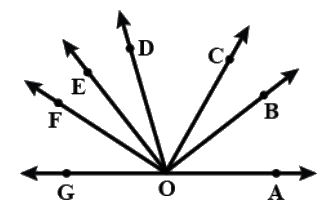
Ans: Adjacent angles share a common vertex and a common side and do not overlap. From the figure three pairs of adjacent angles are:
∠BOC and ∠COD;
∠COD and ∠DOE;
∠DOE and ∠EOF.
Each pair shares a common side and a common vertex and hence they are adjacent angles.
FAQs on Practice Questions with Solutions: Lines and Angle
| 1. What are the different types of angles formed by intersecting lines? |  |
| 2. How do you calculate the measure of an angle when two parallel lines are cut by a transversal? | |
| 3. What is the relationship between angles in a triangle? | |
| 4. What are complementary and supplementary angles? | |
| 5. How does the concept of angle bisectors work in geometry? | |