CBSE Class 10  >  Class 10 Notes  >  Science   >  Important Diagrams: Chemical Reactions & Equations

Important Diagrams: Chemical Reactions & Equations

Electrolytic Decomposition

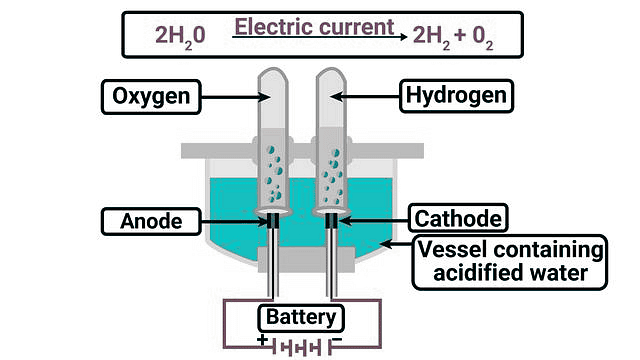
Definition: Electrolytic decomposition is a decomposition reaction in which a compound breaks down into simpler substances when electric current is passed through it.

Diagram Description: The diagram shows electrolysis of water using a battery and electrodes dipped in acidulated water. When electric current is passed, hydrogen gas is collected at the cathode and oxygen gas at the anode. This shows decomposition of water into its elements.
Electrolytic Decomposition

Displacement Reaction

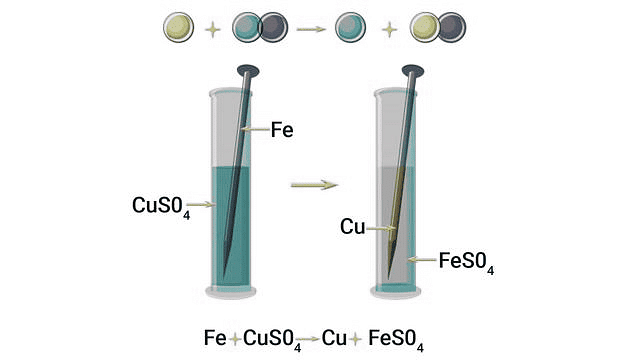
Definition: A displacement reaction is a chemical reaction in which a more reactive element displaces a less reactive element from its compound.

Diagram Description: The diagram shows an iron nail dipped in copper sulphate solution. After some time, copper gets deposited on the iron and the blue solution turns green. This shows iron displacing copper from copper sulphate.

Displacement Reaction

Exothermic and Endothermic Reaction

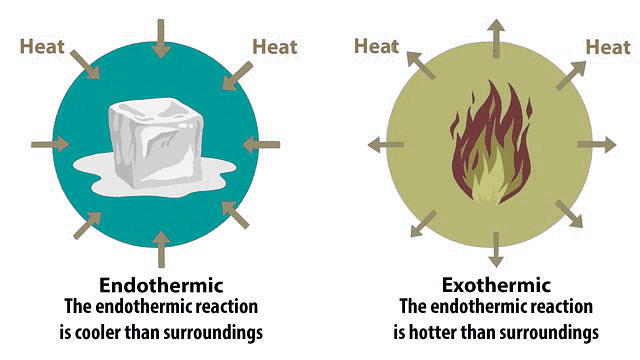
Definition:  Exothermic reaction: A reaction in which heat is released. Endothermic reaction: A reaction in which heat is absorbed.

Diagram Description:  The diagram shows heat flow. In an exothermic reaction, heat is released to the surroundings (arrows going out). In an endothermic reaction, heat is absorbed from the surroundings (arrows coming in).
Exothermic and Endothermic Reaction

Rancidity

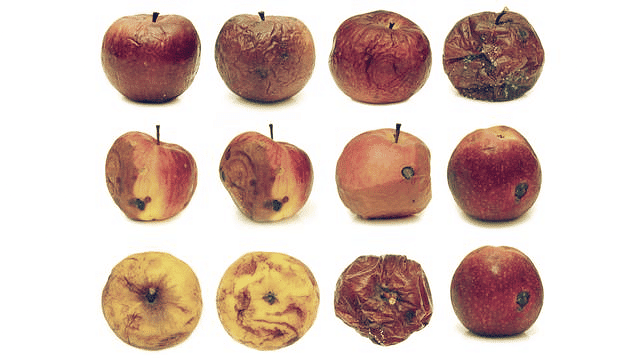
Definition: Rancidity is the process in which fats and oils get oxidised, producing unpleasant smell and taste.

Diagram Description: The diagram shows food (like apples) getting spoiled over time due to exposure to air. This represents oxidation of fats and oils, leading to bad smell and taste.
Rancidity

The document Important Diagrams: Chemical Reactions & Equations is a part of the Class 10 Course Science Class 10.
All you need of Class 10 at this link: Class 10

FAQs on Important Diagrams: Chemical Reactions & Equations

1. What are the main types of chemical reactions shown in diagrams for Class 10 CBSE?
Ans. Chemical reactions in CBSE Class 10 diagrams include combustion, decomposition, combination, and displacement reactions. Combustion involves burning with oxygen, decomposition breaks compounds into simpler substances, combination merges elements into compounds, and displacement occurs when one element replaces another. Visual diagrams help students distinguish between these reaction types through colour-coded arrows and molecular representations, making classification clearer for board exams.
2. How do I read and interpret chemical equation diagrams correctly?
Ans. Chemical equation diagrams use arrows to show reactants converting into products, with coefficients indicating molecule quantities. Reactants appear on the left side, products on the right, and arrows point toward results. Balanced equations have equal atoms on both sides. Students should identify symbols for states (s, l, g, aq), recognise energy changes, and understand that balanced equations ensure conservation of mass-essential for solving numerical problems accurately.
3. Why do some chemical reactions produce heat or light in the diagrams?
Ans. Exothermic reactions release energy as heat or light, shown in diagrams with energy arrows pointing outward or "+Heat" notation. Combustion and neutralisation are common exothermic examples. Endothermic reactions absorb energy, indicated by arrows pointing inward or "-Heat" labels. Understanding these energy changes helps students predict reaction behaviour, identify reaction types visually, and answer thermochemistry questions that frequently appear in CBSE assessments.
4. What's the difference between balanced and unbalanced chemical equations in diagram form?
Ans. Balanced equations have equal numbers of each atom type on both sides; diagrams show matching element counts throughout. Unbalanced equations have mismatched atom counts, violating the law of conservation of mass. Visual diagrams make this difference obvious by displaying molecular structures or atom tallies. Balancing equations is critical-students must adjust coefficients (not subscripts) to equalise atoms, a skill tested repeatedly in Class 10 examinations.
5. How can I use chemical reaction diagrams to prepare better for CBSE exams?
Ans. Chemical reaction diagrams provide visual representations that strengthen conceptual understanding beyond textual descriptions. Refer to mind maps and flashcards on EduRev to categorise reaction types, memorise symbol meanings, and practise identifying products from reactant diagrams. Regular revision of these visual resources helps students build pattern recognition skills and speeds up problem-solving during board exams, where diagram-based questions are frequently asked.
Explore Courses for Class 10 exam
Get EduRev Notes directly in your Google search
Related Searches
Summary, video lectures, Extra Questions, Important Diagrams: Chemical Reactions & Equations, pdf , Viva Questions, MCQs, Free, Objective type Questions, past year papers, mock tests for examination, study material, Semester Notes, practice quizzes, Important Diagrams: Chemical Reactions & Equations, Important Diagrams: Chemical Reactions & Equations, ppt, shortcuts and tricks, Previous Year Questions with Solutions, Exam, Sample Paper, Important questions;


