HOTS Questions: Triangles

Q1: In the figure, O is the interior point of ∆ABC. BO meets AC at D. Show that OB + OC < AB + AC.
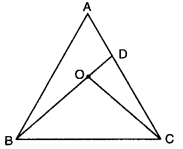
Sol: In any triangle, the sum of any two sides is greater than the third side.
In ∆ABD, AB + AD > BD. ...(i)
But BD = BO + OD.
Therefore AB + AD > BO + OD. ...(ii)
In ∆COD, OD + DC > OC. ...(iii)
Add (ii) and (iii): AB + AD + OD + DC > BO + OD + OC.
Cancel OD from both sides to get AB + (AD + DC) > BO + OC.
Since AD + DC = AC, we have AB + AC > BO + OC.
Thus OB + OC < AB + AC.
Hence proved.
Q2: Show that the difference of any two sides of a triangle is less than the third side.
Sol:
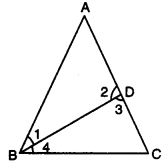
Consider triangle ABC.
To Prove :
(i) AC - AB < BC
(ii) BC - AC < AB
(iii) BC - AB < AC
Construction: Take a point D on AC such that AD = AB. Join BD.
In ∆ABD, AD = AB by construction, so the angles opposite these equal sides are equal; therefore ∠1 = ∠2. ...(iii)
The exterior angle ∠3 of ∆ABD is greater than the interior opposite angle ∠1. Hence ∠3 > ∠1. ...(i)
Similarly, for ∆BCD, the exterior angle ∠2 is greater than the interior opposite angle ∠4. Hence ∠2 > ∠4. ...(ii)
Using ∠1 = ∠2 and the inequalities above, we get ∠3 > ∠4.
Thus the side opposite ∠3 in triangle B C (that is BC) is greater than the side opposite ∠4 (that is CD). So BC > CD.
Now CD = AC - AD = AC - AB (since AD = AB).
Therefore AC - AB < BC. This proves (i).
By similar constructions and reasoning, we obtain (ii) and (iii).
Hence, the difference of any two sides of a triangle is less than the third side.
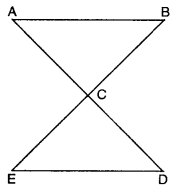
Q3: Rajiv, a good student and actively involved in applying knowledge A of mathematics in daily life. He asked his classmate Rahul to make triangle as shown by choosing one of the vertex as common. Rahul tried but not correctly. After sometime Rajiv hinted Rahul about congruency of triangle. Now, Rahul fixed vertex C as common vertex and locate point D, E such that AC = CD and BC = CE. Was the triangle made by Rahul is congruent ? Write the condition satisfying congruence.
What value is depicted by Rajiv's action?
Sol:
In ∆ABC and ∆DEC, we have AC = DC (by construction) and BC = EC (by construction).
Also, ∠ACB = ∠ECD as they are vertically opposite angles.
By the SAS congruence criterion (two sides and the included angle equal), ∆ABC ≅ ∆DEC.
Value displayed: Cooperative learning, application of concepts and a helpful, friendly attitude.
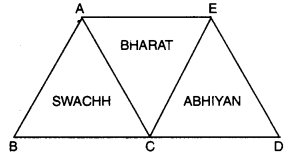
Q4: A campaign is started by volunteers of mathematical club to boost school and its surrounding under Swachh Bharat Abhiyan. They made their own logo for this campaign. What values are acquired by mathematical club ?
If it is given that ∆ABC ≅ ∆ECD, BC = AE.
Prove that ∆ABC ≅ ∆CEA.
Sol:
Given ∆ABC ≅ ∆ECD.
From congruence, corresponding parts of congruent triangles are equal (CPCT). So AB = CE, BC = CD and AC = ED.
It is also given that BC = AE.
Now consider triangles ABC and CEA:
BC = AE (given).
AB = EC (from CPCT).
AC = AC (common side).
Thus the three sides of ∆ABC and ∆CEA are pairwise equal; by SSS congruence axiom, ∆ABC ≅ ∆CEA.
Values acquired by the mathematical club: Cleanliness, social responsibility and community service.
FAQs on HOTS Questions: Triangles
| 1. What are the different types of triangles? |  |
| 2. How do you calculate the area of a triangle? | |
| 3. What is the Pythagorean theorem and how is it used in triangles? | |
| 4. How can you determine if three given side lengths form a triangle? | |
| 5. Can a triangle have two right angles? | |




