Short Question Answer: Cubes & Cubes Roots

Q1: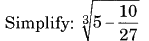
Ans: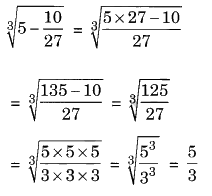
Q2: Find the cubes of the following:
(a) 0.3
(b) 0.8
(c) (0.001)
(d) (2 - 0.3)
Ans:
(a) (0.3)3 = 0.3 × 0.3 × 0.3 = 0.027
(b) (0.8)3 = 0.8 × 0.8 × 0.8 = 0.512
(c) (0.001)3 = (0.001) × (0.001) × (0.001) = 0.000000001
(d) (2 - 0.3)3 = (1.7)3 = 1.7 × 1.7 × 1.7 = 4.913
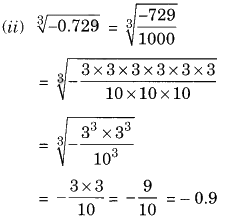
Q3: Find the cube roots of
(i) 
(ii) -0.729
Ans: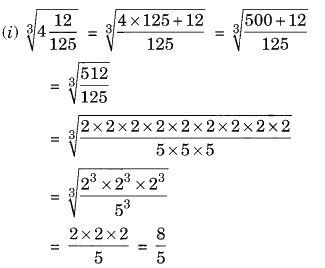
Q4: 135 a perfect cube?
Ans: Prime factorisation of 135, is:
135 = 3 × 3 × 3 × 5
We find that on making triplet, the number 5 does not make a group of the triplet.
Hence, 135 is not a perfect cube.
Q5: Find the smallest number by which 1323 may be multiplied so that the product is a perfect cube.
Ans: Prime factorisation of 1323, is:
1323 = 3 × 3 × 3 × 7 × 7
Since we required one more 7 to make a triplet of 7.
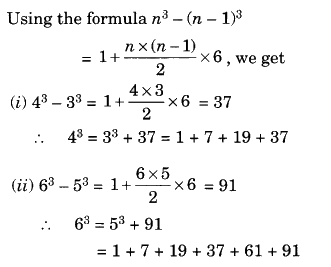
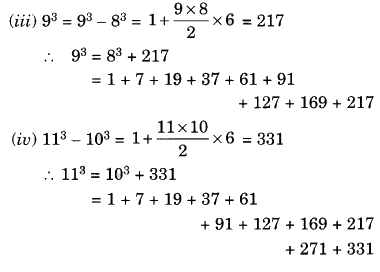
Q6: Express the following numbers as the sum of odd numbers using the given pattern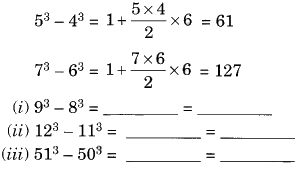
Ans: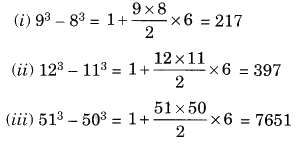
Q7: Observe the following pattern and complete the blank spaces.
13 = 1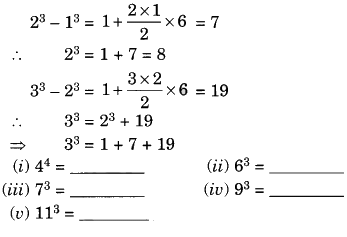
Ans: