Short & Long Questions: Understanding Quadrilaterals

Q1: What is the maximum exterior angle possible for a regular polygon?
Sol: To find the maximum exterior angle possible for a regular polygon, we need to consider a polygon with the minimum number of sides.
A polygon with the minimum number of sides is an equilateral triangle, which has 3 sides.
The sum of all exterior angles of a polygon is always 360 degrees.
So, to find the maximum exterior angle, we divide 360 degrees by the number of sides:
Maximum Exterior Angle = 360° / Number of Sides
In this case, for an equilateral triangle:
Maximum Exterior Angle = 360° / 3 = 120°
Therefore, the maximum exterior angle possible for a regular polygon is 120 degrees.
Q2: Find the measure of angles P and S if SP and RQ are parallel.
Sol: When SP and RQ are parallel lines, there are two pairs of corresponding angles that are congruent. These pairs are:
∠P and ∠Q (alternate interior angles)
∠R and ∠S (alternate interior angles)
Let's use the information provided:
∠Q is given as 130°.
First, find ∠P:
∠P + ∠Q = 180° (because they are on the same side of the transversal)
∠P + 130° = 180°
Now, subtract 130° from both sides to solve for ∠P:
∠P = 180° - 130°
∠P = 50°
Now, let's find ∠S:
∠R + ∠S = 180° (because they are on the same side of the transversal)
90° + ∠S = 180°
Now, subtract 90° from both sides to solve for ∠S:
∠S = 180° - 90°
∠S = 90°
So, the measures of angles P and S are:
∠P = 50°
∠S = 90°
Q3: Triangle ABC is a right-angled triangle, and O is the midpoint of the side opposite to the right angle. State why O is equidistant from A, B and C. (The dotted lines are drawn additionally to help you).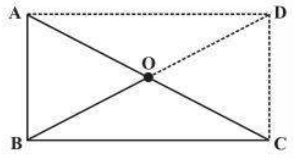 Sol: AD and DC are drawn in such a way that AD is parallel to BC and AB is parallel to DC
AD = BC and AB = DC
ABCD is a rectangle since the opposite sides are equal and parallel to each other, and the measure of all the interior angles is altogether 90°.
In a rectangle, all the diagonals bisect each other and are of equal length.
Therefore, AO = OC = BO = OD
Hence, O is equidistant from A, B and C.
Q4: State whether true or false.
(a) All the rectangles are squares.
(b) All the rhombuses are parallelograms.
(c) All the squares are rhombuses and also rectangles.
(d) All the squares are not parallelograms.
(e) All the kites are rhombuses.
(f) All the rhombuses are kites.
(g) All the parallelograms are trapeziums.
(h) All the squares are trapeziums.
Sol:
(a) This statement is false.
Since all squares are rectangles, all rectangles are not squares.
(b) This statement is true.
(c) This statement is true.
(d) This statement is false.
Since all squares are parallelograms, the opposite sides are parallel, and opposite angles are congruent.
(e) This statement is false.
Since, for example, the length of the sides of a kite is not the same length.
(f) This statement is true.
(g) This statement is true.
(h) This statement is true.
Q5: The two adjacent angles of a parallelogram are the same. Find the measure of each and every angle of the parallelogram.
Sol: A parallelogram with two equal adjacent angles.
To find:- the measure of each of the angles of the parallelogram.
The sum of all the adjacent angles of a parallelogram is supplementary.
∠A+∠B=180°
2∠A = 180°
∠A = 90°
∠B = ∠A = 90°
In a parallelogram, the opposite sides are the same.
Therefore,
∠C=∠A=90°
∠D=∠B=90°
Hence, each angle of the parallelogram measures 90°.
Q6: ABCD is a parallelogram in which ∠A=110°. Find the measure of the angles B, C and D, respectively.
Sol: The measure of angle A = 110°
the sum of all adjacent angles of a parallelogram is 180°
∠A + ∠B = 180
110°+ ∠B = 180°
∠B = 180°- 110°
= 70°.
Also ∠B + ∠C = 180° [Since ∠B and ∠C are adjacent angles]
70°+ ∠C = 180°
∠C = 180°- 70°
= 110°.
Now ∠C + ∠D = 180° [Since ∠C and ∠D are adjacent angles]
110o + ∠D = 180°
∠D = 180°- 110°
= 70°
Q6: The measure of the two adjacent angles of the given parallelogram is the ratio of 3:2. Then, find the measure of each angle of the parallelogram.
Sol: A parallelogram with adjacent angles in the ratio of 3:2
To find:- The measure of each of the angles of the parallelogram.
Let the measure of angle A be 3x
Let the measure of angle B be 2x
Since the sum of the measures of adjacent angles is 180° for a parallelogram,
∠A + ∠B = 180°
3x + 2x = 180°
5x = 180°
x = 36°
∠A =∠C = 3x =108°
∠B =∠D = 2x = 72° (Opposite angles of a parallelogram are equal).
Hence, the angles of a parallelogram are 108°, 72°,108°and 72°
Q7: Find x in the following figure.
Sol: The two interior angles in the given figures are right angles = 90°
70° + m = 180°
m = 180° - 70°
= 110°
(In a linear pair, the sum of two adjacent angles altogether measures up to 180°)
60° + n = 180°
n = 180° - 60°
= 120°
(In a linear pair, the sum of two adjacent angles altogether measures up to 180°)
The given figure has five sides, and it is a pentagon.
Thus, the sum of the angles of the pentagon = 540°
90° + 90° + 110° + 120° + y = 540°
410° + y = 540°
y = 540° - 410° = 130°
x + y = 180°..... (Linear pair)
x + 130° = 180°
x = 180° - 130°
= 50°
Q8: Adjacent sides of a rectangle are in the ratio 5: 12; if the perimeter of the given rectangle is 34 cm, find the length of the diagonal.
Sol: The ratio of the adjacent sides of the rectangle is 5: 12
Let 5x and 12x be adjacent sides.
The perimeter is the sum of all the given sides of a rectangle.
5x + 12x + 5x + 12x = 34 cm ......(since the opposite sides of the rectangle are the same)
34x = 34
x = 34/34
x = 1 cm
Therefore, the adjacent sides of the rectangle are 5 cm and 12 cm, respectively.
That is,
Length =12 cm
Breadth = 5 cm
Length of the diagonal = √( l2 + b2)
= √( 122 + 52)
= √(144 + 25)
= √169
= 13 cm
Hence, the length of the diagonal of a rectangle is 13 cm.
Q9: Find the measure of all the exterior angles of a regular polygon with (i) 9 sides and (ii) 15 sides.
Sol:
(i) Total measure of all exterior angles = 360°
Each exterior angle =sum of exterior angle = 360° = 40°
number of sides 9
Each exterior angle = 40°
(ii) Total measure of all exterior angles = 360°
Each exterior angle = sum of exterior angle =360° = 24°
number of sides 15
Each exterior angle = 24°
Q10: A quadrilateral has three acute angles, each measuring 80°. What is the measure of the fourth angle of the quadrilateral?
Sol: Let x be the measure of the fourth angle of a quadrilateral.
The sum of all the angles of a quadrilateral + 360°
80° + 80° + 80° + x = 360° ............(since the measure of all the three acute angles = 80°)
240° + x = 360°
x = 360° - 240°
x = 120°
Hence, the fourth angle made by the quadrilateral is 120°.
Q11: How many sides do regular polygons consist of if each interior angle is 165°?
Sol: A regular polygon with an interior angle of 165°
We need to find the sides of the given regular polygon:-
The sum of all exterior angles of any given polygon is 360°.
Formula Used: Number of sides = 360∘ /Exterior angle
Exterior angle=180∘-Interior angle
Thus,
Each interior angle =165°
Hence, the measure of every exterior angle will be
= 180°-165°
= 15°
Therefore, the number of sides of the given polygon will be
= 360°/15
= 24°
Q12: ABCD is a parallelogram with ∠A = 80°. The internal bisectors of ∠B and ∠C meet each other at O. Find the measure of the three angles of ΔBCO.
Sol: The measure of angle A = 80°.
In a parallelogram, the opposite angles are the same.
Hence,
∠A = ∠C = 80°
And
∠OCB = (1/2) × ∠C
= (1/2) × 80°
= 40°
∠B = 180° - ∠A (the sum of interior angles situated on the same side of the transversal is supplementary)
= 180° - 80°
= 100°
Also,
∠CBO = (1/2) × ∠B
∠CBO= (1/2) × 100°
∠CBO= 50°.
By the property of the sum of the angle BCO, we get,
∠BOC + ∠OBC + ∠CBO = 180°
∠BOC = 180° - (∠OBC + CBO)
= 180° - (40° + 50°)
= 180° - 90°
= 90°
Hence, the measure of all the angles of triangle BCO is 40°, 50° and 90°.
Q13: Is it ever possible to have a regular polygon, each of whose interior angles is 100?
Sol: The sum of all the exterior angles of a regular polygon is 360°
As we also know, the sum of interior and exterior angles are 180°
Exterior angle + interior angle = 180-100=80°
When we divide the exterior angle, we will get the number of exterior angles
since it is a regular polygon means the number of exterior angles equals the number of sides.
Therefore n=360/ 80=4.5
And we know that 4.5 is not an integer, so having a regular polygon is impossible.
Whose exterior angle is 100°
Q14: A diagonal and a side of a rhombus are of equal length. Find the measure of the angles of the rhombus.
Sol: Let ABCD be the rhombus.
All the sides of a rhombus are the same.
Thus, AB = BC = CD = DA.
The side and diagonal of a rhombus are equal.
AB = BD
Therefore, AB = BC = CD = DA = BD
Consider triangle ABD,
Each side of a triangle ABD is congruent.
Hence, ΔABD is an equilateral triangle.
Similarly,
ΔBCD is also an equilateral triangle.
Thus, ∠BAD = ∠ABD = ∠ADB = ∠DBC = ∠BCD = ∠CDB = 60°
∠ABC = ∠ABD + ∠DBC = 60° + 60° = 120°
And
∠ADC = ∠ADB + ∠CDB = 60° + 60° = 120°
Hence, all angles of the given rhombus are 60°, 120°, 60° and 120°, respectively.
Q15: The measures of the two adjacent angles of a parallelogram are in the given ratio 3: 2. Find the measure of every angle of the parallelogram.
Sol: Let the measures of two adjacent angles ∠A and ∠B be 3x and 2x, respectively, in parallelogram ABCD.
A + ∠B = 180°
⇒ 3x + 2x = 180°
⇒ 5x = 180°
⇒ x = 36°
The opposite sides of a parallelogram are the same.
∠A = ∠C = 3x = 3 × 36° = 108°
∠B = ∠D = 2x = 2 × 36° = 72°
Q16: Two adjacent angles of a parallelogram are equal. What is the measure of each of these angles?
Sol: Let ∠A and ∠B be two adjacent angles.
But we know that the sum of adjacent angles of a parallelogram is 180o
∠A + ∠B = 180°
But given that ∠A = ∠B
Now substituting, we get
∠A + ∠A = 180°
2∠A = 180°
∠A=180/2 = 90°
Q17: Is the quadrilateral ABCD a parallelogram if
(i) the measure of angle D + the measure of angle B = 180°?
(ii) AB = DC = 8 cm , the length of AD = 4 cm and the length of BC = 4.4 cm?
(iii)The measure of angle A = 70° and the measure of angle C = 65°?
Sol: (i) Yes, the quadrilateral ABCD can be a parallelogram if ∠D + ∠B = 180° but it should also fulfil certain conditions, which are as follows:
(a) The sum of all the adjacent angles should be 180°.
(b) Opposite angles of a parallelogram must be equal.
(ii) No, opposite sides should be of the same length. Here, AD ≠ BC
(iii) No, opposite angles should be of the same measures. ∠A ≠ ∠C
Q18: The opposite angles of a parallelogram are (3x + 5)° and (61 - x)°. Find the measure of four angles.
Sol: (3x + 5)° and (61 - x)° are the opposite angles of a parallelogram.
The opposite angles of a parallelogram are the same.
Therefore, (3x + 5)° = (61 - x)°
3x + x = 61° - 5°
4x = 56°
x = 56°/4
x = 14°
The first angle of the parallelogram =3x + 5
= 3(14) + 5
= 42 + 5 = 47°
The second angle of the parallelogram=61 - x
= 61 - 14 = 47°
The measure of angles adjacent to the given angles = 180° - 47° = 133°
Hence, the measure of the four angles of the parallelogram is 47°, 133°, 47°, and 133°.
