Worksheet Solutions: Food, Nutrition, Health & Diseases - 2

Q1: Fill in the blanks.
(i) The word "disease" stands for ________.
Ans: 'Dis-ease' meaning "not at ease" or "uncomfortable."
The word disease originates from 'Dis-ease', which signifies 'not at ease' or 'uncomfortable'. It refers to the state of discomfort or imbalance within the body during an illness. The term captures the essence of feeling unwell, highlighting the disruption of normal function.
(ii) Diseases that do not pass from one person to another are called _________ diseases.
Ans: Non-communicable diseases.
Non-communicable diseases are defined as diseases that do not pass from one person to another. Unlike communicable diseases, which can be transmitted from an infected individual to a healthy person, non-communicable diseases remain isolated and do not spread through direct contact.
(iii) Germs that cause communicable diseases are also known as _______.
Ans: Pathogens or infectious agents.
Pathogens are disease-causing germs responsible for causing communicable diseases. They include viruses, bacteria, fungi, protozoa, and worms.
(iv) Diseases like chickenpox and measles spread through ________ contact.
Ans: Direct.
Diseases like chickenpox and measles spread through direct contact with an infected person.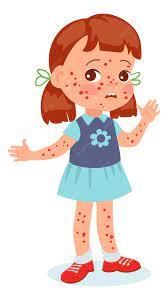
(v) Hygiene may be defined as practices that ensure cleanliness and _______.
Ans: Good health.
Hygiene practices are essential for maintaining cleanliness and good health, thus preventing the spread of communicable diseases.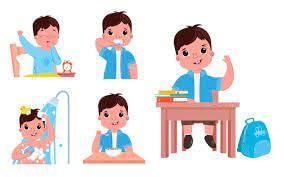
Q2: Match the column.
Match the communicable diseases with their respective disease-causing germs (pathogens).
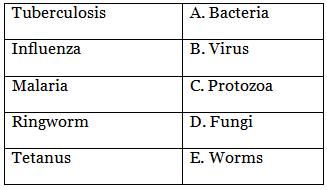
Ans:
- Tuberculosis is caused by bacteria.
- Influenza is caused by a virus.
- Malaria is caused by protozoa.
- Ringworm is caused by fungi.
- Tetanus is also caused by bacteria.
Q3: True or False.
(i) Non-communicable diseases can be passed from one person to another. (True/False)
Ans: False.
(ii) Germs that cause communicable diseases cannot be seen through a microscope. (True/False)
Ans: False.
(iii) Hygiene practices are essential to prevent communicable diseases. (True/False)
Ans: True.
(iv) Vaccination helps our body acquire immunity against certain diseases. (True/False)
Ans: True.
(v) Houseflies and cockroaches can carry disease-causing germs on their bodies. (True/False)
Ans: True.
Q4: Choose the odd one out.
(i) Measles, Mumps, Tetanus, Chickenpox
Ans: Tetanus (It is not a communicable disease).
(ii) Virus, Bacteria, Protozoa, Snake
Ans: Snake (It is not a microorganism).
(iii) Influenza, Tuberculosis, Cholera, Malaria
Ans: Malaria (It is caused by a protozoa, while the others are caused by bacteria or viruses).
(iv) Hygiene, Vaccination, Medication, Quarantine
Ans: Medication (It is a treatment method, not a preventive measure).
(v) Direct Mode, Indirect Mode, Vectors, Non-communicable
Ans: Non-communicable (It refers to a different category of diseases).
Q5: Arrange in the correct order.
Arrange the following steps in the correct order to prevent communicable diseases.
A. Use a mosquito net or mosquito repellent at night.
B. Wash your hands before and after eating food and after going to the toilet with soap and water.
C. Wash fruits and vegetables well before cooking or eating them.
D. Drink clean water.
E. Do not allow heaps of garbage to collect near your home. Dustbins should be kept covered.
Ans:
B. Wash your hands before and after eating food and after going to the toilet with soap and water.
C. Wash fruits and vegetables well before cooking or eating them.
E. Do not allow heaps of garbage to collect near your home. Dustbins should be kept covered.
D. Drink clean water.
A. Use a mosquito net or mosquito repellent at night.
Q6: Define the following words.
(i) Non-communicable diseases
Ans: Non-communicable diseases are health conditions that do not spread from one person to another. These diseases are not caused by pathogens but may result from factors like genetic predisposition, lifestyle choices, or deficiencies in essential nutrients.
(ii) Hygiene
Ans: Hygiene refers to a set of practices that ensure cleanliness and good health. It includes habits like washing hands regularly, maintaining personal cleanliness, keeping living spaces clean, and practicing proper food handling and preparation techniques.
(iii) Vaccination
Ans: Vaccination is a preventive measure in which a person is administered a vaccine containing weakened or killed pathogens or their parts. The purpose of vaccination is to stimulate the immune system to produce antibodies and develop immunity against specific diseases, thus protecting the individual from future infections.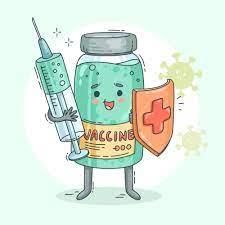
(iv) Communicable diseases
Ans: Communicable diseases, also known as infectious diseases, are health conditions that can be transmitted from an infected person to a healthy individual through direct or indirect contact. These diseases are caused by various pathogens such as viruses, bacteria, fungi, protozoa, and worms.
(v) Pathogens
Ans: Pathogens are disease-causing microorganisms or germs that can infect a host organism and cause illness or disease. Common pathogens include bacteria, viruses, fungi, protozoa, and helminths.
FAQs on Worksheet Solutions: Food, Nutrition, Health & Diseases - 2
| 1. What are the key components of a balanced diet for optimal health? |  |
| 2. How does poor nutrition contribute to the development of chronic diseases? | |
| 3. What role do vitamins and minerals play in maintaining health? | |
| 4. How can dietary changes improve mental health? | |
| 5. What are some common food-related diseases, and how can they be prevented? | |