Worksheet Solutions: Light and Shadow - 2


Cause & Effect Questions
(i) Why do shadows change size during the day?
Ans: Shadows change size because the position of the Sun in the sky changes. In the morning and evening, the Sun is low, creating long shadows, while at noon, when the Sun is directly overhead, shadows are shorter.
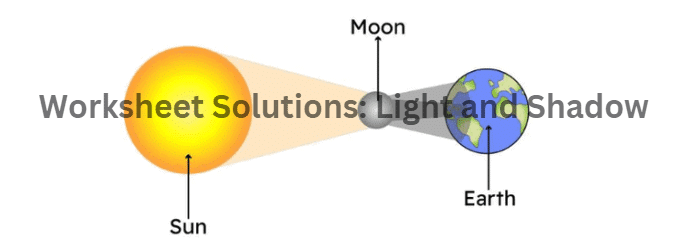
(ii) Why does a solar eclipse not happen every new moon?
Ans: A solar eclipse does not happen every new moon because the Moon's orbit is slightly tilted compared to the Earth's orbit. Most of the time, the Moon passes slightly above or below the Sun from our point of view.
(iii) What happens to an object's shadow when the light source moves closer to it?
Ans: The shadow becomes larger because a closer light source spreads its rays over a larger area behind the object.
(iv) Why does the Moon appear to glow even though it is not a source of light?
Ans: The Moon appears to glow because it reflects sunlight. The surface of the Moon is made of materials that bounce sunlight back towards Earth.
(v) Why do objects appear dark when placed in the shadow?
Ans: Objects appear dark in the shadow because they do not receive direct light from the source, and there is less light being reflected to our eyes.
Find the Error in Statement & Correct It
(i) A lunar eclipse occurs when the Moon blocks the Sun's light from reaching the Earth.
Ans: A lunar eclipse occurs when the Earth blocks the Sun's light from reaching the Moon.
(ii) A shadow forms on the same side as the light source.
Ans: A shadow forms on the opposite side of the light source.
(iii) The Sun is the only source of light in the universe.
Ans: The Sun is one of many sources of light in the universe; stars and fireflies are also natural sources of light.
(iv) During a solar eclipse, the Earth comes between the Sun and the Moon.
Ans: During a solar eclipse, the Moon comes between the Sun and the Earth.
(v) Shadows remain the same size throughout the day.
Ans: Shadows change size throughout the day depending on the position of the Sun.
Arrange in Correct Order
(i) Arrange the steps of a Solar Eclipse in the correct order:
(a) The Moon comes between the Sun and the Earth.
(b) The Sun's light is blocked by the Moon.
(c) A shadow is cast on Earth.
(d) People in some areas see a total or partial eclipse.
Correct Order: (a) → (b) → (c) → (d)
(ii) Arrange the sequence of Shadow Formation:
(a) Light travels in a straight line.
(b) An opaque object blocks the light.
(c) A dark area appears behind the object.
Correct Order: (a) → (b) → (c)
Real - Life Application-Based Questions
(i) You are playing outside in the evening, and your shadow is very long. What does this tell you about the position of the Sun?
Ans: The Sun is low in the sky, close to the horizon. Shadows are longer when the Sun is lower, such as in the morning or evening.
(ii) You stand under a tree on a hot sunny day and feel cooler. Why does this happen?
Ans: The tree blocks the direct sunlight, creating a shadow. The shaded area has lower temperature because less heat reaches the ground.
(iii) Your friend claims that the Moon is a source of light. How would you correct them?
Ans: The Moon is not a source of light; it only reflects sunlight. It does not produce its own light.
(iv) A person standing near a streetlight casts a shorter shadow than someone standing farther away. Why?
Ans: The person closer to the light source has a smaller shadow because the angle of the light is more direct, spreading less behind them.
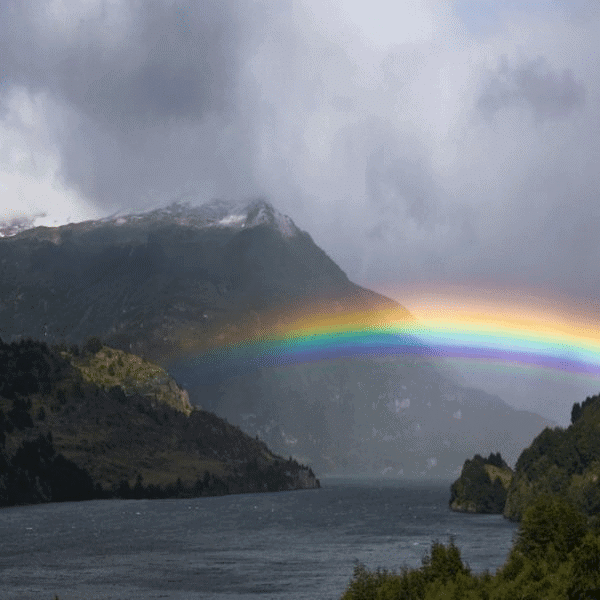
(v) A rainbow appears after a rain shower. What natural process is responsible for this?
Ans: The raindrops act as tiny prisms, splitting white sunlight into its seven colors through dispersion, creating a rainbow.
Differentiate between the following
(i) Differentiate between Solar and Lunar Eclipse.
Ans:
- Solar Eclipse: The Moon comes between the Sun and Earth, blocking sunlight.
- Lunar Eclipse: The Earth comes between the Sun and Moon, casting a shadow on the Moon.
(ii) How is an umbra different from a penumbra?
Ans:
- Umbra: The darkest part of a shadow where all light is blocked.
- Penumbra: The lighter part of a shadow where only some light is blocked.
(iii) What is the difference between Opaque and Translucent materials?
Ans:
- Opaque: Does not allow light to pass through (e.g., wood, metal).
- Translucent: Allows some light to pass through but not clearly (e.g., frosted glass, tracing paper).
What If : Questions
(i) What if the Earth had no atmosphere? How would the sky look during the daytime?
Ans: The sky would appear black instead of blue because there would be no atmospheric particles to scatter sunlight.
(ii) What if the Moon disappeared? How would it affect eclipses?
Ans: There would be no solar or lunar eclipses because the Moon is essential for blocking or receiving shadows.
(iii) What if the Sun never set? What would happen to shadows?
Ans: Shadows would remain in the same position all the time and would not change size throughout the day.
(iv) What if all objects were transparent? Would shadows exist?
Ans: No, because shadows require an opaque object to block light. If everything were transparent, light would pass through everything without forming shadows.
(v) What if the Moon had its own light source? How would that change our nights?
Ans: The Moon would always be bright, and we would not have phases of the Moon. The night sky would never be completely dark.
FAQs on Worksheet Solutions: Light and Shadow - 2
| 1. How do shadows form when light hits an object? |  |
| 2. Why do shadows change size and direction throughout the day? | |
| 3. What's the difference between a real shadow and an umbra in light and shadow concepts? | |
| 4. Can transparent and translucent objects cast shadows like opaque ones? | |
| 5. How do pinhole cameras and shadow formation connect in Class 5 Science? | |