Worksheet Solutions: Safety and First Aid - 2

Q1: True or False
(i) In case of severe burns with blisters, it is important to burst the blisters to release fluid.Ans: False
Explanation:
Blisters should not be burst because the fluid inside helps protect the skin as it heals. Popping blisters can let germs enter and cause infection. Instead, cover the area with a clean, dry cloth or sterile dressing and seek medical help if the burn is severe.
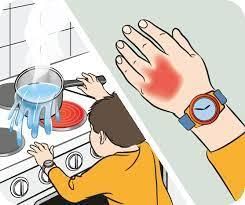
(ii) It is safe to play with electrical outlets and plugs if your hands are dry.
Ans: False
Explanation:
Playing with electrical outlets and plugs is dangerous even if your hands are dry. Faulty wiring, damaged plugs or sockets and sudden contact can cause electric shocks. Only adults should handle plugs and sockets, and all electrical work should be done with power switched off.
(iii) In the event of a nosebleed, tilt your head back to stop the bleeding.
Ans: False
Explanation:
Tilting the head back can make blood flow down the throat and may cause choking or vomiting. The correct action is to sit upright, lean slightly forward and pinch the soft part of the nose for 5-10 minutes. If bleeding continues, get medical help.
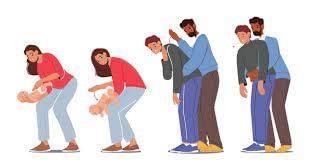
(iv) If someone is choking, you should perform the Heimlich manoeuvre immediately.
Ans: True
Explanation:
If a person is choking and cannot breathe, cough or speak, the Heimlich manoeuvre (abdominal thrusts) can quickly remove the object blocking the airway. It should be done by someone trained if possible. If the person becomes unconscious, start emergency procedures and call for help.
(v) It is necessary to wear a helmet when riding a bicycle or skateboard.
Ans: True
Explanation:
Wearing a helmet protects the head and reduces the chance of serious brain or skull injury in a fall or collision. Make sure the helmet fits well and the strap is fastened securely.
(vi) When using a knife, it is best to cut away from your body.
Ans: True
Explanation:
Cutting away from your body reduces the chance of the knife slipping towards you and causing a cut. Always use a stable surface, keep fingers out of the cutting path and hold the item you are cutting firmly.
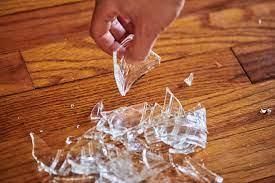
(vii) If you find a broken glass on the floor, you should pick it up with your bare hands.
Ans: False
Explanation:
Do not pick up broken glass with bare hands. Use thick gloves, a broom and dustpan, or fold thick paper/cardboard to collect the pieces. Wipe the area with a damp paper towel afterwards to pick up tiny shards.
(viii) If someone is experiencing a seizure, you should restrain them to prevent movement.
Ans: False
Explanation:
Do not hold a person down during a seizure because this can harm them. Instead, move hard or sharp objects away, cushion their head, loosen tight clothing and turn them gently onto their side when the seizure stops to keep the airway clear. Call for medical help if the seizure lasts longer than a few minutes or if it is the first seizure.
(ix) It is safe to mix different cleaning chemicals together to increase their effectiveness.
Ans: False
Explanation:
Mixing cleaning chemicals can create dangerous fumes or harmful reactions. Always read and follow the instructions on product labels and use products only as recommended.
(x) If someone is bitten by a venomous snake, apply a tourniquet above the bite area to prevent the venom from spreading.
Ans: False
Explanation:
Applying a tourniquet can stop blood flow and cause serious damage. For a snake bite, keep the person calm and still, remove tight items such as rings or watches, wash the bite gently with soap and water if possible, keep the bitten limb immobilised and lower than the heart, and get medical help immediately.
Q2: Match the Following
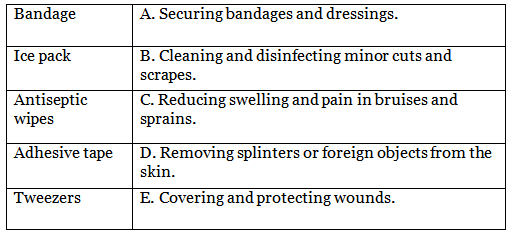
Ans:
Bandage - E. Covering and protecting wounds.
Ice pack - C. Reducing swelling and pain in bruises and sprains.
Antiseptic wipes - B. Cleaning and disinfecting minor cuts and scrapes.
Adhesive tape - A. Securing bandages and dressings.
Tweezers - D. Removing splinters or foreign objects from the skin.
Q3: Arrange in the Correct Order
Arrange the steps in the correct order for the following first aid procedures. Skip the parts that do not fit in the procedure.
(i) First Aid for a Nosebleed
(a) Avoid tilting the head back.
(b) Pinch the soft part of the nose.
(c) Lean slightly forward.
(d) Keep the head elevated for a few minutes after the bleeding stops.
Ans: c → b → d
Explanation:
When someone has a nosebleed, first ask them to sit and lean slightly forward (c) so blood does not run down the throat. Then pinch the soft part of the nose (b) and keep firm pressure for 5-10 minutes. After the bleeding stops, keep the head slightly elevated for a few minutes (d). Avoid tilting the head back (a).
(ii) First Aid for a Minor Burn
(a) Apply ice to the burn immediately.
(b) Run cold water over the burn for at least 10 minutes.
(c) Pop any blisters that form.
(d) Cover the burn with a sterile non-stick bandage.
Ans: b → d
Explanation:
For a minor burn, the correct first step is to run cold (not ice-cold) water over the burn for at least 10 minutes (b) to cool the skin and reduce damage. After cooling, cover the area with a sterile non-stick dressing (d) to keep it clean. Do not apply ice directly (a) and do not pop blisters (c).
(iii) First Aid for Choking
(a) Perform the Heimlich maneuver.
(b) Call for emergency help if the person cannot breathe or speak.
(c) Encourage the person to drink water.
(d) Pat the person's back forcefully.
Ans: b → a
Explanation:
If a person cannot breathe, cough or speak because of choking, first call for emergency help (b). Then, if trained and it is safe to do so, perform the Heimlich manoeuvre (a) to try to dislodge the object. Encouraging the person to drink water (c) or patting the back forcefully (d) are not appropriate first measures for a severe airway blockage.
(iv) First Aid for a Snake Bite
(a) Apply a tourniquet above the bite area.
(b) Keep the bitten limb elevated.
(c) Wash the bite area with soap and water.
(d) Seek immediate medical attention.
Ans: c → b → d
If someone is bitten by a venomous snake, first wash the bite with soap and water, keep the affected limb raised, and get medical help immediately. Do not use a tourniquet, as it can block blood flow and cause serious problems.
(v) First Aid for Cuts and Scrapes
(a) Apply a bandage to the wound.
(b) Clean the wound with antiseptic wipes.
(c) Use tweezers to remove any debris from the wound.
(d) Elevate the injured limb.
Ans: b → c → a
For cuts and scrapes, first clean the wound with antiseptic wipes, then use tweezers to remove any dirt or debris, and finally cover it with a bandage. Raising the injured limb is not usually needed for these types of injuries.
Q4: Multiple Choice Questions (MCQs)
(i) What is the primary purpose of first aid in the case of burns?(a) To break blisters formed on the skin.
(b) To cool the skin and prevent further damage.
(c) To apply antiseptic cream immediately.
(d) To wait for a doctor to arrive.
Ans: (b)
Explanation:
The first aim in burn first aid is to cool the skin and stop the burning process. Running cool water over the burn for at least 10 minutes reduces pain and limits further damage. Avoid breaking blisters and do not apply substances like butter; seek medical help for serious burns.
(ii) When should you apply tincture of iodine to a wound?
(a) Before washing the wound with water.
(b) After washing the wound with water.
(c) Only if the wound is deep.
(d) Never, as it can be harmful.
Ans: (b)
Explanation:
Tincture of iodine should be used after you have first cleaned the wound with water. Cleaning removes dirt and reduces germs, and then iodine can be applied carefully to disinfect. For deep wounds or heavy bleeding, seek medical care.
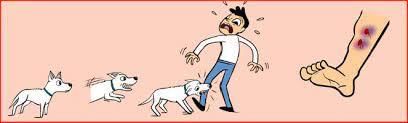
(iii) What is the recommended first aid for an animal bite, such as from a dog?
(a) Apply ice immediately.
(b) Wash with soap and water and apply an antiseptic lotion.
(c) Apply a paste of baking soda.
(d) Take the patient to the hospital for stitches.
Ans: (b)
Explanation:
For a bite, first wash the wound thoroughly with soap and water to reduce infection risk, then apply an antiseptic. Seek medical advice afterwards to check if further treatment, stitches or vaccination (for example tetanus or rabies) is needed.
(iv) How should you provide support for a suspected fractured hand?
(a) Use a cloth sling.
(b) Apply ice to reduce swelling.
(c) Move the hand gently to prevent stiffness.
(d) Tie a tourniquet above the hand to stop blood flow.
Ans: (a)
Explanation:
If a hand is suspected to be fractured, support and immobilise it with a cloth sling (a) to prevent movement and reduce pain. Do not move the injured part unnecessarily (c) and never use a tourniquet (d). Apply ice wrapped in cloth (b) to reduce swelling if appropriate, but seek professional care.
(v) What should you do when experiencing a nosebleed according to the first aid instructions?
(a) Blow your nose vigorously.
(b) Apply pressure to the back of the neck.
(c) Breathe through your nose.
(d) Sit upright with your head held back and arms folded above the head.
Ans: (d)
Explanation:
Option (d) is the closest of the choices because it advises sitting upright, which helps reduce blood flow to the nose. However, the head should be slightly forward (not held back). The correct first aid is to sit upright, lean slightly forward, and pinch the soft part of the nose for several minutes. Do not blow the nose or apply pressure to the back of the neck.
Q5: Short Answer Questions
(i) What is the main aim of first aid?
Ans: The main aim of first aid is to give quick and basic medical help to an injured or sick person until professional medical care is available. First aid saves lives, prevents the condition from worsening, and helps the person recover more quickly.
(ii) What should we do when a cut is deep and bleeding?
Ans: When a cut is deep and bleeding, follow these steps:
- Wash your hands with soap and water to lower the risk of infection.
- Gently clean the wound with water and mild soap if available.
- Apply direct pressure to the wound using a clean cloth or sterile dressing to stop the bleeding.
- Elevate the injured area above heart level if possible to reduce bleeding.
- Once bleeding is controlled, cover the wound with a sterile dressing or clean cloth.
- Seek medical help if bleeding is severe, will not stop, or the wound is large or caused by a dirty or animal bite.
(iii) What is a tourniquet?
Ans: A tourniquet is a band or strap used to tighten and reduce blood flow to an arm or leg. It is used only as a last resort to stop heavy bleeding when direct pressure has failedTourniquets are placed above the injury (closer to the body) to limit blood flow to the hurt limb. They should only be used as a last resort when other methods, like applying direct pressure, haven't worked. After using a tourniquet, it's important to get medical help right away.
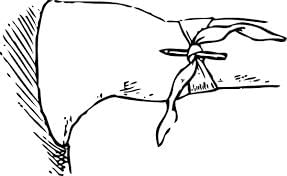
(iv) What do you mean by a fracture? What first aid should be given to the victim of a fracture?
Ans: A fracture is a break or crack in a bone caused by a fall, accident or strong force. First aid for a fracture includes:
- Encourage the person to stay still to avoid further injury.
- Call for emergency medical help immediately.
- If there is an open wound, cover it with a clean cloth or sterile dressing.
- Apply an ice pack wrapped in cloth to reduce swelling and pain.
- Immobilise the injured limb using splints or improvised supports (for example, a board or rolled-up newspapers) to keep the bone from moving.
- Do not try to realign the bone; leave that to medical professionals.
(iv) Suggest the first aid to be given for nose bleeding.
Ans: For a nosebleed, follow these first aid steps:
- Ask the person to sit down and lean slightly forward to avoid swallowing blood.
- Pinch the soft part of the nose (just below the bridge) using your thumb and index finger.
- Hold steady pressure on the nose for 10-15 minutes without releasing it.
- Apply a cold compress or ice pack wrapped in cloth to the bridge of the nose to help narrow blood vessels.
- Avoid tilting the head back or lying down, as this can cause blood to go down the throat.
- If bleeding continues for more than 20-30 minutes or follows a head injury, seek immediate medical help.
FAQs on Worksheet Solutions: Safety and First Aid - 2
| 1. What are the basic first aid steps I should know for minor injuries? |  |
| 2. How can I treat a burn at home? | |
| 3. What should I do if someone is choking? | |
| 4. When should I call emergency services for a medical issue? | |
| 5. What is the importance of knowing CPR? | |