Worksheet: Solids, Liquids and Gases - 2

Q1: Fill in the Blanks.
(i) Matter is made up of molecules that are very_____(large/small).
(ii) In the case of solids, there is _____(no/some) space between molecules.
(iii) Copper sulphate crystals are _____ (solids/liquids).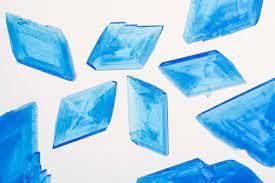
(iv) Solids and _____ (gases/liquids) have fixed volume.
(v) Solute and _____ (gas/solvent) makes a solution.
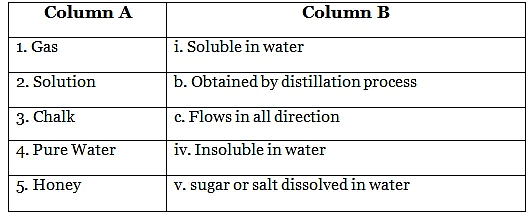
Q2: Match the following.
Q3: True or False.
(i) Air is a mixture of several gases such as nitrogen, oxygen, carbon dioxide, etc
(ii) Air contains dust particles and smoke.
(iii) Oxygen is taken in by green plants to prepare food.
(iv) Nitrogen in air controls the process of burning.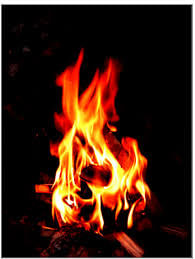
(v) Air has no weight.
(vi) A gentle wind is called gale.
(vii) The land breeze takes place during daytime.
(viii) Summer monsoon wind brings rain in India.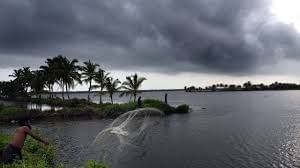
Q4: Short Answers Questions.
(i) Is the arrangement of all molecules in all states of matter the same?
(ii) Name the state of matter in which molecules are very loosely packed.
(iii) What is a solution? Give two examples.
(iv) What are soluble and insoluble substances in a liquid?
(v) Why is distilled water not suitable for drinking?
(vi) Define filtration with the help of an example.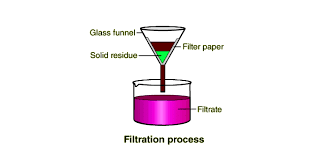
(vii) What are the different properties of air?
Q5: Long Answers Questions.
(i) Write three properties each of solids, liquids, and gases.
(ii) Write an activity to identify soluble and insoluble substances in water.
(iii) Explain two methods to separate soluble substances.
(iv) How is the sea and land breeze formed?
(v) What are monsoon winds? How are they helpful to us?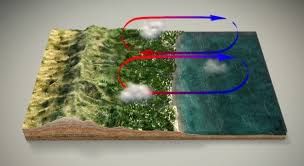
The solutions of the worksheet "Solids, Liquids and Gases - 2"
FAQs on Worksheet: Solids, Liquids and Gases - 2
| 1. What are the main differences between solids, liquids, and gases? |  |
| 2. How do particles behave in solids, liquids, and gases? | |
| 3. Can you give examples of each state of matter? | |
| 4. What happens to the states of matter when heated or cooled? | |
| 5. Why is it important to understand solids, liquids, and gases? | |