Worksheet: The Great Indian Desert

Q1: Fill in the Blanks.
(i) The Great Indian Desert is located to the ______________ of the Gangetic plain.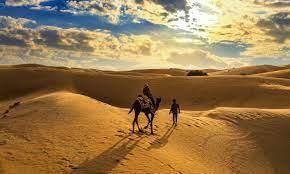
(ii) The western region of which Indian state is covered by the Great Indian Desert?
(iii) In the desert lands, there is a ______________ of water.
(iv) People in some villages have to travel a few ______________ to get drinking water.
(v) The natural growing plants in the desert are mostly ______________.
(vi) The beast of burden commonly found in the desert is the ______________.
(vii) During the day, the desert sand becomes very ______________ due to the heat.
(viii) The Indira Gandhi Canal provides ______________ facilities in several districts.
(ix) The district of ______________ is known for the production of cotton.
(x) The people of Rajasthan are skilled ______________ who make beautiful handicrafts.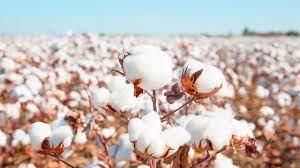
Q2: Multiple Choice Questions (MCQs).
(i) The Great Indian Desert lies to the ______________ of the Gangetic plain.
(a) east
(b) south
(c) west
(d) north
(ii) Which animal is known as the "ship of the desert"?
(a) Cow
(b) Horse
(c) Camel
(d) Elephant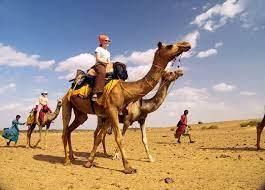
(iii) What is the traditional clothing worn by men in Rajasthan?
(a) Sari
(b) Kurta-Pajama
(c) T-shirt and jeans
(d) Skirt
(iv) Which festival is celebrated during the monsoon months in Rajasthan?
(a) Diwali
(b) Holi
(c) Teej
(d) Navratri
(v) The famous Taj Mahal was built using marble from which region?
(a) Mount Abu
(b) Udaipur
(c) Makrana
(d) Chittaurgarh
Q3: True or False.
(i) The Great Indian Desert covers the northern region of India.
(ii) Rajasthanis celebrate the festival of Teej in the winter months.
(iii) The natural surroundings of the desert are very colorful.
(iv) Wheat and rice are not commonly consumed by the people of Rajasthan.
(v) The annual fair at Jaipur features camel races.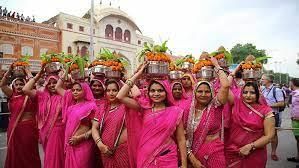
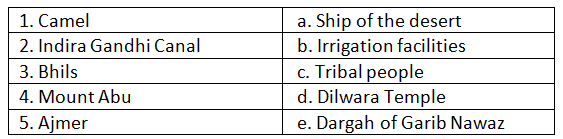
Q4: Match the Following.
Q5: Choose the Odd One Out.
(i) (a) Wheat
(b) Rice
(c) Millets
(d) Camel
(ii) (a) Forts
(b) Palaces
(c) Temples
(d) Skyscrapers
(iii) (a) Gangaur
(b) Holi
(c) Diwali
(d) Teej
(iv) (a) Sand dunes
(b) Mountains
(c) Camel caravans
(d) Dancing women
(v) (a) Copper
(b) Marble
(c) Zinc
(d) Mica
Q6: Short Answer Questions.
(i) Why is life in the desert lands hard?
(ii) What is the role of the Indira Gandhi Canal in Rajasthan's agriculture?
(iii) Name two important festivals celebrated in Rajasthan.
(iv) How have the people of Rajasthan made their lives colorful despite the dull natural surroundings?
(v) What are some of the prominent cities in Rajasthan?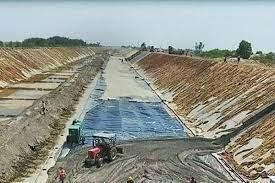
You can find Worksheets Solutions here: Worksheet Solutions: The Great Indian Desert
FAQs on Worksheet: The Great Indian Desert
| 1. What is the location of the Great Indian Desert? |  |
| 2. What is the climate like in the Great Indian Desert? | |
| 3. What is the flora and fauna found in the Great Indian Desert? | |
| 4. How do people survive in the Great Indian Desert? | |
| 5. Can tourists visit the Great Indian Desert? | |