Short Notes: Triangles


What is a Triangle?
A triangle is a closed two-dimensional figure formed by three line segments. The end points of these segments are called the vertices of the triangle. A triangle has three sides, three vertices and three interior angles.
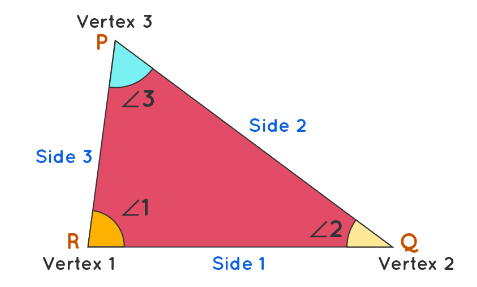
Types of Triangle
Triangles can be classified in two commonly used ways: on the basis of the lengths of their sides, and on the basis of their interior angles.
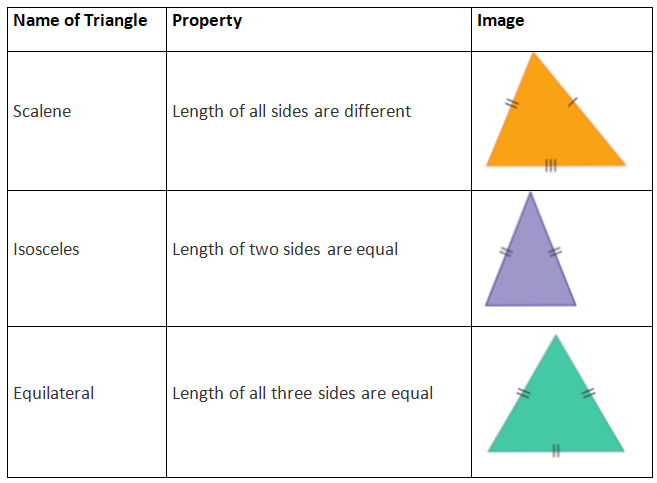
On the basis of sides
- Equilateral triangle: All three sides are equal in length. All internal angles are equal and each angle measures 60°.
- Isosceles triangle: Two sides are equal in length. The angles opposite the equal sides are equal.
- Scalene triangle: All three sides have different lengths and all three internal angles are different.
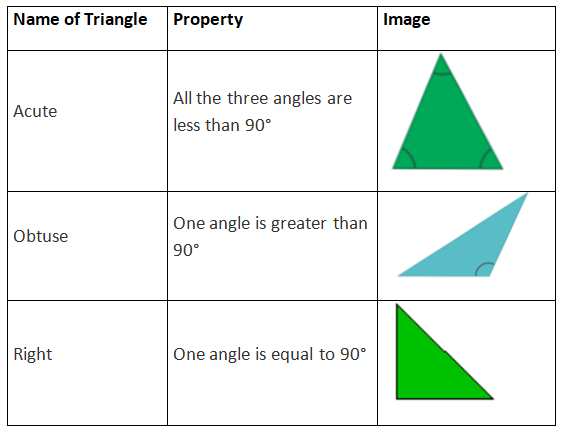
On the basis of angles
- Acute-angled triangle: All three interior angles are less than 90°.
- Right-angled triangle: One interior angle is exactly 90°.
- Obtuse-angled triangle: One interior angle is greater than 90°.
Try yourself: Which type of triangle has all three sides of equal length?
Congruence
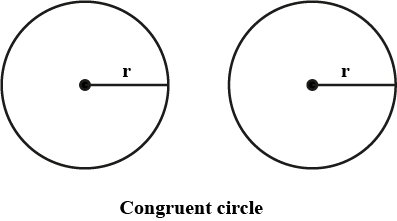
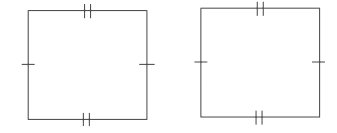
Two figures are said to be congruent if they have exactly the same shape and size. Corresponding sides are equal in length and corresponding angles are equal in measure.
- Two circles are congruent if their radii are equal.
- Two squares are congruent if their side lengths are equal.
Congruence of Triangles
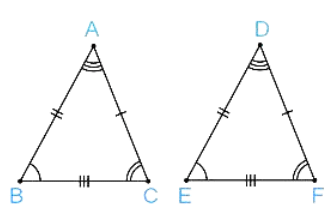
Two triangles are congruent if all corresponding sides and all corresponding angles are respectively equal. The symbol used for congruence is ≅. For example, if corresponding vertices are written in the same order,
∆ABC ≅ ∆DEF implies:
- AB = DE, BC = EF, AC = DF
- m∠A = m∠D, m∠B = m∠E, m∠C = m∠F
Criteria for Congruence of Triangles
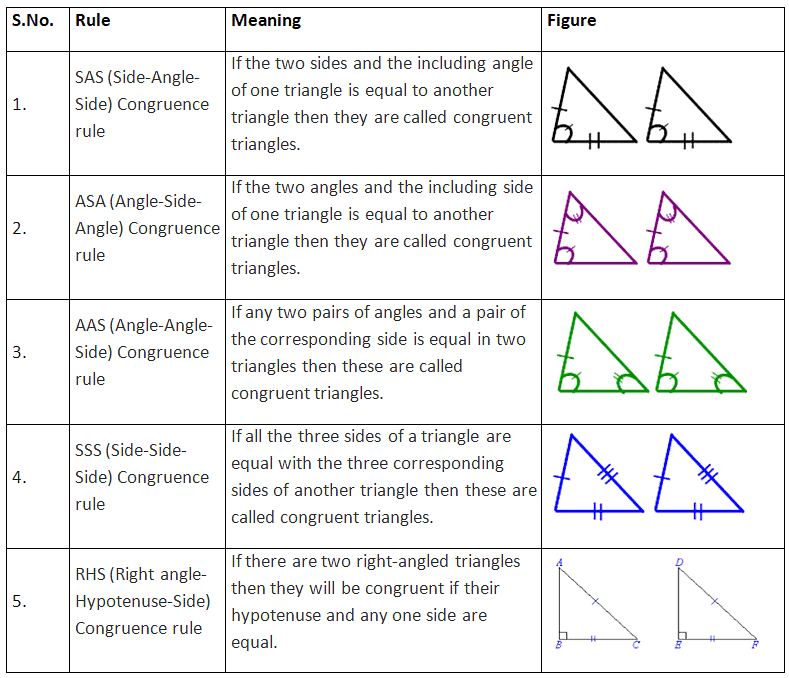
- SSS (Side-Side-Side): If three sides of one triangle are equal respectively to three sides of another triangle, then the triangles are congruent.
- SAS (Side-Angle-Side): If two sides and the included angle of one triangle are equal respectively to two sides and the included angle of another triangle, then the triangles are congruent.
- ASA (Angle-Side-Angle): If two angles and the included side of one triangle are equal respectively to two angles and the included side of another triangle, then the triangles are congruent.
- RHS (Right angle-Hypotenuse-Side): For right-angled triangles, if the hypotenuse and one other side of a triangle are equal respectively to the hypotenuse and one other side of another right-angled triangle, the triangles are congruent.
Remark
- SSA or ASS (two sides and a non-included angle) does not generally prove congruence; it can lead to ambiguous cases.
- AAA (three angles equal) does not prove congruence; it only proves similarity (same shape but possibly different size).
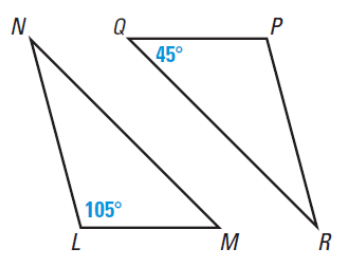
Example: Find the ∠P, ∠R, ∠N and ∠M if ∆LMN ≅ ∆PQR.
Sol:
Corresponding angles of congruent triangles are equal, so ∠L = ∠P, ∠M = ∠Q and ∠N = ∠R.
Given ∠P = 105° and ∠Q = 45°.
Therefore ∠L = 105° and ∠M = 45°.
Sum of interior angles of a triangle is 180°.
∠L + ∠M + ∠N = 180°
105° + 45° + ∠N = 180°
∠N = 180° - 150°
∠N = 30°
Hence ∠R = ∠N = 30° and ∠P = ∠L = 105°, ∠Q = ∠M = 45°.
Try yourself: Which condition is required to prove the congruence of two triangles?
Some Properties of a Triangle
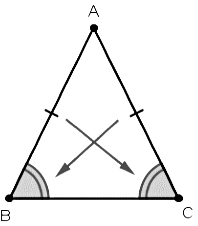
If a triangle has two equal sides it is called an isosceles triangle.
- If two sides of a triangle are equal, the angles opposite those sides are equal (base angles of an isosceles triangle are equal).
- The converse is also true: if two angles of a triangle are equal, the sides opposite those equal angles are equal.
Inequalities in a Triangle
Theorem 1. In any triangle, if two sides are unequal, then the angle opposite the longer side is larger.
That is, if side a > side b, then ∠A > ∠B.
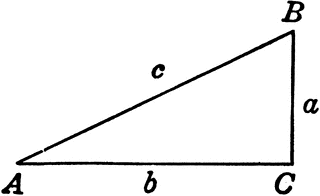
Theorem 2 (Converse). In any triangle, if one angle is larger than another angle, then the side opposite the larger angle is longer than the side opposite the smaller angle.
Theorem 3 (Triangle inequality). In any triangle the sum of the lengths of any two sides is greater than the length of the remaining side.
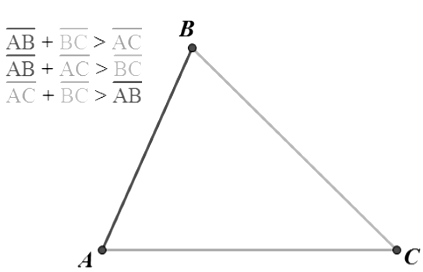
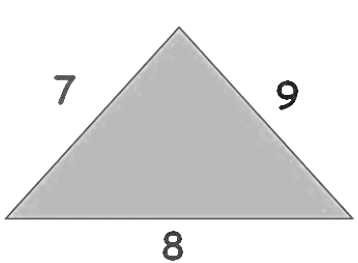
Example: Show whether the inequality theorem is applicable to this triangle or not?
Sol:
The three side lengths given are 7, 8 and 9.
Check the sum of each pair of sides and compare to the third side.
7 + 8 = 15 and 15 > 9
8 + 9 = 17 and 17 > 7
9 + 7 = 16 and 16 > 8
All three checks satisfy the triangle inequality; therefore a triangle with sides 7, 8 and 9 is possible and the triangle inequality theorem is applicable.
Summary
Triangles are three-sided polygons classified by side lengths and angles. Congruence of triangles is established by specific criteria (SSS, SAS, ASA, RHS). Important properties include base angles of isosceles triangles being equal and triangle inequality rules relating side lengths and angles. These theorems and criteria form the basis for solving many geometric problems involving triangles.




