Classroom Assignment: 5

On the basis of your understanding of the passage, answer the following questions.
1.
Ans: Cities across the world have grown, thrived and expanded along rich, continuous sources of water...
2.
Ans: The author is surprised at the water crisis facing many cities in the world because cities across the world have historically developed and thrived around rich, perennial sources of water such as lakes, rivers, springs, and seas. It is unexpected that despite these natural water sources, many cities are running out of water. The author suggests that the main long-term driver of these water shortages is the unprecedented urban growth occurring worldwide, which has led to increased water demand and pressure on existing water resources.
3.
Ans: 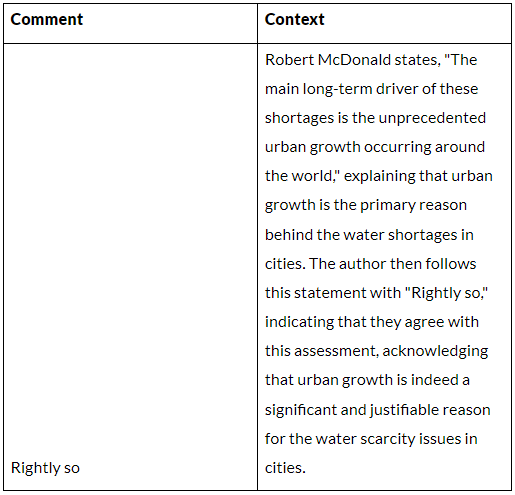
4.
Ans: (c) fear
5.
Ans: From paragraph 2, one solution that can help address the problem of water shortage in metropolitan cities turning worse is to implement planned urbanization. The paragraph highlights the negative impact of unplanned urbanization (mirgration of so many people) on water availability and suggests that the scarcity of water will increase as more people migrate to urban areas. Therefore, planned and sustainable urban development could help mitigate the water shortage issue by ensuring that infrastructure and resources are managed more efficiently and effectively to support the growing urban population.
6.
Ans: (d) a little under 55% of the world population
7.
Ans: (a) 1-B, 2-C, 3-A and 4-D
8.
Ans: (d) Nearly 1 billion people in rural areas are likely to face water shortage by 2050.
9.
Ans: As a result, the urban water demand will increase by 80 per cent by 2050, it adds.
10.
Ans: According to paragraph 3, aside from urbanization, "climate change" is mentioned as a factor that will affect the timing and distribution of water. Climate change is expected to influence the availability and distribution of water, exacerbating the challenges of water scarcity in urban areas.
11.
Ans: (b) Option 2
12.
Ans: (c) Water shortage in rural areas all over the world
FAQs on Classroom Assignment: 5
**The input provided is incomplete and insufficient to generate meaningful FAQs.**
Here's what's missing:
1. **Course Name**: Empty
2. **Chapter Name**: Empty
3. **Topic Name**: "Classroom Assignment: 5" - This is a content *type* label, not an actual topic
Without knowing:
- Which subject (Science, Mathematics, Social Studies, English, etc.)
- Which chapter within that subject
- What specific concepts are covered in Assignment 5
...I cannot create authentic, student-focused questions that reference real sub-topics, concepts, or terminology students would actually search for.
**What I need to proceed:**
Please provide:
1. **Subject/Course** (e.g., "Science", "Mathematics", "Social Studies")
2. **Chapter Name** (e.g., "Chemical Reactions and Equations", "Quadratic Equations", "The French Revolution")
3. **Confirmation**: Is this Assignment 5 a worksheet, solution set, question bank, or notes document?
Once you supply these details, I'll generate five high-search-volume FAQs with naturally optimised answers that students would genuinely type into Google.

