Sure Shot Questions: Indian Economy 1950-1990

Very Short Answer Type Questions
Q1: What do you mean by the Planning Commission and who is the chairman of this commission?
Ans: The Planning Commission was an agency of the Government of India established in 1950 to formulate India's Five-Year Plans and to assess and allocate resources for economic and social development. It coordinated policy between the centre and states and advised the government on development priorities. The Chairman of the Planning Commission was the Prime Minister of India. The Commission was dissolved in 2014 and replaced by the NITI Aayog in 2015.
Q2: Who is the father of a high-yielding variety seed?
Ans: Norman Borlaug, an American agricultural scientist, is widely regarded as the father of high-yielding varieties (HYVs) and the Father of the Green Revolution. He developed dwarf, high-yielding wheat varieties and improved agronomic practices, for which he was awarded the Nobel Peace Prize (1970).
Q3: What is meant by import substitution in Indian economy?
Ans: Import substitution is a trade and industrial policy that encourages domestic production of goods that were earlier imported. The aim is to reduce dependence on foreign products by developing local manufacturing, often through protective tariffs, import controls and incentives for domestic industry. In India, import substitution was a key strategy during the early post-independence decades; today many mechanical goods, instruments and software are being produced domestically to save foreign exchange and create jobs.
Q4: Define small scale industries.
Ans: Small scale industries are enterprises with a limited fixed investment in plant and machinery. As given here, they are defined by a ceiling on fixed investment not exceeding Rs. 1 crore. Such industries typically include production of items like paper napkins, facial tissues, candles and wooden toothpicks, often operated by small entrepreneurs and local units.
Q5: Who presented the 1st five year plan of the country?
Ans: Pandit Jawaharlal Nehru, India's first Prime Minister, presented the First Five-Year Plan in Parliament. The First Plan covered the period 1951-56 and was prepared by the Planning Commission.
Q6: Define Economy.
Ans: An economy is a system of production, distribution and consumption of goods and services through which a society organises the allocation of its scarce resources to satisfy human wants. It comprises households, firms and government activities that interact to determine what is produced and how resources are used.
Q7: What were the priorities in the 11th five-year plan?
Ans: The 11th Five-Year Plan (2007-12) emphasised inclusive growth. Major priorities included agricultural development, expansion of infrastructure (roads, power, irrigation), improvement of health and education services, and targeted programmes for poverty reduction and rural development.
Q8: What do you mean by land ceiling?
Ans: Land ceiling refers to a statutory limit on the amount of agricultural land that an individual or family can own. Land ceiling laws were introduced in India in the 1950s-1960s and implemented by states with varying limits, with the objective of redistributing surplus land to the landless and tenants.
Q9: What were the focus points of the first and second five year plan?
Ans: The First Five-Year Plan (1951-56) concentrated on agriculture, rural development and irrigation to raise food production. The Second Five-Year Plan (1956-61) shifted emphasis to industrialisation, particularly heavy industries and the public sector, to build industrial capacity and modernise the economy.
Short Answer Type Questions
Q10: Why did India take up a mixed economy?
or
Amidst different types of economies in the world, why does India focus on a mixed economy model?
Ans: After independence India faced the twin tasks of rapid economic development and social justice. A mixed economy was chosen because:
- It combined the efficiency and innovation of the private sector with the planning role and social objectives of the public sector.
- A purely capitalist model risked neglecting equity and basic services; a purely socialist model was not considered suitable for a democratic country with a large private sector and diverse ownership patterns.
- The state could invest in heavy industries, infrastructure and essential services while the private sector could promote entrepreneurship and consumer goods production.
This approach allowed the government to pursue redistribution, planning and regulation while also encouraging private initiative. Gradual liberalisation after 1991 increased the role of the private sector, but the mixed-economy character remains.
Q11: What is meant by socialist economy? Elaborate with examples.
Ans: A socialist economy is one in which the state or the collective owns and directly controls major means of production with the aim of producing primarily for social needs rather than private profit. Key features are state ownership of key industries, central planning of output and distribution, and emphasis on equality.
Examples:
- The former Soviet Union and Cuba are often cited as examples of economies that followed centralized socialist models, where the government managed production, distribution and major services.
- Many countries in Europe (for example, the Nordic countries) follow strong welfare and public-service models within a market framework; these are better described as social democracies or mixed economies with extensive social safety nets rather than pure socialist systems.
Q12: What was the aim of five year plans? Or Why did India need five year plans? Or What were the goals of five year plans in our country and how much has been achieved?
Ans: Five-year plans were formal instruments of economic planning designed to set priorities and allocate resources for national development over a five-year period. Main aims included:
- Growth: Raise the national income and per capita income.
- Modernisation: Promote industrial and technological development.
- Self-reliance: Reduce dependence on imports.
- Equity: Reduce regional and social inequalities and provide for the poor.
Key achievements across plans included:
- Significant rise in national and per capita income over decades.
- Large gains in agricultural output and foodgrain self-sufficiency.
- Expansion of industrial capacity and development of heavy industries.
- Improvement in transport, communications and power infrastructure.
- Creation of many employment opportunities.
- Advances in science and technology and increased capital formation.
Q13: What is the policy of 'land to the tiller'?
Or
Have you heard about land tiller policy? What is it?
Ans: The policy of "land to the tiller" means giving ownership rights of agricultural land to those who actually cultivate it (the tillers). It emerged from land-reform efforts after independence, aiming to abolish intermediaries such as zamindars, secure tenant rights, reduce exploitation, and provide small farmers with incentives to invest in and improve the land they cultivate. The principal goals were equitable land distribution and increased agricultural productivity.
Q14: What are the advantages and disadvantages of the green revolution?
Or
What are the drawbacks of the green revolution?
Ans: The Green Revolution introduced high-yielding varieties (HYVs), improved irrigation, chemical fertilisers and better farm technology, which had mixed consequences.
Benefits:
- Substantial increase in foodgrain production, particularly wheat and rice.
- Enabled large-scale, commercialised agriculture on many farms.
- Reduced the need to keep land fallow and improved cropping intensity.
- Generated employment in agriculture and related industries and helped achieve food self-sufficiency.
Disadvantages:
- Soil degradation and declining soil fertility in some areas due to intensive cultivation and overuse of chemical fertilisers.
- Increase in use of pesticides harmed beneficial organisms and created environmental and health concerns.
- Small and marginal farmers often could not afford HYV seeds, fertilisers and machinery, which widened inequalities and benefited larger farmers more.
- Over-dependence on a few crops in some regions reduced crop diversity and made production vulnerable to pests, diseases and price fluctuations.
Long Answer Type Questions
Q15: What are the general problems of an economy?
Or
Throw some light on the central problems of the economy.
Ans: The central economic problems arise from the fact that human wants are unlimited while resources (land, labour, capital and entrepreneurship) are limited. This creates the need for choices and efficient allocation. The main problems are:
- Scarcity and Choice: Because resources are limited, an economy must decide how to economise them and choose among competing uses.
- What to Produce: Decide which goods and services to produce and in what quantities (consumer goods, capital goods, public goods etc.).
- How to Produce: Choose production techniques. Options include:
- Labour-intensive methods: Use more labour relative to capital.
- Capital-intensive methods: Use more capital equipment relative to labour.
- For Whom to Produce: Decide how the output and national income will be distributed among individuals and social groups. This involves personal distribution (who gets income) and functional distribution (income shares of factors of production such as wages, rent, interest and profit).
- Efficient Use and Full Utilisation of Resources: Avoid under-utilisation (unemployment of labour or idle capital) so that maximum possible output is produced from available resources.
- Resource Expansion: Increase the economy's productive capacity over time through investment, technology, land reforms and human capital development.
Addressing these problems requires policy choices in taxation, public investment, land and labour reforms, infrastructure development (roads, irrigation, electrification), and agricultural support measures to improve production and equity.
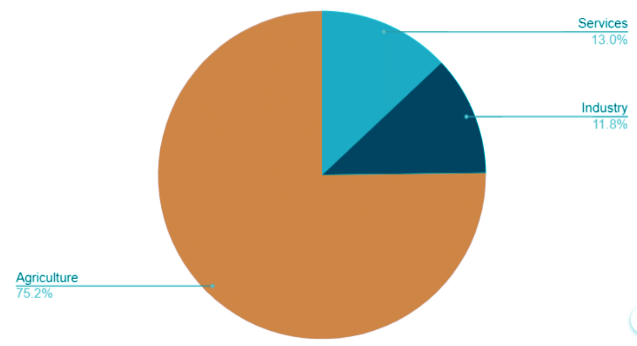
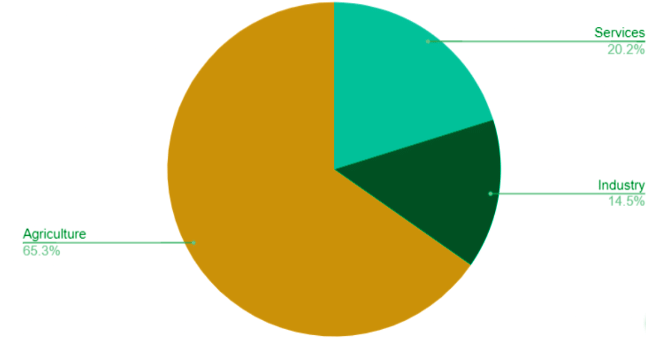
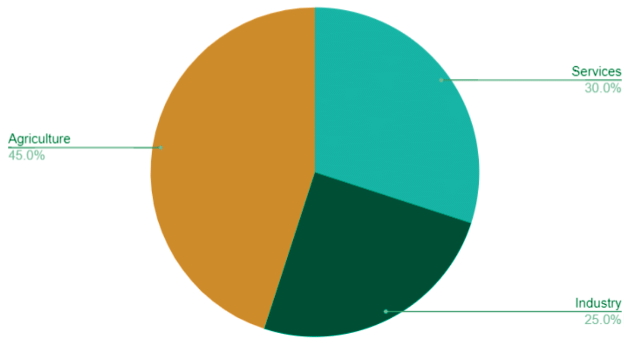
Q16: Construct a pie chart on the occasional structure of the Indian economy available in the following table: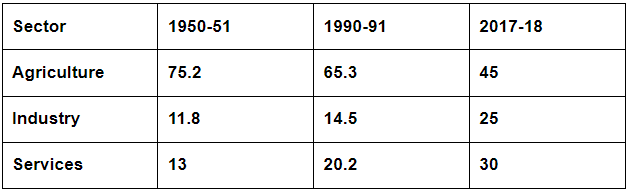
- Compute the percentage share of each sector (if not already provided).
- Convert each percentage into a central angle: Angle = (Percentage × 360) ÷ 100.
- Draw a circle and use a protractor to mark each sector angle from the centre; label each sector with the sector name and percentage.
- Use distinct colours or shading and include a clear legend.
Pie-chart for 1950-51
Pie-chart for 1990-91
Pie-chart for 2017-18
Or
Why is the term Green Revolution so famous?
Ans: Food is the essential requirement for all living beings. The Green Revolution refers to the period when modern agricultural techniques were widely adopted to raise foodgrain yields, especially for wheat and rice. Key features included the use of high-yielding varieties (HYVs) of seeds, expanded and improved irrigation, increased use of chemical fertilisers and pesticides, and mechanisation (tractors, harvesters). Norman Borlaug is credited with pioneering the HYV wheat varieties that sparked the revolution.
The Green Revolution is famous because it transformed India from a food-deficit country in the 1950s and early 1960s into a largely self-sufficient foodgrain producer by the 1970s. Some facts and outcomes:
- Initial demonstration area was small, but coverage grew substantially across successive plans.
- Main components included improved seeds, irrigation, fertilisers, farm mechanisation, rural roads, and marketing support.
- It raised overall agricultural production and helped stabilise food supplies, though regional spread was uneven.
Limitations remained: uneven regional benefits, rising input costs, environmental stress in some areas and low gains for small and marginal farmers. Nevertheless, the Green Revolution had a lasting impact on India's food security and rural transformation.
Q18: Though the public sector is very essential for industries, many public sector undertakings incur huge losses and are a drain on the economy's resources. Discuss the usefulness of public sector undertakings in this light of the fact.
Or
Explain the rationale of public sector enterprises.
Ans: A public sector enterprise (PSE) is one where the Union, a State Government or a Territorial Government holds a majority (51% or more) of the equity. The rationale for PSEs includes:
- Strategic Control: Government ownership in vital sectors (for example, railways, atomic energy, defence) preserves national security and prevents essential services from being dominated by private monopolies.
- Market Failure and Public Goods: PSEs can provide services where private firms may not find it profitable (railways, postal services, water supply), ensuring wider access and social welfare.
- Balancing Regional Development: PSEs are used to promote industrialisation in backward regions and create employment.
- Revenue and Redistribution: Profitable PSEs generate government revenue that can be used for welfare programmes and redistribution.
However, some PSEs make sustained losses because of poor management, political interference, overstaffing, lack of commercial orientation, or protection from competition. Despite losses, public enterprises remain useful when they serve broader social objectives, deliver essential services, or operate in strategic sectors.
Role of Public Sector Enterprises in India
- Promote rapid economic growth by investing in capital-intensive industries.
- Support balanced regional development through location of projects in backward areas.
- Promote agricultural development by providing inputs, credit and marketing facilities.
- Generate employment and provide stable jobs.
- Encourage import substitution and build domestic industrial capability.
Governance of Public Sector Undertakings:
The government department responsible for public enterprises issues policy guidelines and monitors PSE performance. Its duties include setting broad public policy, issuing directives to enterprises, framing guidelines on performance evaluation, financial and personnel management, and overseeing Memoranda of Understanding between PSEs and administrative ministries. It also reviews proposals on restructuring, revival, joint ventures and delegation of powers to boards of directors. Organisations and forums such as SCOPE (Standing Conference of Public Enterprises) and guidelines from the Department of Public Enterprises (DPE) assist in monitoring and improving PSE performance.