Important Questions: Geomorphic Processes

Very Short Answer Type Questions
Q1: What are endogenetic forces?
Ans: The internal forces operating from within the earth are known as endogenetic forces.
Q2: What is the function of endogenetic forces?
Ans: These forces continuously elevate or build up parts of the earth's surface.
Q3: How is energy generated within the earth?
Ans: Energy within the earth is generated by radioactivity, rotational and tidal friction, and primordial heat from the origin of the earth.
Q4: What is orogeny?
Ans: Orogeny is a mountain building process.
Q5: Name the denudation processes.
Ans: Weathering, mass wasting/movements, erosion and transportation are the denudation processes.
Q7: What are the important agents of weathering?
Ans: Temperature changes, water, air (oxygen and carbon dioxide), and biological activity are important factors responsible for weathering.
Q8: What do you mean by exfoliation?
Ans: Exfoliation is the flaking or peeling off of curved sheets from rocks due to expansion and contraction caused by temperature changes.
Short Answer Type Questions
Q9: Distinguish between exogenetic and endogenetic forces.
Ans:
- Exogenetic forces:The earth's surface is continuously subjected to external forces induced mainly by the energy of the sun. These forces are known as exogenic forces and they mainly wear down the earth's surface.
Endogenetic forces:
The forces originating from within the earth's interior are known as endogenic forces. They are mainly responsible for building and uplifting the earth's surface.
Q10: What do you understand by oxidation?
Ans: Oxidation is the process in which oxygen combines with minerals of rocks, especially iron, to form oxides. This chemical reaction causes the decomposition and weakening of rocks.
Q11: How does mass wasting take place?
Ans: The force of gravity acts constantly upon the soil and bedrock. At various places, the internal strength of these materials is sufficient to keep them in place. But when the ground surface is sloping, the force of gravity is directed down the slope parallel with the surface. Every particle has least same tendency to roll or slide downhill and will do so whenever the downslope force exceeds the resisting forces of friction and cohesion that tend to bind the particles to the rest of the mass.
Q12: What is the pH value of soils?
Ans: The pH value is a measure of the acidity or alkalinity of soil. The pH scale ranges from 0 to 14, where 7 is neutral, values below 7 indicate acidity and values above 7 indicate alkalinity.
Q13: How many essential elements are required by plants?
Ans: Plants require 17 essential elements for their growth and development, including carbon, hydrogen, oxygen, nitrogen, phosphorus, potassium, calcium, magnesium, sulphur, iron, manganese, copper, zinc, boron, molybdenum, chlorine and nickel.
Long Answer Type Questions
Q14: Describe the geomorphic processes and how the gravity force affects the materials.
Ans: The endogenetic and exogenetic forces causing physical stresses and chemical action on earth materials and bringing about changes in the configuration of the surface of the earth are known as geomorphic processes. The common geomorphic processes are diastrophism, volcanism, weathering, mass wasting, erosion and deposition.
Any exogenetic element of nature (like ice, wind, water, etc.) capable of acquiring and transporting earth materials can be called a geomorphic agent. When these elements become mobile due to gradients, they remove the materials and transport them over slopes. An agent is a mobile medium which removes, transports and deposits ' earth materials. Running water, groundwater, glaciers, wind, waves and currents, etc. can be called geomorphic agents.
Gravity is a directional force activating all downslope movements of matter and also causes stresses on the earth materials. Gravitational stresses activate wave and tide induced currents and winds. Without p gravity and gradients, there would be no mobility and hence no erosion, transportation and deposition are possible. So, the gravitational stresses are as important as the other geomorphic processes. Gravity force keeps us in contact with the surface and switches on the movement of all surface earth materials.
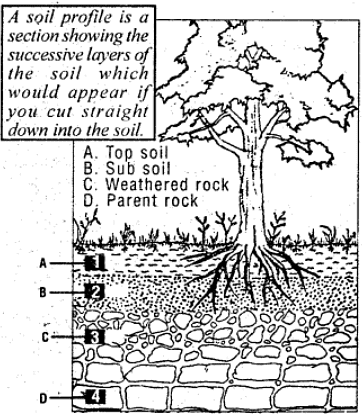
Q15: Define and describe soil horizons.
Ans: Soil horizons are distinct layers of soil that are approximately parallel to the soil surface. Each horizon differs in colour, composition and texture due to variations in soil-forming processes.
Soil horizons are commonly identified from the surface downwards:
A Horizon (Topsoil): This is the uppermost layer containing humus and organic matter. Materials are often washed down from this layer through leaching, so it is called the eluvial horizon.
B Horizon (Subsoil): This layer lies beneath the A horizon and is a zone of deposition or accumulation of materials such as clay and minerals washed down from the A horizon. It is called the illuvial horizon.
C Horizon: This layer consists of weathered parent material from which the soil develops.
Q16: What is the rock weathering? Discuss various ways in which it takes place.
Ans: Rock weathering refers to the mechanical disintegration and chemical decomposition of rocks through the action of elements of weather and climate. Weathering occurs mainly through three types of processes:
Physical or Mechanical Weathering: This occurs due to temperature changes, pressure release and expansion and contraction of rocks, which cause rocks to crack and break into smaller fragments.
Chemical Weathering: Chemical reactions such as solution, carbonation, hydration and oxidation act on rocks and minerals, causing them to decompose and dissolve.
Biological Weathering: Living organisms such as plants, animals and microorganisms contribute to weathering. Plant roots can break rocks and organic acids produced by organisms help in decomposing minerals.
These processes often act together and gradually break rocks into smaller particles.
Q17: Discuss the factors responsible for soil formation and also the processes involved.
Ans: Soil forming factors: There are five factors that influence soil formation, viz., parent material, climate, biota, topography and time.
- Parent material: Parent material in soil science is weathered bedrock or the transported glacial or alluvial material. Soils from weakly cemented sandstone will be sandy and soils from shales will be shallow and fine-textured. Similarly, clay formation is favoured more by a high percentage of decomposable dark mineral and less by quartz.
- Climate: Climate is an important active factor in soil formation. Several processes are involved in soil formation and may to some extent affect the soil profile.
- Biota: Biota is the collective term for the animal and plant life of a specific area as per the period of time. The decomposition of organic wastes and residues and the activities of living plants and animals have marked influence on soil development. Burrowing animals such as moles, prairie dogs, earthworms, ants and termites help soil development slowly by decomposing organic matter and forming weak acids that dissolve minerals faster. The roots of living plants and decomposed plant material release weak organic acids that help in weathering and soil development.
- Topography: Topography means relief features. Steep hillsides have thin soil cover because of surface runoff that results in the erosion of the surface. On the other hand, gentle hillside preserves appreciable soil cover due to the luxuriant vegetation and sufficient water passing in vertically to deeper levels. The landlocked depressions receive a high amount of runoff water that favours appreciable vegetation cover but slower decomposition because of oxidation deficiency. This results in the formation of soil that is rich in organic water. Thus, topography influences soil formation through its relationship with water and temperature.
- Time: Soil formation is a very slow process. It may take a few hundred to a few thousand years. This period of time, however, varies from place to place, depending upon other factors discussed above (plant material, -biota, topography, climate). Under ideal conditions, a recognisable soil profile may develop in 200 years and under less favourable circumstances, it may extend to several thousand years.
Soil, forming processes: Several processes are involved in soil formation. These are:
- Eluviation: It is the mechanical translocation of clay or other fine particles down the profile.
- Illuviation: ft is the accumulation of the washed down material in the lower horizons of the soil profile.
- Leaching: It is the removal and downward movement of material from a horizon in solution.
- Cheluviation: It is a downward movement of the material, similar to leaching, but under the influence of complex organic compounds.
Q18: How are the exogenetic earth processes driven?
Ans: Exogenetic Earth processes, also known as external geological processes, refer to the processes that occur at or near the Earth's surface, leading to the modification and shaping of the landforms. These processes are primarily driven by energy from the Sun and the Earth's internal heat. Here's how they work:
Solar Energy:
- Solar Radiation: Energy from the Sun drives weather patterns, creating wind and influencing temperature gradients on Earth. Solar radiation is the primary source of energy for the Earth's climate system. It causes the evaporation of water from oceans, lakes, and rivers, leading to the formation of clouds and precipitation, which are essential components of exogenetic processes like erosion and weathering.
- Photosynthesis: Solar energy fuels plant growth through photosynthesis. Plants play a crucial role in exogenetic processes as their roots help prevent soil erosion, and they contribute to the weathering of rocks through processes like root expansion and the release of organic acids.
Earth's Internal Heat:
- Geothermal Heat: Heat from the Earth's interior drives processes such as volcanism and the movement of tectonic plates. Volcanic activity contributes to the formation of new landforms, including mountains, islands, and lava plateaus. Tectonic movements lead to the creation of earthquakes, which, in turn, can cause landslides and other surface modifications.
Gravity:
- Gravitational Force: Gravity plays a fundamental role in various exogenetic processes such as mass wasting, erosion, and sediment transportation. Gravity causes rocks and sediments to move downhill, shaping landscapes through processes like landslides, rockfalls, and river erosion.
Hydrological Cycle:
- Precipitation and Runoff: Water, driven by gravity, flows downhill, carving out river valleys, canyons, and other landforms. The constant movement of water over the Earth's surface through rivers, streams, and glaciers leads to erosion, shaping the landscape over time.
Biological Activity:
- Plant Growth and Decay: Plants contribute to soil stability, prevent erosion, and enhance weathering. When plants die and decay, organic material enriches the soil, promoting vegetation growth and stabilizing the surface.
- Biological Weathering: Organisms such as lichens, mosses, and tree roots secrete acids that can weather rocks. Burrowing animals can also churn the soil, facilitating weathering processes.
Q19: Discuss the role of topography in soil formation.
Ans: The topography influences the soil formation through its relationship with relief, water and temperature. Steep hillsides have thin soil cover because of surface runoff that results in the erosion of the surface. On the other hand, gentle hillside preserves appreciable soil overdue to the luxuriant vegetation and sufficient water passing in vertically to deeper levels. The land-locked depressions receive a high amount of runoff water that favours appreciable vegetation cover but slower decomposition because of oxidation deficiency. This results in the formation of soil that is rich in organic matter.
Q20: How does biota help in soil development?
Ans: Biota is the collective term for the animal and plant life of a specific area as per the period of time. The decomposition of organic wastes and residues and the activities of living plants and animals have marked influence on soil development. Burrowing animals such as moles, prairie dogs, earthworms, ants and termites help soil development slowly by decomposing organic matter and forming weak acids that dissolve minerals faster. The roots of living plants and decomposed plant material release weak organic acids that help in weathering and soil development.
FAQs on Important Questions: Geomorphic Processes
| 1. What are geomorphic processes? |  |
| 2. How does weathering contribute to landform development? | |
| 3. What role does erosion play in shaping landscapes? | |
| 4. Can you explain the process of sediment deposition? | |
| 5. What are the main agents of geomorphic processes? | |