Important Derivations: Moving Charges and Magnetism

Biot-Savart Law
Biot-Savart law gives the magnetic field produced at a point in space by a steady current. It was established from careful experiments by Jean-Baptiste Biot and Félix Savart and provides the relation between a current element and the magnetic field it produces at a point.
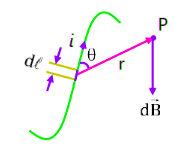
Experimentally the following dependences were observed for the magnetic field produced by a small current element:
- The magnetic field is directly proportional to the current I in the element.
- The magnetic field is directly proportional to the length of the current element dℓ.
- The magnetic field depends on the angle θ between the current element and the line joining the element to the point; it is proportional to sinθ.
- The magnetic field varies inversely as the square of the distance r between the element and the point.
- The direction of the infinitesimal magnetic field dB is perpendicular to the plane containing the current element and the position vector from the element to the point; its sense is given by the right-hand rule.
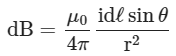
These observations lead to the differential (scalar) form of the law:
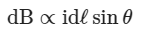
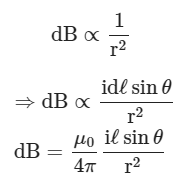
Here μ0 is the permeability of free space.
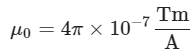
Unit of magnetic field B: tesla (T) or weber per square metre (Wb m-2).
Writing the scalar dependence of the magnitude of the contribution from a small current element gives
The vector form (differential form) of the Biot-Savart law is
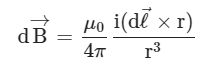
In words: the infinitesimal magnetic field dB at a point due to a current element I dℓ is
- proportional to I and to the magnitude of the element dℓ,
- inversely proportional to the square of the distance r from the element to the point,
- directed along dℓ × r̂ (where r̂ is the unit vector from the element to the point), and
- has magnitude given by μ0/(4π) × I dℓ sinθ / r^2.
To obtain the total magnetic field B produced by an arbitrary steady current distribution, integrate the differential form over the entire current path:
B = (μ0 / 4π) ∫ (I dℓ × r̂) / r^2
For commonly used configurations the Biot-Savart law leads to familiar results after evaluation of the line integral, for example the field due to an infinitely long straight wire and the field on the axis of a circular coil.
(2) The parallel coaxial circular coils of equal radius R and equal number of turns N carry equal currents I in the same direction and are separated by a distance 2R. Find the magnitude and direction of the net magnetic field produced at the mid-point of the line joining their centres.
We use superposition: magnetic fields produced by each coil add vectorially at the midpoint. Each coil is a circular coil of radius R and number of turns N carrying current I. The centres of the two coils are separated by 2R, therefore the midpoint is at a distance R from the centre of each coil.
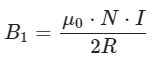
Solve the problem by using the expression for the magnetic field on the axis of a circular coil of N turns and radius R, at a distance x from its centre:
B(x) = (μ0 N I R2) / (2 (R2 + x2)3/2)
Evaluate this expression at x = R, which is the distance from each coil to the midpoint.
Solution
The magnetic field at the midpoint due to one coil, B1, is
B1 = (μ0 N I R2) / (2 (R2 + R2)3/2)
Simplify the denominator:
R2 + R2 = 2 R2
(2 R2)3/2 = 23/2 R3
Therefore
B1 = (μ0 N I R2) / (2 × 23/2 R3)
Cancel R2 with R3:
B1 = (μ0 N I) / (2 × 23/2 R)
Simplify the powers of 2:
2 × 23/2 = 25/2
Thus
B1 = (μ0 N I) / (25/2 R)
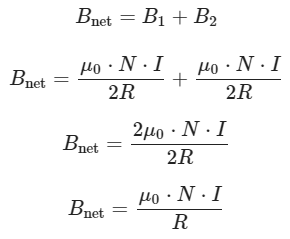
Both coils are identical and carry current in the same direction, so their fields at the midpoint have the same magnitude and the same direction along the common axis. The net field is the sum of the two contributions:
Bnet = 2 B1
Substitute B1:
Bnet = 2 × (μ0 N I) / (25/2 R)
Simplify the numerical factor:
2 / 25/2 = 1 / 23/2
Therefore
Bnet = (μ0 N I) / (23/2 R)

Recognising 23/2 = 2√2, the result can also be written as
Bnet = (μ0 N I) / (2 √2 R)

Direction: The direction of B at the midpoint is along the common axis of the coils. Use the right-hand rule: curl the fingers in the direction of the current in each coil; the thumb gives the direction of the magnetic field on the axis. Since currents are in the same direction, the fields produced by the two coils at the midpoint reinforce each other and point along the same sense of the axis (from the coil side indicated by the right-hand rule towards the other).
Remarks and applications
- The Biot-Savart law is valid for steady (time-independent) currents and is the basis for computing magnetic fields from known current geometries.
- The formula for the axial field of a circular coil is used in designing electromagnets, Helmholtz coils and for calculating field uniformity near the midplane of coil pairs.
- The specific separation 2R used in this problem is close to the arrangement used for Helmholtz coils (which use separation R for improved uniformity); the given separation 2R gives a different magnitude and a different uniformity profile.
Summary
The Biot-Savart law relates a current element to the magnetic field it produces: dB = (μ0 / 4π) (I dℓ × r̂) / r2. For a circular coil the axial field at distance x is B(x) = (μ0 N I R2)/(2 (R2 + x2)3/2). For the two identical coaxial coils separated by 2R and carrying equal currents in the same direction, the field at the midpoint is Bnet = (μ0 N I)/(23/2 R) directed along the common axis as given by the right-hand rule.
FAQs on Important Derivations: Moving Charges and Magnetism
| 1. What is the formula to calculate the magnetic field due to a long straight wire? |  |
| 2. How can the direction of the magnetic field due to a current-carrying wire be determined? | |
| 3. What is Ampere's circuital law? | |
| 4. Explain the working principle of a cyclotron. | |
| 5. What is the force experienced by a current-carrying conductor placed in a magnetic field? | |