Q1. Write whether the following statements are True or False? Justify your answers. [2026] (i) ax + by + c, where a, b and c are real numbers, is a linear equation in two variables.
(ii) A linear equation 2x + 3y = 5 has a unique solution.
(iii) All the points (2, 0), (-3, 0), (4, 2) and (0, 5) lie on the x-axis.
(iv) The line parallel to y-axis at a distance 4 units to the left of y-axis is given by the equation x = -4.
(v) The graph of the equation y = mx + c passes through the origin.
Solution:
(i) False. [As written, ax + by + c is an expression, not an equation. The linear equation in two variables is usually written as ax + by + c = 0 with a and b not both zero.]
(ii) False. [A single linear equation in two variables (like 2x + 3y = 5) represents a line in the plane, so it has infinitely many solutions (every point on that line is a solution). It would have a unique solution only if a second independent equation is given.]
(iii) False. [Points on the x-axis must have y = 0. Only (2, 0) and (-3, 0) lie on the x-axis; (4, 2) and (0, 5) do not.]
(iv) True. [The vertical line 4 units to the left of the y-axis has equation x = -4 (all points with x = -4).]
(v) False. [The graph of y = mx + c passes through the origin only when c = 0. For general c it does not pass through (0,0).]
Q2. Write whether the following statement is True or False? Justify your answer. [2025] The coordinates of points given in the table:
Represent some of the solutions of the equation 2x + 2 = y.
Solution:
True. [Since, on looking at the given coordinates, we observe that each y-coordinate is two units more than double the x-coordinate.]
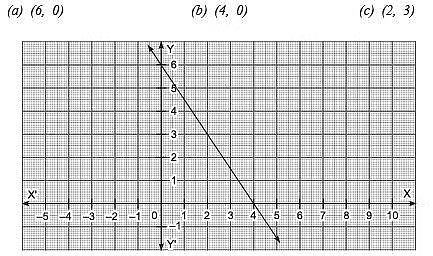
Q3. Look at the following graphical representation of an equation. Which of the following is not its solution? [2023]
Solution:
The point (6, 0) does not lie on the graph. ∴ The point (6, 0) is not the solution of the equation.
Short Answer Type Questions
Q1. Is a solution of 2x + 3y = 12? [2026]
Solution:
The given equation is 2x + 3y = 12 ...(1)
Here Solution =
⇒ x = 2 and y = (8/3) Substituting x = 2 and y =(8/3) in (1), we get
⇒ 4 + 8 = 12⇒ 12 = 12∵ L.H.S. = R.H.S
∴ is a solution of 2x + 3y = 12.
Q2. Write two solutions of 3x + y = 8. [2024]
Solution:
We have 3x + y = 8 For x = 0, we have 3(0) + y = 8 ⇒ 0 x y= 8 ⇒ y = 8
.e. (0, 8) is a solution.For x = 1, we have 3(1) + y = 8⇒ 3 + y = 8⇒ y = 8 - 3 = 5
i.e. (1, 5) is another solution.
Q3. If x = -1 and y = 2 is a solution of kx + 3y = 7, find the value k. [2023]
Solution:
We have kx + 3y = 7 ...(1) ∴ Putting x = -1 and y = 2 in (1), we get k(-1) + 3(2) = 7 ⇒ -k + 6 = 7 ⇒ -k = 7 - 6 = 1 ⇒ k= -1 Thus, the required value of k = -1.
Q4. Show that x = 2 and y = 1 satisfy the linear equation 2x + 3y = 7. [2021]
Solution:
We have 2x + 3y = 7 ...(1) Since, x = 2 and y = 1 satisfy the equation (1). ∴ Substituting x = 2 and y = 1 in (1), we get L.H.S. = 2(2) + 3(1) = 4 + 3 = 7 = R.H.S. Since, L.H.S. = R.H.S. ∴ x = 2 and y = 1 satisfy the given equation.
Long Answer Type Questions
Q1. The taxi fare in a town is ₹10 for the first kilometre and ₹ 6 per km for the subsequent distance. Taking the distance as 'x' km and total fare as ₹y, write a linear equation for this information, what will be the total fare for 15 km? [2025]
Solution:
∵ Total distance is x km. Total fare = ₹y ∴ x = 1 + (x - 1) = First km + Subsequent distance Since, fare the first km = ₹10 ∴ Fare for the remaining distance = ₹6 x (x - 1) = ₹6x - ₹6 ⇒ Total fare = ₹10 + ₹6x - ₹6 = ₹4 + ₹6x ∴ y = 4 + 6x
⇒ y - 6x = 4 ⇒ 6x - y + 4 = 0 Which is the required equation.
Now, total fare for 15 km: 6 x 15 - y + 4 = 0 [Substituting x = 15] ⇒ 90 - y + 4 = 0 ⇒ 94 - y = 0 ⇒ y = 94 ∴ Total fare = ₹94.
Q2. Draw the graph x + 2y = 6 and from the graph, find the value of x when y = - 3. [2024]
Solution:
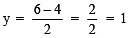
We have: x + 2y = 6 ⇒ When x = 0, then When x = 2, then When x = 4, then
We get the following table of values of x and y.
x
0
2
4
y
3
2
1
(x, y)
(0, 3)
(2, 2)
(4, 1)
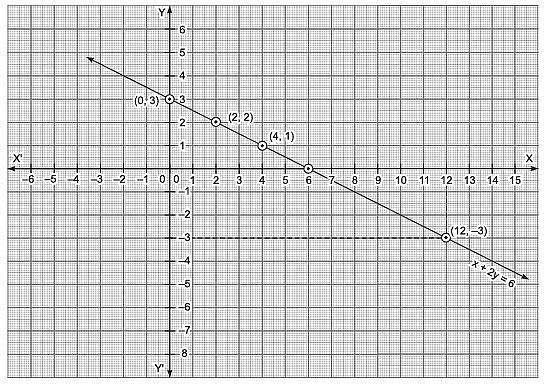
Plotting the ordered pairs (0, 3), (2, 2) and (4, 1) and then joining them, we get the graph of x + 2y = 6 as shown below:
From the graph, we find that for y = - 3, the value of x = 12.
FAQs on Previous Year Questions : Linear Equations in Two Variables
1. What are the different methods to solve linear equations in two variables for CBSE Class 9?
Ans. Three primary methods exist: substitution method (solving for one variable and substituting into the other equation), elimination method (adding or subtracting equations to remove a variable), and graphical method (plotting both equations and finding their intersection point). Each method works for any system of linear equations in two variables, though some are more efficient depending on the equation structure. Students should practise all three approaches to identify which suits specific problems best.
2. How do I know if a system of linear equations has no solution or infinite solutions?
Ans. A system has no solution when lines are parallel (same slope, different intercepts)-the equations are inconsistent. Infinite solutions occur when both equations represent the same line (identical slope and intercept)-they're dependent. A unique solution exists when lines intersect at exactly one point. Checking coefficients and constants helps determine consistency before solving. Visual representation through graphs clarifies these relationships instantly.
3. Why do some previous year questions on linear equations ask about real-world situations instead of just solving equations?
Ans. Examiners test whether students can translate word problems into algebraic equations-a crucial application skill. Questions involving distance, age, cost, and mixture problems assess comprehension and problem-solving ability beyond mechanical calculation. CBSE emphasises contextual understanding alongside computational skills. Students scoring well recognise that converting scenarios into equations in two variables is equally important as finding solutions themselves.
4. What's the difference between a linear equation in two variables and just any equation with two unknowns?
Ans. Linear equations in two variables contain variables with power one only (e.g., 2x + 3y = 5), producing straight-line graphs. Non-linear equations include squared or higher powers (e.g., x² + y = 5), creating curves. The term "linear" specifically indicates first-degree polynomial relationships. This distinction matters because different solving techniques apply; linear systems use substitution, elimination, or graphical methods exclusively.
5. How should I prepare specifically for previous year questions on linear equations in two variables?
Ans. Review actual CBSE exam papers to identify recurring question patterns and difficulty levels. Focus on substitution and elimination method fluency, graphical interpretation skills, and word problem translation. Practise identifying inconsistent and dependent systems quickly. Use EduRev's mind maps, flashcards, and MCQ tests to reinforce concepts and strengthen problem-solving speed. Solving multiple previous year papers builds exam confidence and pattern recognition.
video lectures, Exam, practice quizzes, Previous Year Questions with Solutions, Semester Notes, Sample Paper, past year papers, Previous Year Questions : Linear Equations in Two Variables, study material, Previous Year Questions : Linear Equations in Two Variables, shortcuts and tricks, Extra Questions, Objective type Questions, Free, Summary, Previous Year Questions : Linear Equations in Two Variables, mock tests for examination, Viva Questions, pdf , MCQs, ppt, Important questions;


 a solution of 2x + 3y = 12? [2026]
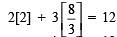 ⇒ 4 + 8 = 12⇒ 12 = 12∵ L.H.S. = R.H.S
 is a solution of 2x + 3y = 12.
 .e. (0, 8) is a solution.For x = 1, we have 3(1) + y = 8⇒ 3 + y = 8⇒ y = 8 - 3 = 5
 i.e. (1, 5) is another solution.
 When x = 0, then
  When x = 2, then
 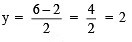 When x = 4, then