Important Formulas: Permutation and Combination


Permutation
A permutation is an arrangement of a set of objects in a specific order. When order matters, different arrangements of the same objects are considered different permutations. The number of permutations of n distinct objects taken r at a time is denoted by nPr. Permutations appear across mathematics and computer science, for example in counting arrangements, ordering tasks and analysing sorting algorithms.
Combination
A combination is a selection of objects where order does not matter. When only the choice of members matters and not their order, we count combinations. The number of combinations of n distinct objects taken r at a time is denoted by nCr. Combinations are used when forming committees, groups, subsets and in probability problems.
Permutation and Combination Formulas
The number of all permutations of n things taken r at a time is given by:
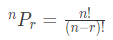
In standard notation this is
nPr = n! ÷ (n - r)!
where n! denotes factorial of n.
The number of all combinations of n things taken r at a time is given by:
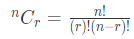
In standard notation this is
nCr = nPr ÷ r! = n! ÷ (r!(n - r)!)
Use combinations when the order of selection does not matter.
Important Points
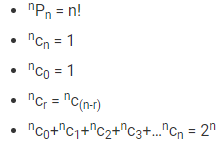
- Factorial of a negative integer is not defined.
- If one task can be done in m ways and another independent task in n ways, then either one of the two tasks can be done in m + n ways and both tasks together can be done in m × n ways.
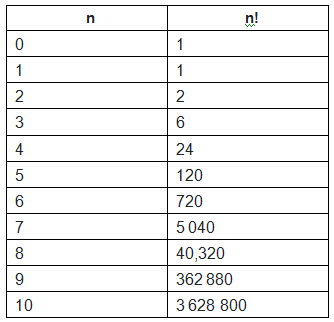
- 0! = 1.
- 1! = 1.
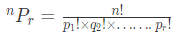
- When some objects are identical, the number of distinct permutations decreases. If from n objects, p1 are of one kind, p2 are of another kind, ..., pr are of the rth kind, then the number of distinct linear arrangements is given by a correction to n! that divides by identical-block factorials.
Factorial
For a non-negative integer n, the factorial n! is defined by the product of all positive integers from n down to 1.
n! = n × (n - 1) × (n - 2) × ... × 2 × 1
Example:
5! = 5 × 4 × 3 × 2 × 1
Standard Truths
- 0! = 1.
- The factorial n! is defined for n ≥ 0 and is not defined for negative integers.
Permutations
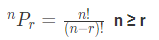
nPr denotes the number of ways to select and arrange r objects from n distinct objects. The general formula is
nPr = n! ÷ (n - r)!
Common permutation cases and formulas:
- Permutations when repetition is allowed: For arranging r positions where each position can be filled independently from n distinct types, the number of arrangements is n^r.
- Permutations with identical objects: If objects include identical items, divide total permutations by the factorials of repetitions. Example: arrangements of letters in the word BANANA.
- Circular permutations (arrangements around a circle): For arranging n distinct objects in a circle where rotations are considered identical, the number is (n - 1)!.
Combinations
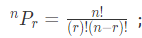
nCr denotes the number of ways to select r objects from n distinct objects when order does not matter. The formula is
nCr = n! ÷ (r!(n - r)!)
- Symmetry: nCr = nC(n - r).
- Relation with permutations: nCr = nPr ÷ r!.
- Pascal's identity: nCr = (n - 1)C(r - 1) + (n - 1)Cr.
- Combinations with repetition (multiset combinations): The number of ways to choose r items from n types with repetition allowed is (n + r - 1)C r.
Worked Examples
Example 1. How many ways can a committee of 3 be chosen from 7 people?
Sol.
Select 3 from 7; order does not matter.
7C3 = 7! ÷ (3!4!)
Compute or simplify to obtain the numeric value.
Ans. 35
Example 2. How many distinct arrangements are there of the letters in the word BANANA?
Sol.
Total letters = 6.
If letters were all distinct, permutations = 6!.
Letters repeated: A appears 3 times and N appears 2 times.
Distinct arrangements = 6! ÷ (3! × 2!)
Ans. 60
Example 3. In how many ways can 4 students be seated in a row of 10 chairs?
Sol.
Choose 4 chairs from 10 and arrange 4 students in those chairs.
Number of ways = 10P4 = 10! ÷ 6!
Ans. 5040
Applications and Tips
- Decide first whether order matters. If it does, use permutations; if not, use combinations.
- For repeated items divide by factorials of repetition counts.
- For problems with multiple independent choices, use sum rule for exclusive choices and product rule for sequential independent choices.
- Use complement counting when direct counting is hard: count the total and subtract the unwanted cases.
- Familiarise yourself with factorial growth and cancellation to simplify factorial expressions quickly.
Summary: Use nPr = n! ÷ (n - r)! when order matters and nCr = n! ÷ (r!(n - r)!) when order does not matter. Remember special cases such as repetition, identical objects and circular arrangements, and apply product/sum rules where appropriate.
FAQs on Important Formulas: Permutation and Combination
| 1. What is the definition of a permutation? |  |
| 2. How is the factorial of a number defined, and how does it relate to permutations? | |
| 3. What is the formula for calculating combinations, and how does it differ from permutations? | |
| 4. Can you provide an example of a real-world application of permutations and combinations? | |
| 5. What are some important tips for solving problems involving permutations and combinations? | |