Worksheet Solutions: Nomadic Empires


Fill in the Blanks
Q1:The term "barbarian" is derived from the Greek word "__________," which meant a non-Greek.
Ans: barbaros
The word barbaros in Greek described people who did not speak Greek; Greeks thought non-Greek speech sounded like meaningless "bar-bar" noise, so they used this term for foreigners.
Q2: The Great Wall of China was built to defend against nomadic invasions, particularly from the __________.
Ans: Huns
The Great Wall of China was constructed mainly to protect farming communities and frontier states from raids by northern nomadic groups, among whom the Huns were a prominent threat.
Q3: Genghis Khan was born near the __________ river in the north of present-day Mongolia.
Ans: Onon
Genghis Khan was born in the region around the Onon River in north-eastern Mongolia; this area formed part of the steppe homeland of the Mongols.
Q4: Genghis Khan proclaimed himself as the "Universal Ruler" or "Great Khan" in the year __________.
Ans: 1206
In 1206, after uniting many Mongol tribes at a council (quriltai), Temüjin took the title Genghis Khan and was recognised as the supreme ruler of the Mongols.
Q5: The Mongol courier system known as "__________" connected distant areas of the empire.
Ans: yam
The yam was a system of relay stations, mounted couriers and waystations that enabled fast communication and official travel across the vast Mongol domains.
Q6: "Yasa" served as a __________ code of Genghis Khan.
Ans: legal
Yasa functioned as a legal and administrative code introduced by Genghis Khan; it combined customary practices and new rules to govern the Mongol state.
Q7: The administrative regulations, including the organization of the hunt and the army, were part of the "yasa" and helped integrate the __________ regions.
Ans: conquered
Provisions in the yasa - such as rules for the army, the hunt and administration - were applied in both the Mongol heartland and the conquered territories to integrate diverse peoples.
Q8: The tax levied on nomads for the maintenance of the Mongol communication system was known as the __________ tax.
Ans: qubcur
The qubcur (sometimes spelled qubchir) was a levy imposed to help maintain the yam network and other communication and transport facilities used by the empire.
Match the Column
Q1:
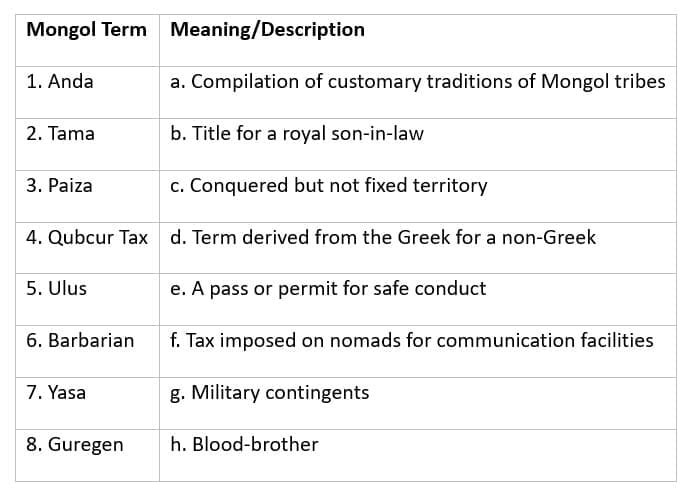
Ans: 1. Anda - h. Blood-brother
Anda was a ritual bond of sworn friendship between two men, like becoming blood-brothers; it cemented personal loyalty and alliance within Mongol society.
2. Tama - g. Military contingents
Tama referred to organised military contingents or units into which soldiers were grouped for campaign and command purposes.
3. Paiza - e. A pass or permit for safe conduct
A paiza was a tablet or badge that granted its holder official privileges, such as safe passage and access to supplies and mounts when travelling on state business.
4. Qubcur Tax - f. Tax imposed on nomads for communication facilities
The qubcur tax was collected to support the upkeep of the empire's communication and relay system, including waystations of the yam.
5. Ulus - c. Conquered but not fixed territory
An ulus referred to the people, following and territory subject to a particular Mongol leader; it could include mobile or newly conquered lands rather than a single fixed prefecture.
6. Barbarian - d. Term derived from the Greek for a non-Greek
Barbarian is derived from Greek barbaros, used to denote those outside Greek linguistic and cultural circles.
7. Yasa - a. Compilation of customary traditions of Mongol tribes
Yasa incorporated customary practices of the Mongol tribes which Genghis Khan formalised into a legal and administrative code.
8. Guregen - b. Title for a royal son-in-law
Guregen was the title given to a man who had married into the ruling family, typically the son-in-law of a khan, and who therefore had a special status.
Assertion and Reason Based
Q1: Assertion: The term "barbarian" is derived from the Greek word "barbaros."
Reason: "Barbaros" referred to someone whose language sounded like a random noise.
(a) Both Assertion and Reason are true, and Reason is the correct explanation of the Assertion.
(b) Both Assertion and Reason are true, but Reason is not the correct explanation of the Assertion.
(c) Assertion is true, but Reason is false.
(d) Assertion is false, but Reason is true.
Ans: (a)
Explanation:
(i) Assertion: The term barbarian is derived from the Greek word barbaros. This is true - the English word is directly taken from Greek usage.
(ii) Reason: "Barbaros" described speech that sounded unintelligible or like repeated syllables (for example "bar-bar") to Greek ears. This is true.
Justification: The Reason correctly explains the Assertion because the Greek perception of non-Greek speech as meaningless noise is precisely why the label barbaros (and hence "barbarian") was used for outsiders.
Q2: Assertion: The Mongol courier system was known as the yam.
Reason: The yam system was mainly used for collecting taxes from nomads.
(a) Both Assertion and Reason are true, and Reason is the correct explanation of the Assertion.
(b) Both Assertion and Reason are true, but Reason is not the correct explanation of the Assertion.
(c) Assertion is true, but Reason is false.
(d) Assertion is false, but Reason is true.
Ans: (c)
Explanation:
(i) Assertion: True
The Mongol courier system was known as the yam. It was a relay network used for communication across the empire
Reason: False
The yam system was not used for collecting taxes. Its main purpose was communication and administration
Conclusion: Assertion is true but Reason is false, therefore the correct answer is c
Q3: Assertion: Genghis Khan's "yasa" served as a code of law.
Reason: It was a compilation of customary traditions of Mongol tribes.
(a) Both Assertion and Reason are true, and Reason is the correct explanation of the Assertion.
(b) Both Assertion and Reason are true, but Reason is not the correct explanation of the Assertion.
(c) Assertion is true, but Reason is false.
(d) Assertion is false, but Reason is true.
Ans: (a)
Explanation:
(i) Assertion: Yasa served as a code of law - true. It provided rules for governance, military conduct and social order under Genghis Khan.
(ii) Reason: Yasa drew upon and formalised customary traditions of the Mongol tribes - true.
(iii) Justification: The Reason explains the Assertion because the legal code was built by adapting tribal customs into a uniform set of rules applicable across the empire, thereby functioning as a law code.
Q4: Assertion: The yam was a tax imposed on nomads in the Mongol Empire.
Reason: The qubcur tax was the contribution made by nomads to maintain the communication system.
(a) Both Assertion and Reason are true, and Reason is the correct explanation of the Assertion.
(b) Both Assertion and Reason are true, but Reason is not the correct explanation of the Assertion.
(c) Assertion is true, but Reason is false.
(d) Assertion is false, but Reason is true.
Ans: (d)
Explanation:
(i) Assertion: False
The yam was not a tax; it was the communication and courier system of the Mongol Empire
(ii) Reason: True
The qubcur tax was the contribution made by nomads for maintaining the communication network
Conclusion: Assertion is false but Reason is true, therefore the correct answer is d
Very Short Answer Type Questions
Q1: What does the term "barbarian" mean, and where does it originate?
Ans: The term barbarian originally meant a non-Greek person and comes from the ancient Greek word barbaros, used for those outside Greek language and culture.
Q2: What was the primary purpose of the Great Wall of China?
Ans: The primary purpose of the Great Wall was defence - to protect agricultural states and settlements from raids by northern nomadic tribes.
Q3: When and where was Genghis Khan born?
Ans: Genghis Khan (Temüjin) was born around 1162 in the region of the Khentii Mountains in what is now Mongolia.
Q4: What title did Genghis Khan proclaim himself in 1206?
Ans: In 1206, Temüjin proclaimed himself Genghis Khan or the Great Khan, becoming leader of the unified Mongol tribes.
Q5: What was the Mongol courier system known as, and what was its purpose?
Ans: The courier system was called the yam; its purpose was to provide a network of relay stations, fresh horses and couriers so that official messages and travellers could move rapidly across the empire.
Q6: What did "yasa" serve as, and what did it compile?
Ans: Yasa served as a legal and administrative code; it compiled and formalised the customary rules and regulations of the Mongol tribes to govern the empire.
Q7: What tax did nomads pay for the maintenance of the Mongol communication system?
Ans: Nomads paid the qubcur tax, a levy used to support the maintenance of the yam and related communication facilities.
Q8: What was the significance of the term "guregen" in the Mongol context?
Ans: Guregen was a title given to a royal son-in-law - a man married into the ruling family - and signalled a special status within the Mongol polity.
Short Answer Type Questions
Q1: Explain the reasons for the success of Genghis Khan's military campaigns.
Ans: Genghis Khan's military success rested on several clear factors:
- Innovative tactics: He used feigned retreats, rapid manoeuvres and coordinated attacks to outsmart enemies.
- Discipline and organisation: Armies were strictly disciplined and organised into decimal units (10s, 100s, 1,000s, 10,000s) for command and control.
- Adaptability: Mongol forces quickly learned and adopted technologies (for example siege engines) and tactics from conquered peoples.
- Superior cavalry: Light, highly mobile horsemen with composite bows gave them speed, range and flexibility in the steppe and beyond.
Q2: What were the main features of Genghis Khan's political system, and how did it differ from Attila's?
Ans: Genghis Khan's political system featured:
- Centralised authority: Power was concentrated under the khan and implemented via appointed officials.
- Legal code (yasa): A system of laws and regulations that applied across the empire.
- Meritocracy and organisation: Leadership and positions were often awarded for ability and loyalty rather than only birth.
In contrast, Attila's Hunnic rule was:
- More tribal and decentralised: Authority rested on personal loyalty to a leader and tribal alliances.
- Less institutionalised: Attila's system lacked a lasting administrative code and largely collapsed soon after his death.
Q3: How did the relationship between nomadic and settled societies affect trade and communication in the Mongol empire?
Ans: The Mongols created strong links between nomadic and settled societies that had several effects:
- Trade expansion: Settled regions provided agricultural goods, artisans' products and manufactured items; nomads supplied horses, furs and pastoral products, increasing exchange.
- Improved communication: Institutions like the yam improved message transmission and travel across regions, aiding administration and commerce.
- Cultural exchange: Contacts led to the transfer of ideas, technologies and religions across Eurasia.
- Security and instability: While the Pax Mongolica made trade safer in many regions, military campaigns and taxation sometimes disrupted local economies.
Overall, Mongol rule both stimulated long-distance trade and spread cultural contacts, while also producing tensions between nomadic demands and settled societies.
Q4: Discuss the administrative features of Genghis Khan's rule and the significance of "yasa" in Mongol society.
Ans: Genghis Khan's administration combined central control with flexible practice:
- Central authority: The khan held supreme power supported by a network of trusted commanders and administrators.
- Merit-based appointments: Officials were chosen for ability and loyalty rather than simply for noble birth.
- Military organisation: The decimal structure of the army doubled as an administrative framework for mobilising people and resources.
- Yasa: The yasa served as an overarching legal and disciplinary code. It unified diverse groups under common rules, regulated military conduct, protected trade routes and helped maintain public order.
The combination of centralised authority, practical administration and the yasa helped integrate conquered peoples and sustain the empire's governance.
Long Answer Type Questions
Q1. Describe the social and political background of the Mongols during Genghis Khan's time.
Ans: The Mongols were a diverse, mobile people whose society and politics were shaped by the steppe environment:
- Social composition: Most Mongols were pastoralists who depended on horses, sheep and other livestock; in northern areas some groups combined pastoralism with hunting and gathering.
- Tribal organisation: Society was organised into clans and tribes with shifting alliances; loyalty to kin and to personal leaders was crucial.
- Steppe environment: The open plains, seasonal pastures and harsh climate encouraged mobility, military skill and pastoral economy.
- Political fragmentation and opportunity: Before Genghis Khan, rival chiefs and clans competed for power. This fragmentation provided both the challenge and the opportunity for a strong leader to unite the tribes.
- Integration under Genghis Khan: He transformed a fragmented society into a unified polity by promoting meritocracy, codifying laws (yasa) and organising a disciplined military and administrative structure that could govern both nomadic and settled populations.
These social and political features made the Mongols formidable in warfare and able to build an empire that could manage a wide range of peoples and economies.
Q2: Provide an overview of Genghis Khan's early life and the challenges he faced before becoming the Great Khan. How did he rise to power and unify the Mongol tribes?
Ans: Temüjin (later Genghis Khan) experienced hardship and exile in his youth, which shaped his leadership:
- Early hardships: Born around 1162, he lost his father when young; his family was abandoned by their clan and lived in poverty, teaching him resilience and the need for new alliances.
- Building alliances: Temüjin forged relationships through marriage, oath-taking (including anda bonds) and political deals; he both made and broke alliances as needed.
- Military skill: He proved a capable commander, using superior tactics and organisation to defeat rivals such as the Tatars, Naimans and Jamukha.
- Organisational reforms: He restructured the army into decimal units, promoted on merit and loyalty, and introduced laws that bound diverse groups together.
- Quriltai and title: In 1206 a tribal assembly (quriltai) recognised his leadership and he took the title Genghis Khan, giving him the legitimacy to rule over the united Mongol tribes.
His rise combined personal skill, practical reforms and political strategy to turn a fragmented steppe society into a centralised and expansionist power.
Q3: Examine the impact of the Mongol Empire on Eurasian history, including its military conquests, administrative innovations, and the establishment of the Pax Mongolica. How did the Mongols facilitate cultural exchanges and trade along the Silk Road?
Ans: The Mongol Empire had far-reaching effects on Eurasia:
- Military expansion: From China to Eastern Europe, Mongol conquests created a contiguous domain that connected distant regions.
- Administrative innovations: The empire used meritocratic appointments, a disciplined military structure and legal measures (yasa) to govern a multi-ethnic population.
- Pax Mongolica: Under Mongol rule many trade routes became safer and more reliable; this period of relative peace and security is known as the Pax Mongolica.
- Boost to trade: The stabilised routes encouraged merchants, caravan traffic and the movement of goods such as silk, spices, metals and manufactured items along the Silk Road.
- Cultural and technological exchange: Ideas, technologies, religious beliefs and scientific knowledge moved between East and West - for example, paper-making, medical knowledge and new agricultural techniques travelled across regions.
- Religious tolerance and mobility: The Mongols often practised religious tolerance and employed officials from diverse backgrounds, which facilitated the spread and exchange of cultural practices.
In sum, the Mongol Empire reshaped Eurasian connections by combining conquest with administrative practices that promoted long-distance trade and cross-cultural exchange, leaving a lasting legacy on continental history.
FAQs on Worksheet Solutions: Nomadic Empires
| 1. What are the main characteristics of nomadic empires? |  |
| 2. How did nomadic empires interact with sedentary civilizations? | |
| 3. What role did the environment play in the development of nomadic empires? | |
| 4. Can you give examples of famous nomadic empires in history? | |
| 5. What impact did nomadic empires have on world history? | |