Important Questions: Introduction to Trigonometry

Short Answer Type Questions- I
Q1: In ΔABC , Right Angled at B, AB = 24cm, BC = 7cm.
Determine the Following Equations:
(i) sinA, cosA
Ans: Let us draw a right-angled triangle ABC, right angled at B.
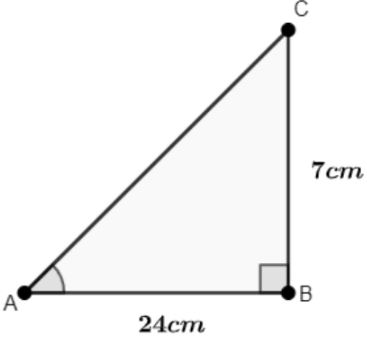
Using Pythagoras theorem, find AC.
AC2 = AB2+BC2
= (24)2+(7)2
= 576+49
= 625
∴ AC = 25cm
Then,
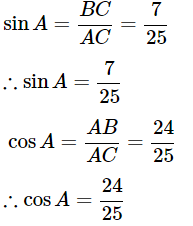
(ii) sinC, cosC
Ans: Let us draw a right-angled triangle ABC, right angled at B.
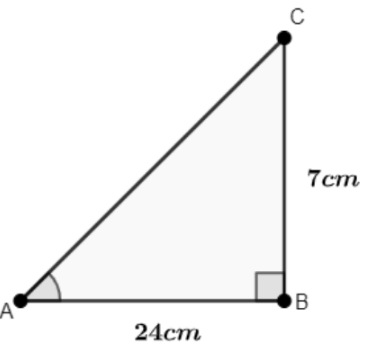
Using Pythagoras theorem, find AC.
AC2 = AB2+BC2
= (24)2+(7)2
= 576+49
= 625
∴ AC = 25cm
Then,
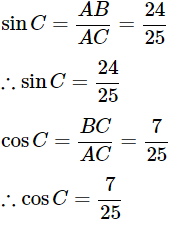
Q2: In Adjoining Figure, Find the Value of tanP - cotR.
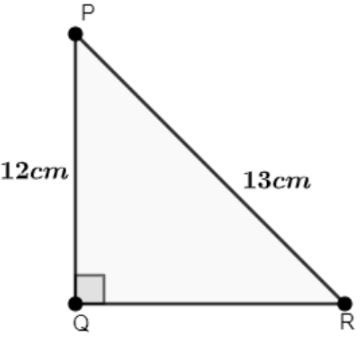
Ans: Using Pythagoras theorem,
PR2 = PQ2+QR2
(13)2 = (12)2+QR2
QR2 = 169-144⇒25
∴ QR = 5cm
Then find tanP - cotR,
First find the value of tanP.
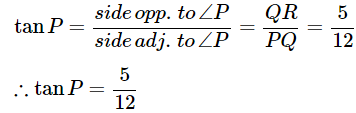
Now find the value of cotR
We know that, tanR= 1/cotR
For that we need to first find the value of tanR
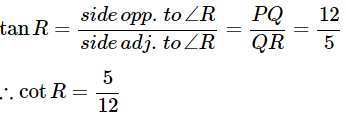
Then,
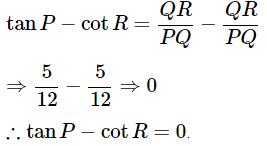
Q3: If sinA = 3/4, Calculate the Value of cosA and tanA.
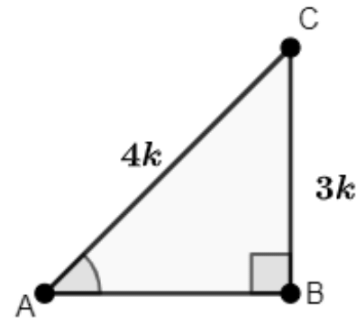
Ans: Given that the triangle ABC in which ∠B = 90º
Let us take BC = 3k and AC = 4k
Then using Pythagoras theorem,
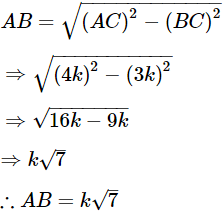
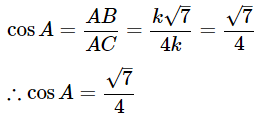
Calculate the value of cosA
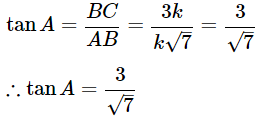
And calculate the value of tanA
Q4: Given 15cotA = 8, Find the Values of sinA and secA.
Ans: Given: 15cotA = 8
Let us assume a triangle ABC in which ∠B = 90º.
Then, 15cotA = 8
⇒ cotA = 8/15
Since cotA =
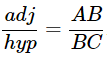
Let us draw the triangle.
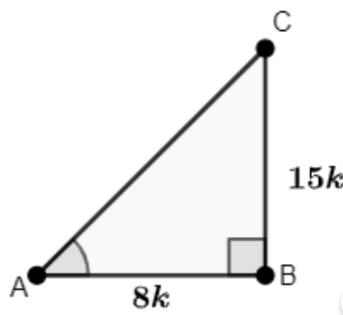
Now, AB = 8k and BC = 15k.
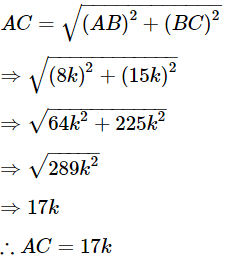
Using Pythagoras theorem, find the value of AC.
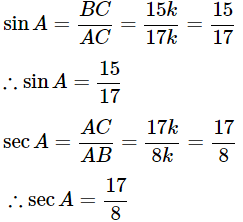
Now, find the values of sinA and secA.
Q5: If ∠A and ∠B are Acute Angles Such That cosA = cosB, then show that ∠A = ∠B
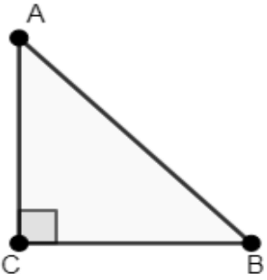
Ans: Given: cosA = cosB
In right triangle ABC,
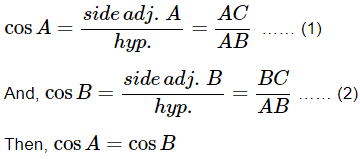
Now, equate equation (1) and (2).
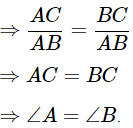
Therefore, Angles opposite to equal sides are equal.
Hence proved.
Q6: State Whether the Following are True or False. Justify Your Answer.
(i) The Value of tanA is Always Less than 1.
Ans: False because sides of a right triangle may have any length, so tanA may have any value. For example,

(ii) secA= 12/5 for Some Value of Angle A.
Ans: True as secA is always greater than 1. For example,
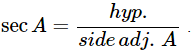 As hypotenuse will be the largest side. So, it is true.
(iii) cosA is the Abbreviation Used for the Cosecant of Angle A.
Ans: False as cosA is the abbreviation of cosineA. Because cosA means cosine of angle A and cosecA means cosecant of angle A.
(iv) cotA is the Product of cotand A.
Ans: False as cotA is not the product of cot and A. cot without A doesn't have meaning.
(v) sinθ = 4/3 for Some Angle θ.
Ans: False as sinθ cannot be greater than 1. For example, sinθ =
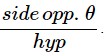 Since the hypotenuse is the largest side. So, sinθ will be less than 1.
Q7: Express the Trigonometric Ratios sinA, secA and tanA in Terms of cotA.
Ans: Find the value of sinA in terms of cotA.
By using identity cosec2A-cot2A = 1.
Then, use cosecA= 1/sinA.
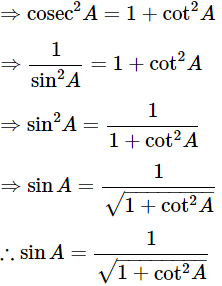
Now find the value for secA in terms of cotA.
Using identity sec2A-tan2A = 1
⇒ sec2A = 1+tan2A
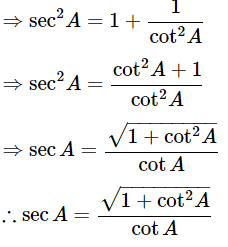
And find the value for tanA in terms of cot A
By trigonometric ratio property, tanA= 1/cot A
Hence, tanA = 1/cot A
Therefore, sinA, secA and tanA are founded in terms of cotA.
Q8: Write the Other Trigonometric Ratios of A in Terms of secA.
Ans: Find the value of sinA in terms of secA
By using identity, sin2A+cos2A = 1
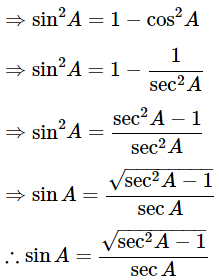
Now find the value for cosA in terms of secA,
By trigonometric ratio property, cosA = 1/sec A
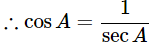
Find the value for tanA in terms of secA,
By using identity, sec2A-tan2A = 1
⇒ tan2A = sec2A-1
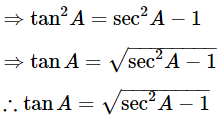
Find the value for cosecA in terms of secA
By trigonometric ratio property, cosecA = 1/sinA
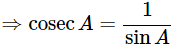
Substitute the value of sinA =
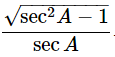
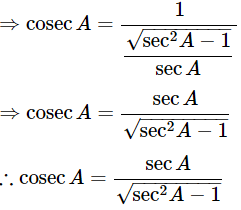
Finally, find the value for cotA in terms of secA
By trigonometric ratio property, cotA = 1/tan A
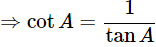
Substitute the value of tanA =
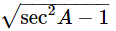
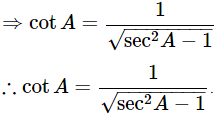
Short Answer Type Questions- II
Q9: Given secθ= 13/12, Calculate the Values for All Other Trigonometric Ratios.
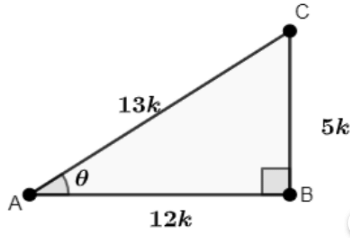
Ans: Given: secθ = 13/12
Let us consider a triangle ABC in which ∠A = θ and ∠B = 90º
Let AB = 12k and AC = 13k
Then, find the value of BC
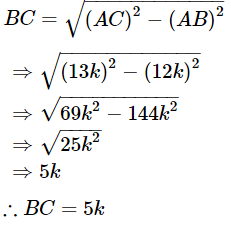
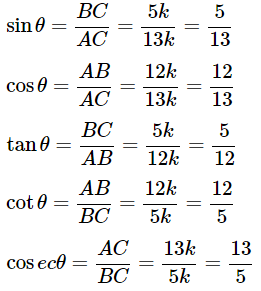
Since, secθ = 13/12
Similarly,
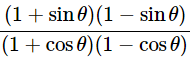
Q10: If cotθ= 7/8, then Evaluate the Followings Equations:
(i)
Ans: Given: cotθ= 7/8
Let us consider a triangle ABC in which ∠A = θ and ∠B = 90°
Then, AB = 7k and BC = 8k
Using Pythagoras theorem, find AC
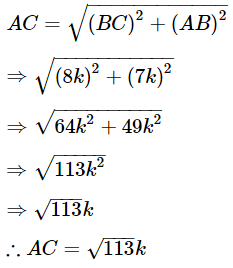
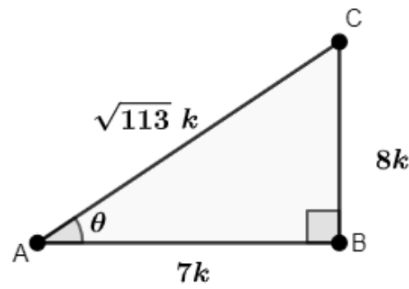
Now find the value of trigonometric ratios.

Then,
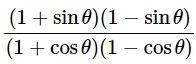
We know that, cos2θ+sin2θ = 1
Then,
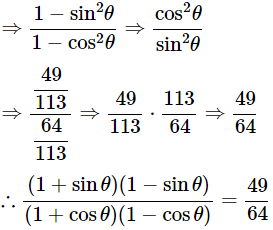
(ii) cot2θ
Ans: Given: cot2θ
We know that, cotθ= cosθ/sinθ
Then,
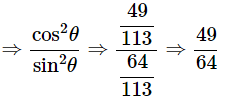
∴ cot2θ = 49/64
Hence,
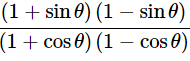 and cot2θ are same.
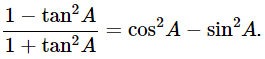
Q11: If 3cotA = 4, then show that
Ans: Given: 3cotA=4
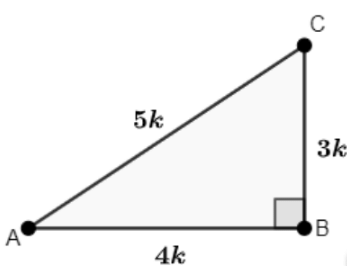
Let us consider a triangle ABC in which ∠B = 90º
Then, 3cotA = 4 ⇒ cotA = 4/3
Let AB = 4k and BC = 3k
Using Pythagoras theorem, find AC
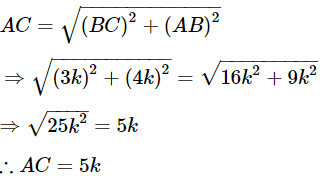
Now find the value of trigonometric ratios.

To prove:
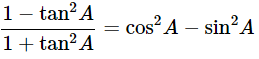
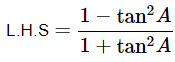
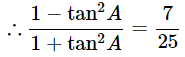
Let us take left-hand side
Substitute the value of tanA.
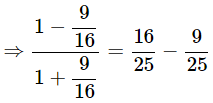
⇒ 7/25
Then,
R.H.S =cos2A-sin2A

⇒ 7/25
∴ cos2A-sin2A = 7/25.
It shows that L.H.S = R.H.S

Hence proved.
Q12: In ΔABC Right Angles at B, if A =
 then Find Value of the Following Equations:
(i) sinA cosC + cosA sinC
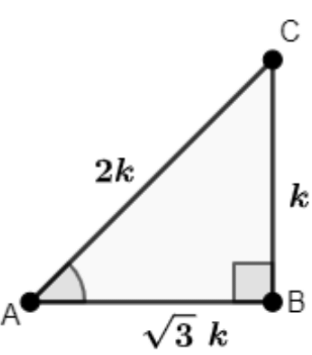
Ans: Let us consider a triangle ABCin which ∠B = 90°
Let BC = k and AB = 3-√k
Then, using Pythagoras theorem find AC
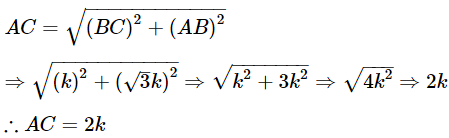
Now find the value of trigonometric ratios.

For ∠C, adjacent = BC, opposite = AB, and hypotenuse = AC

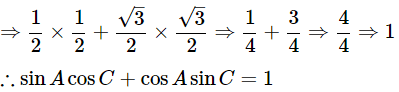
Now find the values of the following equations,
sinAcosC + cosAsinC
(ii) cosAcosC-sinAsinC
Ans:

∴ cosAcosC - sinAsinC = 0
Q13: In ΔPQR, right angled at Q, PR + QR = 25cm and PQ = 5cm. Determine the Values of sinP, cosP and tanP.
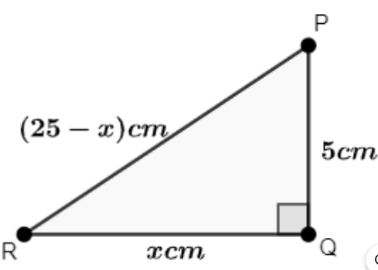
Ans: Given: In ΔPQR, right angled at Q
And PR+QR = 25cm, PQ = 5cm
Let us take QR = x cm and PR = (25-x)cm
By using Pythagoras theorem, find the value of x.
RP2 = RQ2+QP2
⇒ (25-x)2=(x)2+(5)2 ⇒ 625 - 50x + x2 = x2+25
⇒ -50x =-600 ⇒ x =12
Hence, RQ=12cmand RP=25-12=13cm
Now, find the values of sinP, cosP and tanP.

Q14: If tan(A+B) =√3 and tan(A-B) =
 0°<A + B ≤ 90° ; A>B. Find A and B.
Ans: Given: tan(A+B) =√3 and tan(A-B)= 1/√3.
We know that, tan60° =√3 and tan 30° = 1/√3.
Then,
tan(A+B) = tan60°
⇒ A+B = 60° ...... (1)
tan(A-B) = tan30°
⇒ A-B = 30° ...... (2)
Adding equation (1) and (2). We get,
A+B+A-B = 60°+30° ⇒ 2A=90° ⇒ A = 45°
∴A = 45°
Put A = 45° in equation (1).
A+B = 60°
⇒ 45°+B = 60° ⇒ B= 60°-45° ⇒ B=15°
∴ B = 15°
Hence, A = 45° and B = 15°.
Q15: If xcosθysinθ = a, xsinθ+ycosθ = b, Prove that x2+y2 = a2+b2.
Ans: Given:
xcosθysinθ = a ...... (1)
xsinθ+ycosθ = b ...... (2)
Squaring and adding the equation (1) and (2) on both sides.
x2cos2θ+y2sin2θ-2xycosθsinθ+x2sin2θ+y2cos2θ+2xycosθsinθ = a2+b2
⇒ x2(cos2θ+sin2θ)+y2(sin2θ+cos2θ) = a2+b2
⇒ x2+y2 = a2+b2
∴ x2+y2 = a2+b2
Hence proved.
Q16: Prove that sec2θ+cosec2θ Can Never Be Less Than 2.
Ans: Given: sec2θ+cosec2θ
We know that, sec2θ = 1+tan2θ and cosec2θ = 1+cot2θ.
⇒ sec2θ+cosec2θ = 1+tan2θ+1+cot2θ
⇒ sec2θ+cosec2θ = 2+tan2θ+cot2θ
Therefore, sec2θ+cosec2θ can never be less than 2.
Hence proved.
Q17: If sinφ= 1/2, show that 3cosφ-4cos3φ = 0
Ans: Given: sinφ = 1/2
We know that sin30° = 1/2.
While comparing the angles of sin, we get
⇒ φ = 30°
Substitute φ = 30° to get
3cosφ-4cos3φ = 3cos(30°)-4cos3(30°)
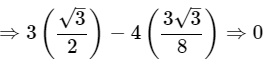
Therefore, 3cosφ-4cos3φ = 0.
Hence proved.
Q18: If 7sin2φ+3cos2φ = 4, then Show that tanφ = 1/√3.
Ans: Given: 7sin2φ+3cos2φ = 4
We know that, sin2φ+cos2φ = 1 and tanθ =

Then, 7sin2φ+3cos2φ = 4(sin2φ+cos2φ)
⇒ 7sin2φ-4sin2φ = 4cos2φ-3cos2φ
⇒ 3sin2φ = cos2φ
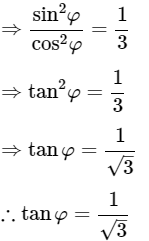
Hence proved.
Q19: If cosφ+sinφ = √2cosφ, Prove that cosφ-sinφ = √2sinφ.
Ans: Given: cosφ+sinφ = √2cosφ
Squaring on both sides, we get
⇒ (cosφ+sinφ)2 = 2cos2φ
⇒ cos2φ+sin2φ+2cosφsinφ = 2cos2φ
⇒ sin2φ = 2cos2φ-cos2φ-2cosφsinφ
⇒ sin2φ = cos2φ-2cosφsin
Add sin2φ on both sides
⇒ 2sin2φ = cos2φ-2cosφsinφ+sin2φ
⇒ 2sin2φ = (cosφ-sinφ)2
∴ cosφ-sinφ = √2 sinφ
Hence proved.
Q20: If tanA+sinA = m and tanA-sinA = n, then Show that m2-n2 = 4√mn.
Ans: Given:
tanA + sinA = m ...... (1)
tanA - sinA = n ...... (2)
Now to prove m2-n2= 4√mn.
Take left-hand side
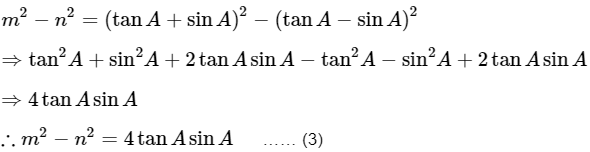
Now take right-hand side
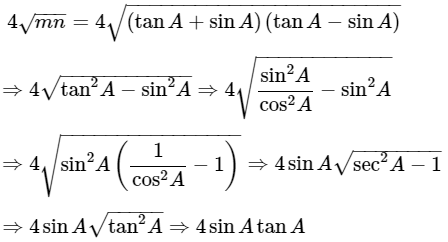
Hence, 4√mn = 4tanAsinA
∴ m2-n2 = 4√mn
Hence proved.
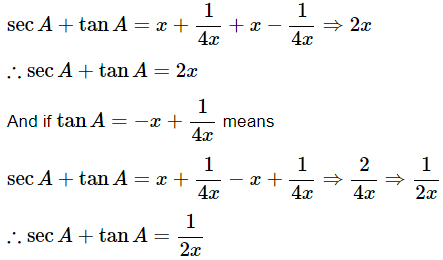
Q21: If secA = x + (1/4x), then prove that secA+tanA = 2x or (1/2x).
Ans: Given: secA = x+ (1/4x)
Squaring on both sides.
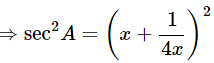
We know that, sec2A = 1+tan2A
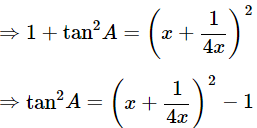

Taking square root on both sides,
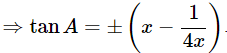
Now, find secA + tanA
If tanA = x - (1/4x)means
Hence proved.
Q22: If A, B are Acute Angles and sinA = cosB, then Find the Value of A+B.
Ans: Given: sinA = cosB
We know that sinA = cos(90°-A)
While comparing the values to get
cosB = cos(90°-A)
⇒ B = 90°-A ⇒ A+B = 90°
∴ A+B = 90°.
Q23: Evaluate the Following Questions:
(i) Solve for ϕ, if tan5ϕ = 1.
Ans: Given: tan5ϕ = 1
We know that, tan-1(1) = 45°
5ϕ = tan-1(1) ⇒ 45°
5ϕ = 45°
ϕ = 45°/5 ⇒ 9°
∵ϕ = 9°
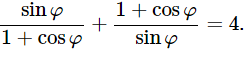
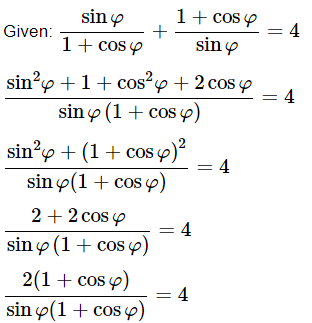
(ii) Solve for φ, if
Ans:
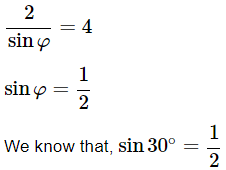
sinφ = sin30° ⇒ φ = 30°
∴ φ = 30°.
Q24: If
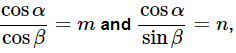 show that (m2+n2)cos2β = n2.
Ans: Given:
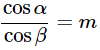 ... (1)
 ... (2)
Squaring equation (1) and (2). We get,
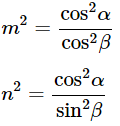
Now to prove (m2+n2)cos2β = n2,
Take left-hand side,
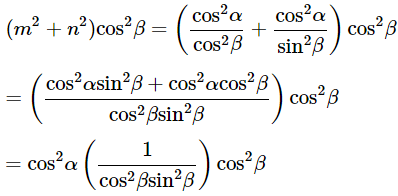

= n2
∴ (m2+n2)cos2β = n2
Hence proved.
Q25: If 7cosecφ-3cotφ = 7, then prove that 7cotφ-3cosecφ = 3.
Ans: Given: 7cosecφ-3cotφ=7
Then prove that, 7cotφ-3cosecφ=3
7cosecφ-3cotφ=7
Squaring on both sides, we get
49cosec2φ+9cot2φ-42cosecφcotφ=49
We know that, cosec2φ=1+cot2φ and cot2φ=cosec2φ-1.
49(cot2φ+1)+9(cosec2φ-1)-42cosecφcotφ=49
49cot2φ+49+9cosec2φ-9-2(3cosecφ⋅7cotφ)=49
(7cotφ-3cosecφ)2 = 49-49+9
(7cotφ-3cosecφ)2 = 9
Take square root on both sides, we get
∴ 7cotφ-3cosecφ = 3
Hence proved.
Q26: Prove that 2(sin6φ+cos6φ) 3(sin4φ+cos4φ)+1 = 0.
Ans: Given: 2(sin6φ+cos6φ) 3(sin4φ+cos4φ)+1=0
Let us take left-hand side,
2(sin6φ+cos6φ) 3(sin4φ+cos4φ)+1=2((sin2φ)3+(cos2φ)3)-3((sin2φ)2+(cos2φ)2)+1
=2[(sin2φ+cos2φ)3-3sin2φcos2φ(sin2φ+cos2φ)]-3[(sin2φ+cos2φ)2-2sin2φcos2φ]+1
=2[1-3sin2φcos2φ]-3[1-2sin2φcos2φ]+1
=2-6sin2φcos2φ-3+6sin2φcos2φ+1
=-1+1
= 0
Therefore, 2(sin6φ+cos6φ) 3(sin4φ+cos4φ)+1 = 0.
Hence proved.
Q27: If tanθ = 5/6 and θ = ϕ = 90°. What is the value of cotϕ.
Ans: Given: tanθ = 5/6 and θ = ϕ = 90°
We know that, tanθ = 1/cotθ.
cotϕ = 1/tanϕ
= 1/(5/6)
= 6/5
∴cotϕ= 6/5.
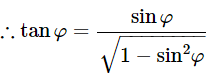
Q28: What is the Value of tanφ in terms of sinφ ?
Ans: Given: tanφ
We know that, tanφ =
 and cos2φ+sin2φ = 1
tanφ = sinφ/cosφ
Q29: If secφ+tanφ = 4, Find the Value of sinφ, cosφ.
Ans: Given: secφ+tanφ = 4
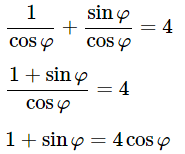
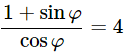
Squaring on both sides.
(1+sinφ)2 = (4cosφ)2
1+2sinφ+sin2φ = 16cos2φ
1+2sinφ+sin2φ = 16(1-sin2φ)
1+2sinφ+sin2φ = 16-16sin2φ
17sin2φ+2sinφ-15 = 0
17sin2φ+17sinφ-15sinφ-15 = 0
17sinφ(sinφ+1)-15(sinφ+1) = 0
(sinφ+1)(17sinφ-15) = 0
If sinφ+1 = 0
Hence, sinφ = -1 is not possible.
Then, 17sinφ-15 = 0
∴ sinφ = 15/17
Now find cosφ
Substitute the value of sinφ
1 + (15/17) = 4cosφ
32/17 = 4cosφ
⇒ cosφ =
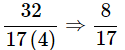
∴ cosφ = 8/17.
Try yourself: Choose the Correct Option. Justify Your Choice:
9sec2A−9tan2A =
Try yourself: Choose the Correct Option. Justify Your Choice:
(1+tanθ+secθ)(1+cotθ−cosecθ) =

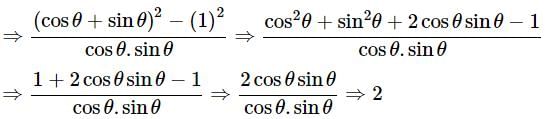
Try yourself: Choose the Correct Option. Justify Your Choice:
(secA+tanA)(1−sinA) =


Try yourself: Choose the Correct Option. Justify Your Choice:
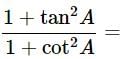


Long Answer Type Questions
Q1: Express the Trigonometric Ratios sinA, secA and tanA in Terms of cotA.
Ans: Find the value for sinA in terms of cotA
By using identity cosec2A-cot2A = 1
Then,
⇒ cosec2A = 1+cot2A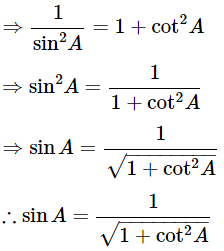
Express the value of secA in terms of cotA
By using identity sec2A-tan2A = 1
Then,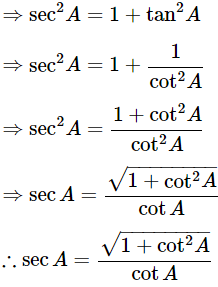
Express the value of tanA in terms of cotA
We know that, tanA = 1/cotA
∴ tanA =1/cotA.
Q2: Write the Other Trigonometric Ratios of A in Terms of secA.
Ans: Express the value of sinA in terms of secA
By using identity, sin2A+cos2A = 1
⇒ sin2A = 1-cos2A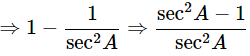
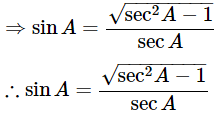
Express the value of cosA in terms of secA
We know that, cosA = 1/secA
∴ cosA = 1/secA
Express the value of tanA in terms of secA
By using identity sec2A-tan2A = 1
Then,
⇒ tan2A = sec2A-1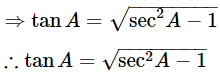
Express the value of cosecA in terms of secA
We know that, cosecA= 1sinA
Then, Substitute the value of sinA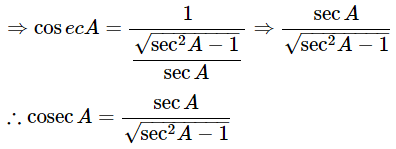
Express the value of cotA in terms of secA
We know that, 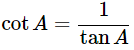
Substitute the value of tanA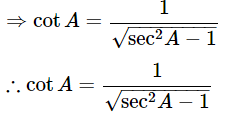
Q3: Prove the Following Identities, Where the Angles Involved are Acute Angles for Which the Expressions are Defined:
(i) (cosecθ-cotθ)2= 
Ans: Given: (cosecθ-cotθ)2= 
We know that, (a-b)2 = a2+b2-2ab, cosecθ = 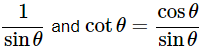
Then, let us take left-hand side
⇒ (cosecθ-cotθ)2 = cosec2θ + cot2θ - 2cosecθcotθ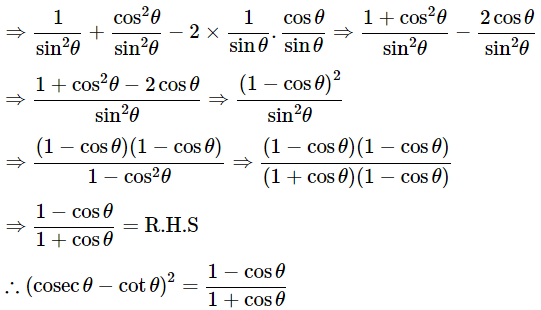
Hence proved.
(ii) 
Ans: Given: 
We know that, sin2θ+cos2θ = 1
Then, let us take left-hand side
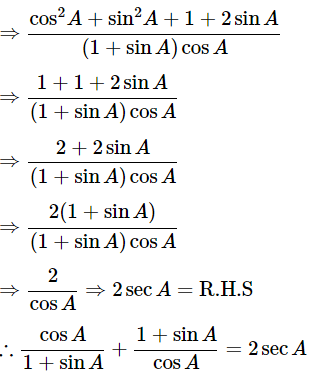
Hence proved.
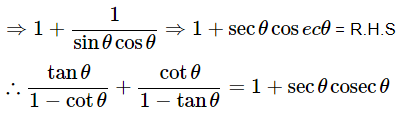
(iii) 
Ans: Given:
We know that, a3-b3= (a-b)(a2+b2+ab) and sin2θ+cos2θ = 1
Then, let us take L.H.S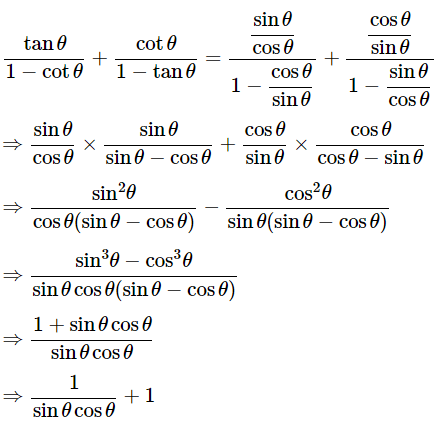
(iv) 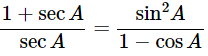
Ans: Given: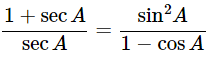
Then, let us take L.H.S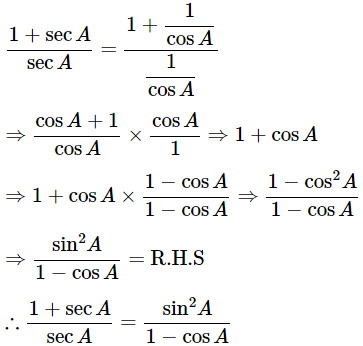
Hence proved.
(v)  using the identity cosec2A = 1+cot2A
Ans: Given:
We know that, cosec2A = 1+cot2A
Then, let us take L.H.S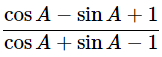
Dividing all terms by sinA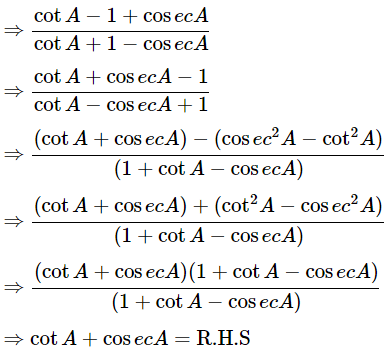

Hence proved.
(vi) 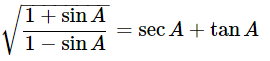
Ans: Given: 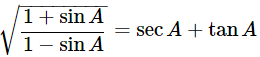
We know that, 1-sin2θ=cos2θ and (a+b)(a-b) = a2-b2
Then, let us take L.H.S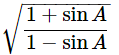
Let us take conjugate of the term. Then,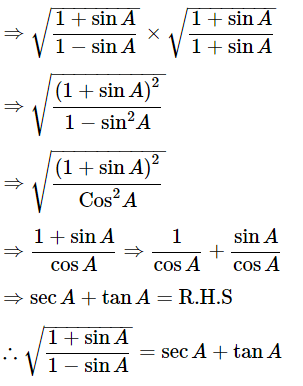
Hence proved.
(vii) 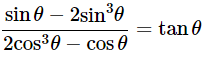
Ans: Given: 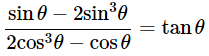
We know that, 1-sin2θ = cos2θ
Then, let us take L.H.S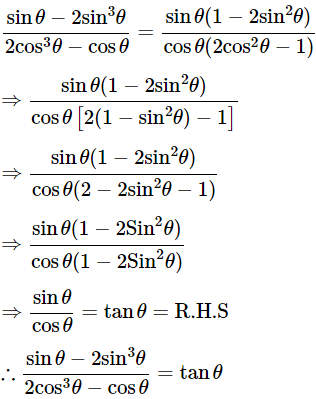
Hence proved.
(viii) (sinA+cosecA)2+(cosA+secA)2 = 7+tan2A+cot2A
Ans: Given: (sinA+cosecA)2+(cosA+secA)2=7+tan2A+cot2A
We know that, cosec2θ =1+cot2θ and sec2θ = 1+tan2θ
Then, let us take L.H.S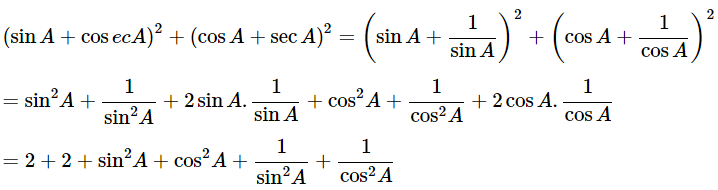
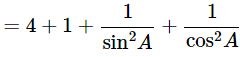
= 5+cosec2A+sec2A
= 5+1+cot2A+1+tan2A
= 7+tan2A+cot2A = R.H.S
∴ (sinA+cosecA)2+(cosA+secA)2=7+tan2A+cot2A
Hence proved.
(ix) (cosecA-sinA)(secA-cosA)= 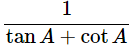
Ans: Given: (cosecA-sinA)(secA-cosA) = 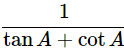
We know that, sin2θ+cos2θ = 1
Then, let us take L.H.S
(cosecA-sinA)(secA-cosA) = 
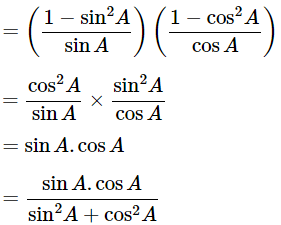
Dividing all the terms by sinA.cosA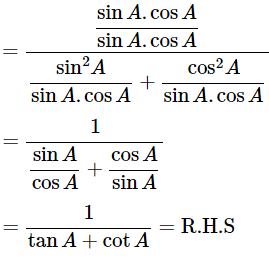
∴ (cosecA-sinA)(secA-cosA) = 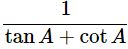
Hence proved.
(x) 
Ans: Given:
We know that, 1+tan2θ = sec2θ and 1+cot2θ = cosec2A
Then, let us take L.H.S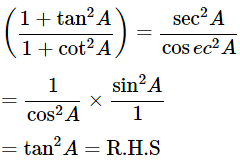
Now, prove the Middle side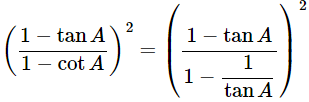
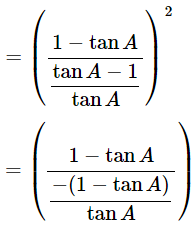
= (-tanA)2
= tan2A = R.H.S
Hence proved.
Q4: Evaluate the Following Equations:
i. sin60°cos30°+sin30°cos60°
Ans: Given: sin60°cos30°+sin30°cos60°
We know that, 
Then, sin60°cos30°+sin30°cos60°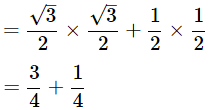
= 4/4 = 1
∴ sin60°cos30°+sin30°cos60° = 1
(ii) 2tan245°+cos230°-sin260°
Ans: Given: 2tan245°+cos230°-sin260°
We know that, tan45° = 1, sin60° = √3/2 and cos30° = √3/2
Then, 2tan245°+cos230°-sin260°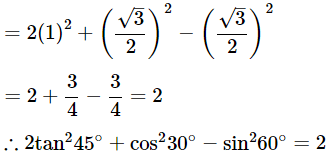
(iii) 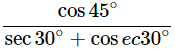
Ans: Given: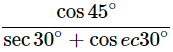
We know that, 
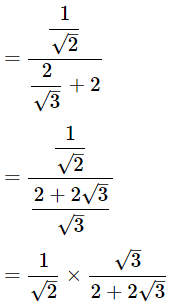
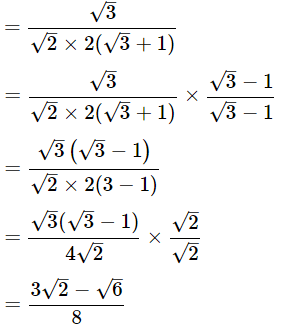

(iv) 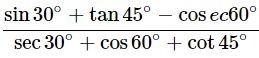
Ans: Given: 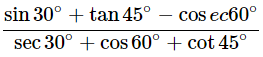
We know that, 
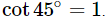
Then, 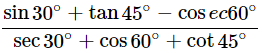
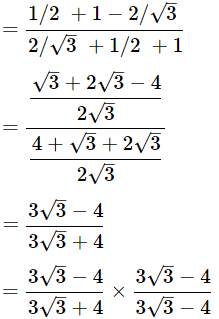
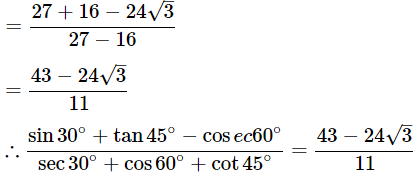
(v) 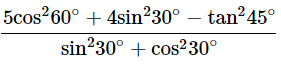
Ans: Given: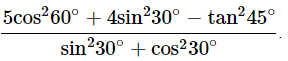 Then,
Then,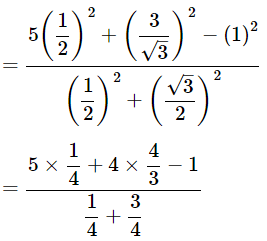
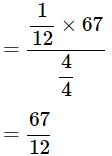

Q5: Prove the Following Identities, Where the Angles Involved are Acute Angles for Which the Expressions are Defined:
(i) (cosecθ-cotθ)2=
Ans: Given: (cosecθ-cotθ)2=
We know that, (a-b)2= a2+b2-2ab, cosecθ = 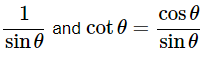
Then, let us take left-hand side
⇒(cosecθ-cotθ)2=cosec2θ+cot2θ-2cosecθcotθ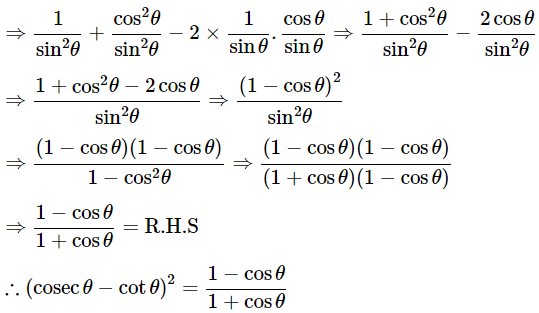
Hence proved.
(ii) 
Ans: Given:
We know that, sin2θ+cos2θ =1
Then, let us take left-hand side
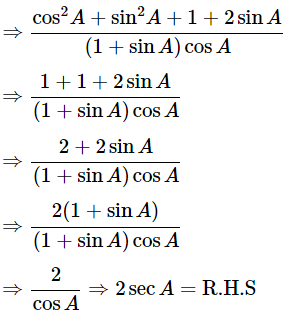

Hence proved.
(iii) 
Ans: Given:
We know that, a3-b3=(a-b)(a2+b2+ab) and sin2θ+cos2θ=1
Then, let us take L.H.S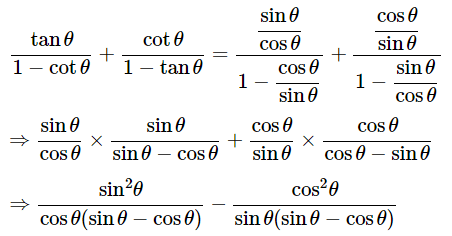
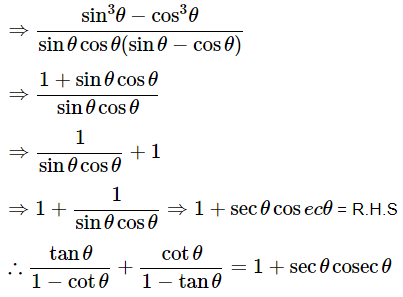
Hence proved.
(iv) 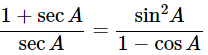
Ans: Given: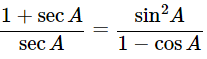
Then, let us take L.H.S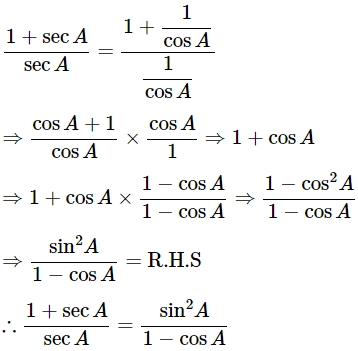
Hence proved.
(v)  using the identity cosec2A=1+cot2A
Ans: Given:
We know that, cosec2A=1+cot2A
Then, let us take L.H.S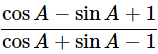
Dividing all terms by sinA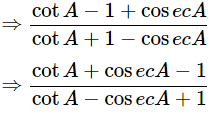
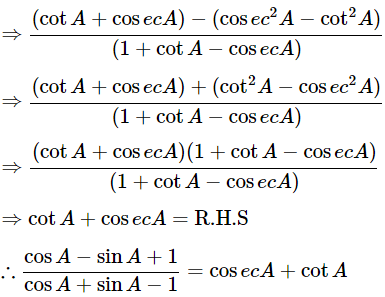
Hence proved.
(vi) 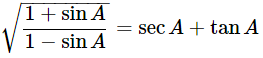
Ans: Given: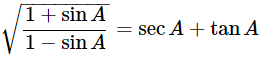
We know that, 1-sin2θ=cos2θ and (a+b)(a-b)=a2-b2
Then, let us take L.H.S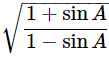
Let us take conjugate of the term. Then,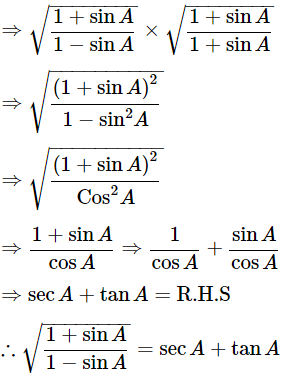
Hence proved.
(vii) 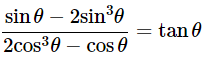
Ans: Given: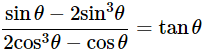
We know that, 1-sin2θ=cos2θ
Then, let us take L.H.S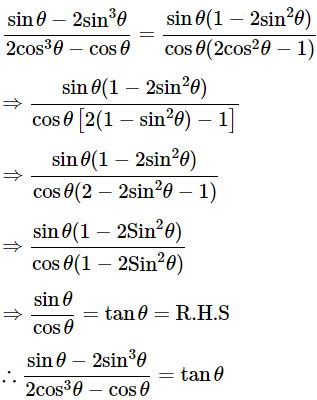
Hence proved.
(viii) (sinA+cosecA)2+(cosA+secA)2=7+tan2A+cot2A
Ans: Given: (sinA+cosecA)2+(cosA+secA)2=7+tan2A+cot2A
We know that, cosec2θ=1+cot2θ and sec2θ=1+tan2θ
Then, let us take L.H.S
(sinA+cosecA)2+(cosA+secA)2= 
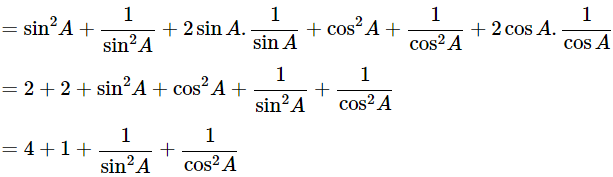
= 5+cosec2A+sec2A
= 5+1+cot2A+1+tan2A
= 7+tan2A+cot2A = R.H.S
∴ (sinA+cosecA)2+(cosA+secA)2=7+tan2A+cot2A
Hence proved.
(ix) (cosecA-sinA)(secA-cosA) =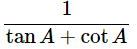
Ans: Given: (cosecA-sinA)(secA-cosA)=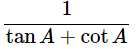
We know that, sin2θ+cos2θ = 1
Then, let us take L.H.S
(cosecA-sinA)(secA-cosA)= 
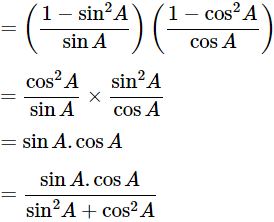
Dividing all the terms by sinA.cosA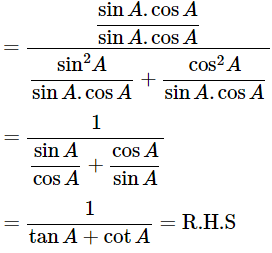
∴(cosecA-sinA)(secA-cosA) = 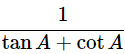
Hence proved.
(x) 
Ans: Given:
We know that, 1+tan2θ=sec2θ and 1+cot2θ=cosec2A
Then, let us take L.H.S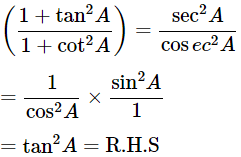
Now, prove the Middle side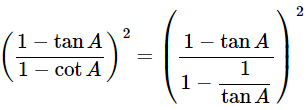
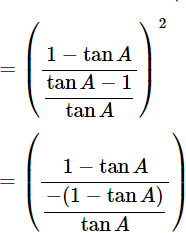
= (-tanA)2
= tan2A = R.H.S
Hence proved.
Try yourself: Choose the Correct Option. Justify Your Choice:
(i) 9sec2A−9tan2A=
Try yourself: Choose the Correct Option. Justify Your Choice:
(i) (1+tanθ+secθ)(1+cotθ−cosecθ) =

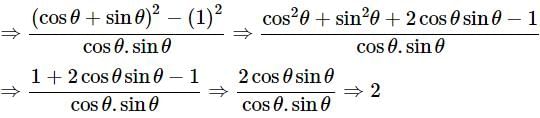
Try yourself: Choose the Correct Option. Justify Your Choice:
(secA+tanA)(1−sinA) =


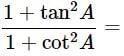
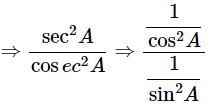
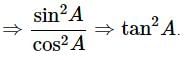
Try yourself: Choose the Correct Option. Justify Your Choice:

FAQs on Important Questions: Introduction to Trigonometry
| 1. What are the basic trigonometric ratios? |  |
| 2. How do you remember the trigonometric ratios? | |
| 3. What are the values of trigonometric ratios for special angles like 0°, 30°, 45°, 60°, and 90°? | |
| 4. How do you find the height of a triangle using trigonometry? | |
| 5. What is the relationship between the trigonometric functions and the unit circle? | |





