Worksheet Solutions: Contemporary Centres of Power


Fill in the Blanks
Q1: The European economy was revived after World War II with extensive financial support from ______________ under the Marshall Plan.
Ans: USA
The European economy was revived after World War II with extensive financial support from USA under the Marshall Plan. This assistance, given as grants and loans, helped rebuild infrastructure, modernise industry and restore trade, laying the basis for post-war recovery and cooperation.
Q2: The Organisation for European Economic Cooperation (OEEC) was founded in ____________ to direct help to West European nations.
Ans: 1948
The Organisation for European Economic Cooperation (OEEC) was founded in 1948 to administer Marshall Plan aid and to coordinate economic cooperation among the West European nations, thereby facilitating reconstruction and policy co-ordination.
Q3: The disintegration of the USSR led to the formation of the ______________ in 1992.
Ans: European Union
The disintegration of the USSR altered the European security environment and encouraged deeper regional integration. These developments culminated in the Maastricht Treaty and the formal establishment of the European Union in 1992, which strengthened economic and political cooperation.
Q4: ASEAN stands for Association of South East Asian Nations, founded in ____________.
Ans: 1967
ASEAN, which stands for Association of South East Asian Nations, was founded in 1967 to promote regional cooperation in political, economic and cultural fields among Southeast Asian countries.
Q5: The ASEAN emblem consists of ten rice stalks representing ______________ South East Asian nations.
Ans: Ten
The ASEAN emblem consists of ten rice stalks, each representing one of the ten member states and symbolising unity, solidarity and shared prosperity among the nations of Southeast Asia.
Q6: China's "Open Door Policy" was announced by ______________ in 1978.
Ans: Deng Xiaoping
China's "Open Door Policy" was announced by Deng Xiaoping in 1978. The policy opened China to foreign investment and technology, promoted export-oriented growth and began the process of market-oriented reforms.
Q7: India experienced a military setback against China in the year ______________.
Ans: 1962
India experienced a military setback against China in 1962 during the Sino-Indian War. The conflict arose from unresolved border disputes and led to a significant deterioration in bilateral relations at that time.
Q8: The slogan "Hindi-Chini-Bhai Bhai" gained popularity during peaceful relations between ______________ and ______________.
Ans: India, China
The slogan "Hindi-Chini-Bhai Bhai" (meaning "Indians and Chinese are brothers") gained popularity when relations between India and China were friendly, reflecting a spirit of goodwill before later tensions emerged.
Q9: The ASEAN Economic Community seeks to create a ______________ market and promote regional social and economic development.
Ans: Single
The ASEAN Economic Community seeks to create a single market to facilitate the freer flow of goods, services, investment, capital and skilled labour, thereby promoting regional social and economic development.
Match the column
Q1:
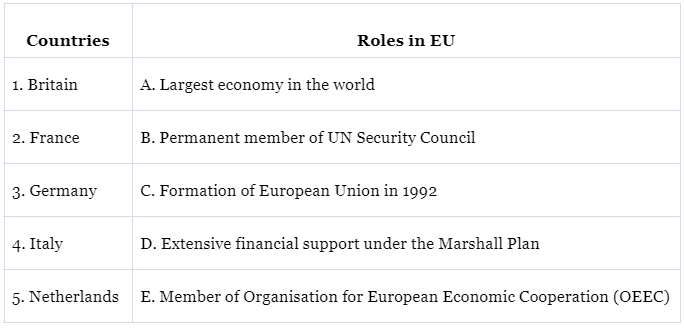
Ans: 1. Britain: C. Formation of European Union in 1992
Britain was a member state at the time the Maastricht Treaty created the European Union in 1992, participating in the political and economic changes that followed.
2. France: B. Permanent member of UN Security Council
France is one of the five permanent members of the United Nations Security Council, giving it a key role in international security and diplomacy.
3. Germany: A. Largest economy in the world
Germany is the largest economy in Europe and a principal contributor to the overall economic strength of the EU, making it an economic leader on the continent.
4. Italy: D. Extensive financial support under the Marshall Plan
Italy received significant financial assistance under the Marshall Plan after World War II, which helped rebuild its economy and infrastructure.
5. Netherlands: E. Member of Organisation for European Economic Cooperation (OEEC)
The Netherlands was among the founding members of the OEEC in 1948, participating in the administration of post-war economic aid and regional co-operation.
Assertion and Reason based
Q1: Assertion: The disintegration of the USSR led to the formation of the European Union in 1992.
Reason: European nations wanted to establish a common foreign and security policy.
(a) Both Assertion and Reason are true, and Reason is the correct explanation for Assertion.
(b) Both Assertion and Reason are true, but Reason is not the correct explanation for Assertion.
(c) Assertion is true, but Reason is false.
(d) Assertion is false.
Ans: (a)
Explanation:
(i) Assertion: The assertion is true - the end of the USSR and the Cold War changed the European strategic environment and encouraged deeper integration, which culminated in the Maastricht Treaty and the European Union in 1992.
(ii) Reason: The reason is true - one key aim of deeper integration was to coordinate foreign and security policy so member states could present a united position in world affairs.
(iii) Justification: The reason correctly explains the assertion because the need for common policies on external relations and security was an important driver behind the political steps that produced the EU in 1992.
Q2: Assertion: China's "Open Door Policy" aimed to boost production through foreign investments.
Reason: Special economic zones were established to attract foreign capital and technology.
(a) Both Assertion and Reason are true, and Reason is the correct explanation for Assertion.
(b) Both Assertion and Reason are true, but Reason is not the correct explanation for Assertion.
(c) Assertion is true, but Reason is false.
(d) Assertion is false.
Ans: (a)
Explanation:
(i) Assertion: The assertion is true - the Open Door Policy launched in 1978 sought to increase production and modernise the economy by attracting foreign investment.
(ii) Reason: The reason is true - special economic zones (SEZs) were created as part of this policy to offer incentives and infrastructure to foreign investors and to facilitate technology transfer.
(iii) Justification: The reason explains the assertion directly because SEZs were a practical measure used to implement the Open Door Policy and thereby boost production and growth.
Q3: Assertion: ASEAN's emblem represents unity with ten rice stalks.
Reason: ASEAN comprises ten South East Asian nations.
(a) Both Assertion and Reason are true, and Reason is the correct explanation for Assertion.
(b) Both Assertion and Reason are true, but Reason is not the correct explanation for Assertion.
(c) Assertion is true, but Reason is false.
(d) Assertion is false.
Ans: (a)
Explanation:
(i) Assertion: The assertion is true - the ASEAN emblem shows ten rice stalks as a symbol of unity.
(ii) Reason: The reason is true - ASEAN comprises ten member states, and the stalks represent those nations.
(iii) Justification: The reason correctly explains the assertion because the emblem was deliberately designed to symbolise the unity of the ten member countries.
Q4: Assertion: India and China had peaceful relations after India's independence.
Reason: The slogan "Hindi-Chini-Bhai Bhai" symbolized the friendship between the two nations.
(a) Both Assertion and Reason are true, and Reason is the correct explanation for Assertion.
(b) Both Assertion and Reason are true, but Reason is not the correct explanation for Assertion.
(c) Assertion is true, but Reason is false.
(d) Assertion is false.
Ans: (a)
Explanation:
(i) Assertion: The assertion is true - in the years immediately after independence, India and China enjoyed friendly and cooperative relations.
(ii) Reason: The reason is true - the slogan "Hindi-Chini-Bhai Bhai" expressed that spirit of friendship and goodwill between the peoples of the two countries.
(iii) Justification: The reason explains the assertion because the popular slogan captured the favourable public sentiment and diplomatic warmth of that period, even though relations later became strained by border disputes.
Very Short Answers Type Questions
Q1: What was the purpose of the Organisation for European Economic Cooperation (OEEC)?
Ans: The OEEC was founded in 1948 to administer Marshall Plan aid and to co-ordinate economic reconstruction and co-operation among West European nations after World War II.
Q2: Name three objectives of ASEAN.
Ans: Accelerate economic growth, promote regional peace and stability, and encourage cultural and social development among member states.
Q3: Who announced China's "Open Door Policy," and what was its goal?
Ans: Deng Xiaoping announced the policy in 1978. Its goal was to attract foreign investment and technology to boost production and modernise the Chinese economy.
Q4: What does the ASEAN emblem symbolize?
Ans: The emblem symbolises unity and solidarity among the ten member states, represented by the ten rice stalks.
Q5: Which two European countries are permanent members of the UN Security Council?
Ans: Britain and France are permanent members of the United Nations Security Council.
Q6: What does ASEAN way refer to in the context of interaction?
Ans: ASEAN way refers to an informal, consultative, consensus-based and non-confrontational method of interaction that emphasises dialogue and non-interference.
Q7: When did India and China experience a military dispute, and what was the cause?
Ans: The dispute occurred in 1962 and was caused by unresolved border disagreements and competing territorial claims, which had been affected by changes such as China's control of Tibet.
Q8: What was the slogan "Hindi-Chini-Bhai Bhai" associated with?
Ans: The slogan symbolised the friendly and brotherly relations between India and China during the early post-independence period.
Q9: What are the three pillars of the ASEAN community established in 2003?
Ans: The three pillars are the ASEAN Socio-Cultural Community, the ASEAN Economic Community, and the ASEAN Security Community.
Q10: What does China's economy aim to achieve through its Special Economic Zones?
Ans: Special Economic Zones were established to attract foreign capital and technology, encourage export-oriented industry and raise productivity, thereby accelerating economic growth.
Short Answers Type Questions
Q1: How did the Cold War aid the integration of Europe after 1945?
Ans: The Cold War encouraged Western European countries to cooperate more closely for economic recovery and security. US aid under the Marshall Plan revived economies, the OEEC coordinated that assistance, and institutions such as the Council of Europe promoted political co-operation, all of which paved the way for deeper integration.
Q2: Explain the objectives of ASEAN's ASEAN Economic Community.
Ans: The ASEAN Economic Community aims to create a single market and production base by removing barriers to the free flow of goods, services, investment, capital and skilled labour, thereby promoting economic development and competitiveness across the region.
Q3: How did China's economic policies change after 1978, leading to its growth as a global economic power?
Ans: From 1978, China moved away from a strictly centralised model and introduced market-oriented reforms. The "Open Door Policy" allowed foreign investment and technology, special economic zones provided favourable conditions for investors, and state-led reforms encouraged export-oriented growth, which together fuelled rapid industrialisation and growth.
Q4: Describe the founding principles of ASEAN and its approach to international relations.
Ans: ASEAN was founded on principles of peace, neutrality, co-operation, non-interference and respect for national differences and sovereignty. Its approach, known as the ASEAN way, favours informal consultation, consensus and non-confrontational diplomacy to resolve regional issues.
Q5: How did the Chinese economy evolve since 1978?
Ans: Since 1978, China's economy transitioned through reform measures that opened the country to foreign investment, established special economic zones, and encouraged enterprise and exports. The state retained a guiding role, but market mechanisms and global engagement became central, producing rapid growth alongside social and labour challenges.
Q6: Discuss the impact of the Chinese economy on the global stage.
Ans: China's rapid growth has made it a major global economic power. Its trade, investment and manufacturing capacity influence global markets and supply chains. Projections suggest that by 2040 China may overtake the United States in size of GDP under some scenarios, making it a central actor in global economic and geopolitical affairs.
Q7: Explain the evolution of the European Union from an economic union to a political entity.
Ans: The EU began as an economic project to integrate markets and prevent conflict. Over time member states adopted common policies on trade, justice and external relations, and moved towards political co-ordination. Milestones such as the Maastricht Treaty (1992) and the introduction of the euro deepened political and institutional integration, giving the EU a stronger role in foreign and security policy.
Q8: Describe the factors that led to the improvement of relations between India and China in 1988.
Ans: Relations improved after Indian Prime Minister Rajiv Gandhi's visit to China in December 1988. Diplomatic engagement, confidence-building measures and growing economic contacts helped thaw tensions and opened channels for dialogue after the long period of hostility following the 1962 conflict.
Long Answer Type Questions
Q1: Explain the factors that contributed to the evolution of the European Union from an economic union to a political one. Provide specific examples of this transformation.
Ans: The evolution of the European Union from an economic union to a political one was driven by a combination of historical, economic and security factors.
- Historical Context: The devastation of World War II created a strong motive for regional cooperation to prevent future conflicts and to rebuild economies.
- Marshall Plan and OEEC: US financial support under the Marshall Plan and the creation of the OEEC in 1948 organised recovery efforts and encouraged policy co-operation among Western European states.
- Political Cooperation: Institutions such as the Council of Europe promoted shared commitments to democracy and human rights, fostering a climate conducive to political integration.
- Formation of the European Union: The end of the Cold War and the desire for a common foreign and security policy led to the Maastricht Treaty and the formal adoption of the title "European Union" in 1992. Subsequent steps, including the adoption of a single currency by some members, furthered political integration.
The EU's transformation was thus the result of economic recovery efforts, the need for political co-ordination in a changing global order, and institutional reforms that extended integration from purely economic matters into foreign policy and other political domains.
Q2: Discuss the founding objectives and principles of ASEAN. How has the ASEAN community evolved over time, and what are its key pillars?
Ans: ASEAN was founded in 1967 with the aim of promoting regional stability and development.
- Founding Objectives: To accelerate economic growth, maintain regional peace and stability, and encourage cultural and social development among member countries.
- Founding Principles: Respect for sovereignty, non-interference in internal affairs, equality, and peaceful settlement of disputes.
Evolution and Key Pillars:
- ASEAN Socio-Cultural Community: Promotes social progress, cultural exchange and human development across the region.
- ASEAN Economic Community: Seeks to create a single market and production base to increase economic integration and competitiveness.
- ASEAN Security Community: Focuses on regional peace and stability through cooperative security arrangements, confidence-building and adherence to the ASEAN way of non-confrontational diplomacy.
Over time ASEAN has broadened from a political grouping to a community with social, economic and security dimensions, emphasising cooperation while respecting national differences.
Q3: Explain the key factors and events that contributed to China's rapid economic growth since 1978. How has this growth positioned China globally?
Ans: Several factors contributed to China's rapid economic rise after 1978.
- "Open Door Policy": Policies introduced by Deng Xiaoping in 1978 opened China to foreign investment and technology, encouraging export-oriented growth.
- Special Economic Zones: SEZs provided favourable regulatory and fiscal conditions that attracted foreign capital and promoted manufacturing and exports.
- State-Led Development: The Chinese state directed investment, infrastructure development and industrial policy while allowing market mechanisms greater scope.
- Global Engagement: Normalisation of diplomatic relations and expanded trade ties integrated China into the world economy and increased foreign demand for Chinese exports.
- Use of Internal Resources: Large labour and domestic markets enabled rapid industrial expansion and economies of scale.
As a result, China emerged as a major global economic power, reshaping global production networks and trade patterns. Its rise has had wide-ranging effects on world markets, investment flows and geopolitical influence.
Q4: Examine the historical trajectory of India-China relations, highlighting key events, conflicts, and turning points. How did the relations between the two countries start improving, and what factors contributed to this improvement?
Ans: India-China relations have followed a complex course with periods of cooperation and conflict.
- Early Relations: Historically there were cultural and trade links; after independence both countries initially sought friendly ties.
- Border Dispute and 1962 War: The takeover of Tibet by China and differing interpretations of the border led to tensions that culminated in the 1962 Sino-Indian War, causing a major setback in relations.
- Prolonged Tension: Relations remained strained for many years after the conflict, with limited diplomatic engagement.
- Improvement from 1988: A turning point came with Indian Prime Minister Rajiv Gandhi's visit to China in December 1988, which opened the way for renewed dialogue and confidence-building measures.
Factors That Helped Improvement:
- Diplomacy: Sustained diplomatic engagement and high-level visits helped rebuild trust.
- Economic Interests: Growing trade and economic linkages created incentives for better relations.
- Practical Cooperation: Talks on border management and confidence-building reduced the risk of accidental escalation and encouraged further dialogue.
These developments show how diplomacy and shared interests can gradually repair and stabilise relations between neighbouring powers.
FAQs on Worksheet Solutions: Contemporary Centres of Power
| 1. What are the contemporary centres of power in the field of humanities and arts? |  |
| 2. How do these centres of power impact the art world and cultural landscape? | |
| 3. What role do universities play as centres of power in humanities and arts? | |
| 4. How do museums and galleries contribute to the contemporary art scene? | |
| 5. How are cultural organizations influencing the development of humanities and arts today? | |