Important Formulas: Algebra

Formulas in Algebra
This section collects essential algebraic identities, exponent rules, factorisation formulas, quadratic-root relations and factorial properties. Each formula is stated clearly and followed by brief explanations or remarks that indicate typical uses. These are standard identities useful for problem solving and quick manipulations.
- Difference of squares: a2 - b2 = (a - b)(a + b)
- Square of a sum: (a + b)2 = a2 + 2ab + b2
- a2 + b2 = (a + b)2 - 2ab
- Square of a difference: (a - b)2 = a2 - 2ab + b2
- Square of three terms: (a + b + c)2 = a2 + b2 + c2 + 2ab + 2bc + 2ca
- (a - b - c)2 = a2 + b2 + c2 - 2ab + 2bc - 2ca
- Cube of a sum: (a + b)3 = a3 + 3a2b + 3ab2 + b3 = a3 + b3 + 3ab(a + b)
- Cube of a difference: (a - b)3 = a3 - 3a2b + 3ab2 - b3 = a3 - b3 - 3ab(a - b)
- Difference of cubes: a3 - b3 = (a - b)(a2 + ab + b2)
- Sum of cubes: a3 + b3 = (a + b)(a2 - ab + b2)
- Fourth powers (binomial expansion): (a + b)4 = a4 + 4a3b + 6a2b2 + 4ab3 + b4
- (a - b)4 = a4 - 4a3b + 6a2b2 - 4ab3 + b4
- Difference of fourth powers: a4 - b4 = (a - b)(a + b)(a2 + b2)
- a5 - b5 = (a - b)(a4 + a3b + a2b2 + ab3 + b4)
- Difference of nth powers (n natural): an - bn = (a - b)(an-1 + an-2b + ... + abn-2 + bn-1)
- Sum of nth powers - even n (n = 2k): an + bn = (a + b)(an-1 - an-2b + ... - abn-2 + bn-1)
- Sum of nth powers - odd n (n = 2k + 1): an + bn = (a + b)(an-1 - an-2b + an-3b2 - ... - bn-2a + bn-1)
- (a + b + c + ...)2 = a2 + b2 + c2 + ... + 2(ab + ac + bc + ...)
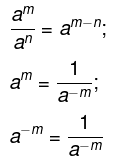
- Laws of exponents: (am)(an) = am+n ; (ab)m = ambm ; (am)n = amn
- Fractional and special exponents: a0 = 1 ; a1 = a ; a1/2 = √a ; am/n = (n√a)m
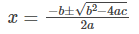
- Roots of a quadratic equation: For ax2 + bx + c = 0 where a ≠ 0, the roots are given by
- Δ = b2 - 4ac is called the discriminant
- For real and distinct roots, Δ > 0
- For real and equal (coincident) roots, Δ = 0
- For non-real roots (complex conjugates), Δ < 0
- If α and β are the two roots of ax2 + bx + c = 0 then α + β = -b/a and α × β = c/a
- If the roots of a quadratic equation are α and β, the equation can be written as (x - α)(x - β) = 0
Factorials
- n! = 1 · 2 · 3 · ... · (n - 1) · n
- Recursive relation: n! = n (n - 1)!
- 0! = 1

Worked Examples
Example 1: Find the value of 52 - 32
Sol:
Use the identity a2 - b2 = (a - b)(a + b).
Substitute a = 5 and b = 3.
(a - b)(a + b)
= (5 - 3)(5 + 3)
= 2 × 8
= 16
Example 2: 43 × 42 = ?
Sol:
Use the exponent rule (am)(an) = am+n.
Here a = 4, m = 3, n = 2.
43 × 42 = 43+2
= 45
= 1024
Notes, Uses and Remarks
- The binomial expansions for (a ± b)n follow the binomial theorem; coefficients correspond to entries in Pascal's triangle and are useful for quick expansions when n is small.
- Difference and sum of powers formulas are often used to factor expressions, simplify rational expressions, or to find roots when substituting particular values.
- Discriminant Δ quickly indicates the nature of roots without calculating them explicitly; use Δ to decide whether quadratic expressions factor over the real numbers.
- Factorials appear in permutations and combinations, series expansions and probability; remember 0! = 1 by convention to make combinatorial formulas consistent.
- Keep the exponent rules at hand to simplify products and powers; converting radicals to fractional exponents and vice versa can simplify many algebraic manipulations.
Summary
This sheet summarises core algebraic identities and elementary rules of exponents, quadratic root relations and factorial basics. Memorise the primary factorisation identities and exponent laws; practise applying them in algebraic simplification, factorisation and solving polynomial equations to build speed and accuracy.