Important Formulas: Quadratic Equations

Quadratic Equation
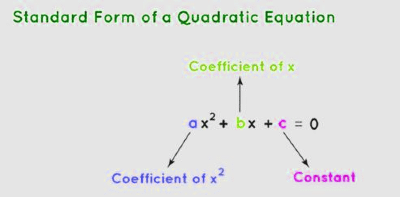
A quadratic equation is a second-degree polynomial equation in a single variable x, written in the standard form ax2 + bx + c = 0, where a, b and c are real coefficients and a ≠ 0. Any equation that can be reduced algebraically to this form is a quadratic equation. In problems it is often necessary to transform a given expression into this standard form before applying the usual methods of solution.
Roots of a Quadratic Equation
The roots (or solutions, or zeros) of a quadratic equation are the values of x that satisfy the equation and correspond to the x-intercepts of its graph. A quadratic generally has two roots; these may be real and distinct, real and equal (repeated), or complex conjugates.
Example: Solve x2 - 3x - 4 = 0 by factorisation and verify the roots.
x2 - 3x - 4 = 0
Factor the left side into two linear factors.
(x - 4)(x + 1) = 0
Set each factor equal to zero to obtain the roots.
x - 4 = 0 → x = 4
x + 1 = 0 → x = -1
Verification by substitution:
For x = -1: (-1)2 - 3(-1) - 4 = 1 + 3 - 4 = 0
For x = 4: 42 - 3(4) - 4 = 16 - 12 - 4 = 0
Methods to Solve Quadratic Equations
- Factorisation (if the quadratic factors over integers or rationals).
- Completing the square (useful for deriving the formula and solving some problems).
- The quadratic formula (works in all cases where a ≠ 0).
- Graphical method (intersection of y = ax2 + bx + c with the x-axis).
- Using sum and product of roots (Vieta's relations) to build or solve equations.
Quadratic Formula
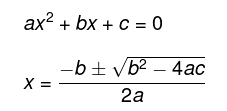
For the quadratic equation ax2 + bx + c = 0, the roots are given by the quadratic formula:
x = [-b ± √(b2 - 4ac)] / 2a
This expression gives both roots in one unified formula by choosing the plus or minus sign. In Indian school texts this is often called the Sridharacharya formula.
Example: Solve x2 - 3x - 4 = 0 using the quadratic formula.
Identify coefficients: a = 1, b = -3, c = -4.
Compute the discriminant: b2 - 4ac = (-3)2 - 4(1)(-4) = 9 + 16 = 25.
Apply the formula: x = [-(-3) ± √25] / (2·1)
x = [3 ± 5] / 2
Thus x = (3 + 5) / 2 = 4, or x = (3 - 5) / 2 = -1.
Nature of Roots and the Discriminant
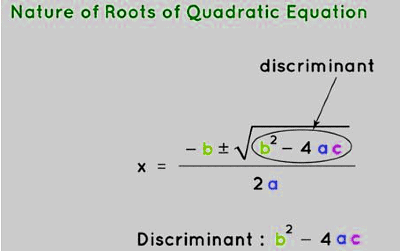
The quantity D = b2 - 4ac is called the discriminant. Its value determines the nature of the roots without computing them explicitly.
- If D > 0, the quadratic has two distinct real roots.
- If D = 0, the quadratic has two equal real roots (a repeated root).
- If D < 0, the quadratic has two non-real complex conjugate roots.
Sum and Product of Roots (Vieta's Formulae)
If the roots of ax2 + bx + c = 0 are denoted by α and β, then the following relations hold:
- α + β = -b/a
- αβ = c/a
Derivation (brief): Write ax2 + bx + c = a(x - α)(x - β) and expand to compare coefficients. The coefficient of x is -a(α + β) and the constant term is aαβ.
Forming a Quadratic Equation from Given Roots
If α and β are the roots required, the monic quadratic with those roots is
x2 - (α + β)x + αβ = 0
For a leading coefficient a (non-unit), the quadratic becomes
a x2 - a(α + β) x + aαβ = 0
Other Useful Results and Conditions
- Axis of symmetry: x = -b / (2a).
- Vertex: The vertex of y = ax2 + bx + c is at the point (-b / (2a), f(-b / (2a))).
- Minimum/Maximum value: If a > 0, the quadratic attains its minimum at x = -b / (2a) and the minimum value is f(-b / (2a)) = (4ac - b2) / (4a). If a < 0, the same x gives the maximum value.
- Domain and range: The domain of any quadratic function is all real numbers. The range is [minimum, ∞) if a > 0, and (-∞, maximum] if a < 0.
- Condition for equal roots: D = 0 implies equal roots, and the repeated root equals -b / (2a).
- Condition for two quadratics to have the same roots: For a1x2 + b1x + c1 = 0 and a2x2 + b2x + c2 = 0, the condition that they have the same pair of roots is
- This is the algebraic condition to check whether two quadratics share the same roots (useful in comparative root problems).
Completing the Square (Technique)
Completing the square transforms ax2 + bx + c into a form that makes vertex and minimum/maximum explicit. For a ≠ 0:
Write ax2 + bx + c = a[x2 + (b/a) x] + c
Add and subtract (b/2a)2 inside the bracket to get a complete square:
ax2 + bx + c = a[(x + b/(2a))2 - (b/(2a))2] + c
Thus the vertex x-coordinate is -b/(2a) and the vertex value is obtained by evaluating the expression at that x.
Applications (Quick Notes for Business / Quant Problems)
- Revenue, cost and profit models often lead to linear or quadratic expressions; profit maximisation problems reduce to finding the vertex of a quadratic profit function.
- Break-even analysis may require solving quadratic equations when revenue and cost curves are nonlinear.
- Optimisation in production, pricing problems and area/geometry problems in case studies frequently need quadratic solution techniques.
Illustration (symbolic): If revenue is R(x) and cost is C(x) = ax2 + bx + c, then profit P(x) = R(x) - C(x) may be a quadratic whose maximum is at x = -B / (2A) when P(x) = A x2 + B x + C and A < 0.
Summary
Quadratic equations are central to algebra and numerous quantitative problems. The quadratic formula and discriminant give immediate information about roots; Vieta's relations connect coefficients to root sums and products; completing the square reveals vertex and extremum. Mastery of factorisation, completing the square and the quadratic formula, together with an understanding of the discriminant and vertex formula, equips students to handle a wide range of algebraic and applied problems.