Worksheet Solutions: India's External Relations


Fill in the Blanks
Q1: India's foreign policy aimed at upholding peace and security through _____________ of all countries.
Ans: respect for the sovereignty
India's foreign policy focused on maintaining global peace and security by recognising and respecting the independence and sovereignty of all nations.
Q2: The first summit of the Non-Aligned Movement (NAM) was held in ____________ in September 1961.
Ans: Belgrade
The inaugural meeting of NAM, a grouping of countries that chose not to align with any major power bloc, took place in Belgrade, Yugoslavia, in 1961. This summit helped shape the Movement's early objectives and international standing.
Q3: The Paonchsheel Agreement outlined the "five principles of peaceful coexistence" between India and ____________.
Ans: China
The Paonchsheel Agreement set out five principles of peaceful coexistence emphasising mutual respect for territorial integrity and sovereignty. It aimed to provide a framework for peaceful relations between India and China.
Q4: The India-Pakistan Indus Waters Treaty was signed in ____________.
Ans: 1960
The Indus Waters Treaty, signed in 1960, governs the sharing and management of the Indus River system between India and Pakistan and established a mechanism for cooperation on water resources.
Q5: India conducted its first nuclear explosion in ____________.
Ans: May 1974
India conducted its first nuclear test in May 1974, marking a significant milestone in its nuclear programme and altering perceptions of its strategic capabilities.
Q6: The Bandung Conference, where NAM was founded, took place in the city of ____________ in 1955.
Ans: Bandung
The Bandung Conference, held in Bandung, Indonesia, in 1955, brought together newly independent countries from Asia and Africa to promote co-operation, oppose colonialism and racism, and laid the political foundation for the Non-Aligned Movement.
Q7: The Shimla Agreement was signed between India and ____________ in 1972.
Ans: Pakistan
The Shimla Agreement, signed in 1972 between India and Pakistan, sought to normalise relations after the 1971 war. It committed both parties to resolving differences through bilateral negotiations and to peaceful coexistence.
Match the Column
Q1:
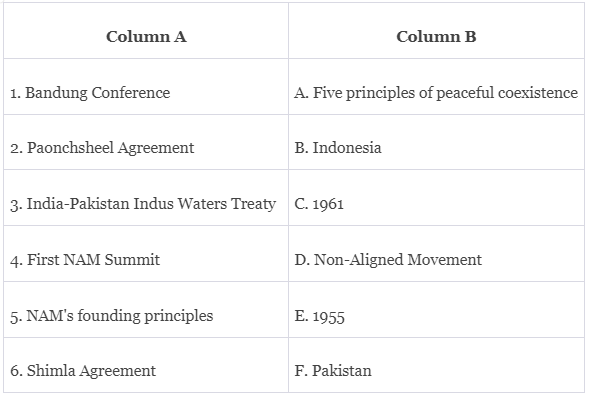
Ans: 1. Bandung Conference - B. Indonesia
The Bandung Conference was held in Indonesia in 1955. It brought together newly independent nations from Asia and Africa to discuss common concerns and to build solidarity against colonialism and racial discrimination.
2. Paonchsheel Agreement - A. Five principles of peaceful coexistence
The Paonchsheel Agreement, signed by Chinese Premier Zhou Enlai and Indian Prime Minister Nehru in 1954, set out the "five principles of peaceful coexistence" to guide peaceful relations between India and China.
3. India-Pakistan Indus Waters Treaty - F. Pakistan
The Indus Waters Treaty of 1960 deals with the allocation and management of the Indus river system between India and Pakistan, establishing a legal framework for co-operation on river waters.
4. First NAM Summit - D. Non-Aligned Movement
The first summit of the Non-Aligned Movement was held in Belgrade in 1961; NAM brought together countries that wished to remain independent of the two Cold War blocs.
5. NAM's founding principles - E. 1955
The founding principles of NAM-non-alignment, peaceful co-existence and opposition to domination by superpower blocs-were articulated at the Bandung Conference in 1955.
6. Shimla Agreement - C. 1972
The Shimla Agreement between India and Pakistan was signed in 1972 to restore and normalise relations after the 1971 war and to commit both countries to bilateral resolution of disputes.
Assertion and Reason Based
Q1: Assertion: India refused to sign the Nuclear Non-Proliferation Treaty (NPT) of 1968.
Reason: India considered NPT as discriminatory.
(a) Both Assertion and Reason are true, and the Reason is the correct explanation of the Assertion.
(b) Both Assertion and Reason are true, but the Reason is not the correct explanation of the Assertion.
(c) Assertion is true, but the Reason is false.
(d) Assertion is false, but the Reason is true.
Ans: (a)
Explanation:
(i) Assertion: India refused to sign the Nuclear Non-Proliferation Treaty (NPT) of 1968.
(ii) Reason: India considered the NPT discriminatory because it recognised only five states as legitimate nuclear weapon holders while denying the right to other states to develop nuclear weapons.
(iii) Justification: The Reason correctly explains the Assertion. India objected to the two-tier structure the NPT appeared to create, viewing it as an unfair distinction between nuclear 'haves' and 'have-nots', which led India to refuse to sign.
Q2: Assertion: The Bandung Conference in 1955 laid the foundation for the Non-Aligned Movement (NAM).
Reason: NAM was formed to counter the dominance of the superpower blocs led by the US and USSR.
(a) Both Assertion and Reason are true, and the Reason is the correct explanation of the Assertion.
(b) Both Assertion and Reason are true, but the Reason is not the correct explanation of the Assertion.
(c) Assertion is true, but the Reason is false.
(d) Assertion is false, but the Reason is true.
Ans: (a)
Explanation:
(i) Assertion: The Bandung Conference in 1955 laid the foundation for the Non-Aligned Movement (NAM).
(ii) Reason: NAM was formed to counter the dominance of the superpower blocs led by the US and the USSR by creating an independent voice for newly independent countries.
(iii) Justification: The Reason correctly explains the Assertion because the Bandung meeting brought together Asian and African states that sought an independent course in international politics, which directly led to the creation of NAM.
Q3: Assertion: The Shimla Agreement in 1972 resolved all the issues between India and Pakistan permanently.
Reason: The Shimla Agreement led to peaceful coexistence and normalized relations between the two countries.
(a) Both Assertion and Reason are true, and the Reason is the correct explanation of the Assertion.
(b) Both Assertion and Reason are true, but the Reason is not the correct explanation of the Assertion.
(c) Assertion is true, but the Reason is false.
(d) Assertion is false, but the Reason is true.
Ans: (b)
Explanation:
(i) Assertion: The Shimla Agreement in 1972 resolved all the issues between India and Pakistan permanently. (This assertion is not correct.)
(ii) Reason: The Shimla Agreement led to peaceful coexistence and normalised relations between the two countries. (This is true in intent and partial effect.)
(iii) Justification: While the Shimla Agreement aimed to normalise relations and to settle matters by bilateral negotiation, it did not permanently resolve every dispute. Thus both statements are true in part, but the Reason does not fully explain the incorrect claim that all issues were permanently resolved.
Very Short Answer Type Questions
Q1: Who was in charge of India's foreign policy from 1946 to 1964?
Ans: Jawaharlal Nehru
Q2: When was the Bandung Conference held?
Ans: 1955
Q3: Name one of the territories over which China has territorial claims in India.
Ans: Aksai-Chin area in Ladakh
Q4: Which Indian leader gave asylum to the Dalai Lama in 1959?
Ans: Jawaharlal Nehru
Q5: Who signed the Shimla Agreement on behalf of Pakistan in 1972?
Ans: Zulfikar Ali Bhutto
Q6: What did the Paonchsheel Agreement outline?
Ans: "Five principles of peaceful coexistence"
Q7: Which Indian state faced armed attacks by Pakistan in 1965?
Ans: Jammu and Kashmir
Q8: Which country hosted the first NAM summit in 1961?
Ans: Belgrade, Yugoslavia
Q9: Who signed the India-Pakistan Indus Waters Treaty in 1960?
Ans: Jawaharlal Nehru and General Ayub Khan
Q10: Why did India conduct nuclear tests in 1998?
Ans: To demonstrate its nuclear capability and to assert strategic deterrence
Short Answer Type Questions
Q1: Describe India's foreign policy goals after independence.
Ans:
- India aimed to uphold peace and security by respecting the sovereignty of all nations and by promoting peaceful co-existence.
- India also pursued rapid economic development while preserving its hard-won political independence and sovereignty.
Q2: How did India handle its relations with the US and the USSR during the Cold War era?
Ans:
- India followed a policy of non-alignment, avoiding formal military alliances with either superpower bloc.
- At the same time, India maintained an independent stance and accepted economic and technical assistance from both the United States and the Soviet Union as required.
Q3: Explain the significance of the Bandung Conference in 1955.
Ans:
- The Bandung Conference provided the platform for newly independent Asian and African countries to come together and to articulate common political and economic concerns.
- It laid the political groundwork for the Non-Aligned Movement by promoting co-operation, opposition to colonialism and racial discrimination, and by encouraging independent foreign policies.
Q4: What were the consequences of the Sino-Indian conflict in 1962?
Ans:
- The 1962 war harmed India's domestic and international standing and exposed weaknesses in defence preparedness.
- The conflict led to political shifts at home, including divisions within parties such as the Communist Party of India, and to a re-evaluation of India's strategic partnerships, resulting in closer ties with the USSR for a period.
Q5: Detail the events leading to the India-Pakistan conflict in 1971.
Ans:
- Political unrest and repression in East Pakistan caused a large-scale refugee influx into India in 1971, creating a major humanitarian and security challenge for India.
- Diplomatic attempts to resolve the crisis failed and tensions escalated, culminating in open war between India and Pakistan in December 1971 and the eventual creation of Bangladesh.
Q6: Explain India's stance on the Nuclear Non-Proliferation Treaty (NPT).
Ans:
- India regarded the NPT as discriminatory because it appeared to legitimise the nuclear status of a few states while denying others the same status; therefore India refused to sign.
- India later carried out nuclear tests (in 1974 and again in 1998) to demonstrate its nuclear capability while emphasising its desire for global disarmament and a responsible nuclear policy.
Q7: What were the main principles outlined in the Paonchsheel Agreement of 1954?
Ans:
- The Panchsheel Agreement set out the "five principles of peaceful coexistence", including mutual respect for territorial integrity and sovereignty, non-aggression, non-interference in internal affairs, equality and mutual benefit, and peaceful co-existence.
- These principles were intended to guide relations between India and China and to promote peaceful resolution of disputes.
Q8: How did the Shimla Agreement in 1972 impact India-Pakistan relations?
Ans:
- The Shimla Agreement aimed to normalise relations after the 1971 war by committing both countries to settle differences through bilateral negotiations rather than third-party mediation.
- While it established a framework for peaceful coexistence, it did not resolve every outstanding issue between the two countries.
Long Answer Type Questions
Q1: Explain India's Policy of Non-Alignment during the Cold War era.
Ans: India's Policy of Non-Alignment, championed by Prime Minister Jawaharlal Nehru, sought to preserve India's independence in foreign affairs by avoiding formal alignment with either superpower bloc. The policy emphasised sovereign decision-making, the pursuit of peaceful co-existence, and the desire to secure economic and technical assistance from multiple sources. Non-alignment allowed India to follow an autonomous path in international relations while supporting decolonisation and cooperation among newly independent states.
Q2: Discuss the Impact of the Sino-Indian Conflict in 1962 on India's Foreign Relations.
Ans: The 1962 Sino-Indian war had several important consequences for India's foreign relations. It exposed deficiencies in India's defence preparedness and led to a loss of confidence at home. Internationally, the conflict strained India's relations with some countries and prompted New Delhi to reassess its strategic options. As a result, India moved closer to the Soviet Union for military and diplomatic support for a time, and it also sought to strengthen its own defence capabilities and border management.
Q3: Describe the Factors Leading to the India-Pakistan Conflict in 1971 and Its Aftermath.
Ans: Political repression and a denial of political rights in East Pakistan produced a mass movement for autonomy and large numbers of refugees fleeing to India in 1971. Diplomatic efforts to resolve the crisis failed, and India intervened militarily in support of the Bengali nationalist movement, which led to a short but decisive war in December 1971. The conflict resulted in the independence of Bangladesh and significantly altered South Asian geopolitics. The Shimla Agreement of 1972 then sought to set the terms for peaceful bilateral relations between India and Pakistan.
Q4: Evaluate India's Nuclear Policy and Its Stance on the Nuclear Non-Proliferation Treaty (NPT).
Ans: India's nuclear policy combined a commitment to peaceful uses of atomic energy with a determination to maintain strategic autonomy. India refused to sign the NPT in 1968 because it considered the treaty discriminatory, as it appeared to grant permanent nuclear status to a limited group of countries while restricting others. India demonstrated its nuclear capability with tests in 1974 and again in 1998, and subsequently articulated a policy that emphasised responsible behaviour, a declared stance of "no first use" and support for global nuclear disarmament under universal and non-discriminatory arrangements.
FAQs on Worksheet Solutions: India's External Relations
| 1. What are India's external relations? |  |
| 2. What is the significance of India's external relations? | |
| 3. How does India conduct its external relations? | |
| 4. What are some key areas of focus in India's external relations? | |
| 5. How does India's external relations impact its citizens? | |