Overview: Progressions (Sequences & Series)


Introduction
Sequence and series are fundamental topics in arithmetic and quantitative aptitude. A sequence is an ordered list of numbers (or objects) that follow a specific rule. A series is the sum of the terms of a sequence. Common examples include arithmetic progressions and geometric progressions, which are widely used in problem solving for competitive examinations.
- A sequence is a list of items arranged in a definite order.
- A series is the sum of terms of a sequence; the sequence must have a definite relationship between terms.
Sequence and Series - Notation and Definition
Let the terms of a sequence be denoted by a1, a2, a3, a4, ... where the index 1, 2, 3, 4, ... denotes the position of each term.
A sequence may be finite or infinite. If a1, a2, ..., aN is a finite sequence, the corresponding finite series is
SN = a1 + a2 + a3 + ... + aN
If the sequence is infinite, the associated series may be finite (convergent) or infinite (divergent) depending on whether the infinite sum converges.
In CAT-oriented problems, infinite series-when discussed-are typically limited to geometric progressions with |r| < 1.
Common Types of Sequences and Series
- Arithmetic sequences (Arithmetic Progression, AP)
- Geometric sequences (Geometric Progression, GP)
- Harmonic sequences (HP)
- Fibonacci sequence
Arithmetic Progression (AP)
An arithmetic progression is a sequence in which each term after the first is obtained by adding a fixed number, called the common difference d, to the previous term. If a is the first term, the sequence is
a, a + d, a + 2d, a + 3d, ...
The nth term (Tn) of an AP is
Tn = a + (n - 1)d
The last term l (if there are n terms) satisfies
l = a + (n - 1)d
The sum of the first n terms (Sn) of an AP is
Sn = n/2 × [2a + (n - 1)d] = n/2 × (a + l)
Geometric Progression (GP)
A geometric progression is a sequence in which each term after the first is obtained by multiplying the previous term by a fixed number, called the common ratio r. If a is the first term, the sequence is
a, ar, ar2, ar3, ...
The nth term (Tn) of a GP is
Tn = a rn-1
The sum of the first n terms (Sn) for r ≠ 1 is
Sn = a × (1 - rn) / (1 - r)
If |r| < 1, the infinite geometric series converges and its sum is
S∞ = a / (1 - r)
Note: In CAT, infinite series questions are limited only to geometric progressions with |r| < 1.
Harmonic Progression (HP)
A sequence is in harmonic progression if the reciprocals of its terms form an arithmetic progression. For example, if bn = 1/an is an AP, then an is an HP.
If a1, a2, a3,...... are in HP, then 1/a1, 1/a2, 1/a3, ...... are in AP.
Note: Problems involving HP are solved by converting the HP into an AP by taking reciprocals of the terms.
Fibonacci Sequence
The Fibonacci sequence is defined by the recurrence
F0 = 0, F1 = 1, and Fn = Fn-1 + Fn-2 for n ≥ 2.
The sequence begins 0, 1, 1, 2, 3, 5, 8, 13, ...
Note: For CAT, Fibonacci problems are solved using the recurrence relation or pattern recognition. Closed-form formulas are not required.
Sequence and Series - Key Formulas
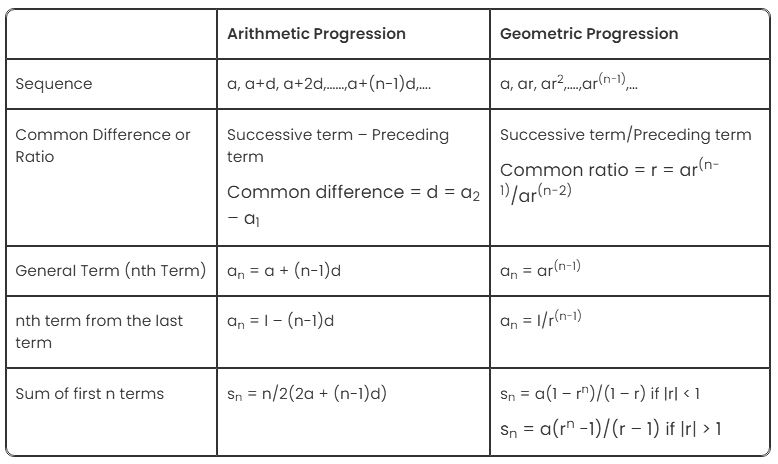
*Here, a = first term, d = common difference, r = common ratio, n = position of term, l = last term.
- AP nth term: Tn = a + (n - 1)d
- AP sum: Sn = n/2 × [2a + (n - 1)d] = n/2 × (a + l)
- GP nth term: Tn = a rn-1
- GP sum (r ≠ 1): Sn = a × (1 - rn) / (1 - r)
- GP infinite sum (|r| < 1): S∞ = a / (1 - r)
- HP: an such that 1/an is arithmetic
- Fibonacci recurrence: Fn = Fn-1 + Fn-2
Difference Between Sequence and Series
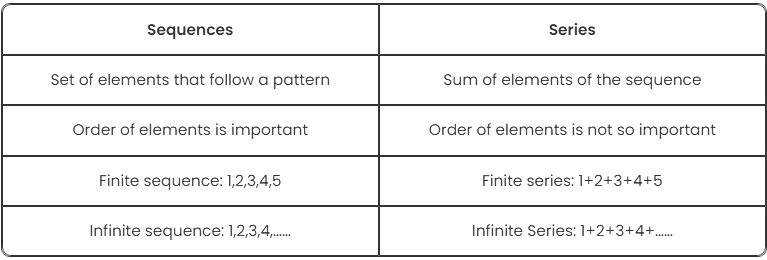
A sequence lists elements in order; a series sums elements of a sequence. A sequence may be finite or infinite. A series formed from an infinite sequence may converge (sum has a finite value) or diverge.
Sequence and Series Examples
Question 1: If 4,7,10,13,16,19,22......is a sequence, Find:
(a) Common difference
(b) nth term
(c) 21st term
Sol:
(a) The common difference = 7 - 4 = 3
(b) The nth term of the arithmetic sequence is denoted by the term Tn and is given by Tn = a + (n-1)d, where "a" is the first term and d is the common difference.
Tn = 4 + (n - 1)3 = 4 + 3n - 3 = 3n + 1
(c) 21st term as: T21 = 4 + (21-1)3 = 4+60 = 64.
Q2: Consider the sequence 1, 4, 16, 64, 256, 1024..... Find the common ratio and 9th term.
Sol: The common ratio (r) = 4/1 = 4
The preceding term is multiplied by 4 to obtain the next term.
The nth term of the geometric sequence is denoted by the term Tn and is given by Tn = ar(n-1) where a is the first term and r is the common ratio.
Here a = 1, r = 4 and n = 9
So, 9th term is can be calculated as T9 = 1* (4)(9-1)= 48 = 65536.
Useful Remarks and Problem-solving Tips
- To identify an AP, check for constant differences between consecutive terms. To identify a GP, check for constant ratios.
- When asked for the nth term, substitute a and d (or r) into the relevant nth-term formula.
- When given sum-related conditions, express the sum using Sn formulas and solve for unknowns.
- For infinite GP sums, ensure |r| < 1 before using S∞ = a/(1 - r).
- Recurrence relations (like Fibonacci) often require initial terms; use them to generate further terms or derive closed forms when needed.
FAQs on Overview: Progressions (Sequences & Series)
| 1. What is the difference between a sequence and a series? |  |
| 2. What are the types of sequences? | |
| 3. How can I differentiate between a geometric sequence and an arithmetic sequence? | |
| 4. What is the formula for a geometric sequence? | |
| 5. What can the GMAT ask us to do with sequences and series? | |