Passage Based Questions: Challenges of Nation Building - 2


Passage - 1
Q. 1. Examine the cartoon carefully and answer the following questions:
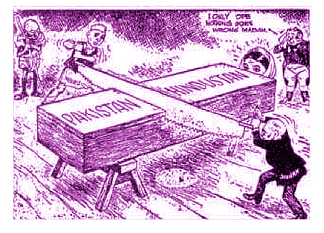
(i) What were the primary causes of the partition? (Mention any two)
Ans: (a) The Two-Nation Theory promoted by the Muslim League, which argued that Hindus and Muslims were distinct nations and therefore needed separate states.
(b) Rising communal tensions and repeated communal violence between the two communities, compounded by political disagreements and failures of negotiated power-sharing, which made a single united settlement appear unworkable. [2]
(ii) On what basis was the Two-Nation Theory formulated?
Ans: The Two-Nation Theory rested on the claim that Hindus and Muslims differed substantially in religion, culture, social practices and political outlook, and that these differences justified separate nation-states so that each community could protect its distinct identity and interests. [1]
(iii) Which two states were undecided about joining either country during the partition?
Ans: Two prominent princely states that were undecided were Jammu and Kashmir and Hyderabad; Travancore also initially considered remaining independent before acceding later. [1]
(iv) Which prominent political leader opposed the partition?
Ans: Mahatma Gandhi opposed the partition and the idea of dividing the country on religious lines, advocating instead for unity and communal harmony. [1]
Passage - 2
Q. 2. Read the passage below and respond to the following questions:
"We have a Muslim minority who are so large in numbers that they cannot, even if they want, go anywhere else. That is a basic fact about which there can be no argument. Whatever the provocation from Pakistan and whatever the indignities and horrors inflicted on non-Muslims there, we have got to deal with this minority in a civilized manner. We must give them security and the rights of citizens in a democratic State. If we fail to do so, we shall have a festering sore which will eventually poison the whole body politic and probably destroy it." -Jawaharlal Nehru
(i) Why did Jawaharlal Nehru emphasize dealing with the Muslim minority in a civilized manner?
Ans: Nehru stressed a civilized approach because a large Muslim population remained within India after partition and could not simply move elsewhere. Given the recent violence across the border, he believed it was essential to protect their safety and rights to prevent further suffering and long-term instability.
(ii) Why should this minority be granted security and rights on par with others in a democratic system?
Ans: In a democratic and secular state, equal treatment of all citizens is a fundamental principle. Granting the Muslim minority security and equal civil and political rights upholds democracy, prevents discrimination, and helps maintain social peace and national unity.
(iii) What scenario is anticipated if this minority is not provided security and rights?
Ans: If the minority is denied security and rights, Nehru warned that it would become a persistent source of grievance - a "festering sore" - that could spread communal distrust, weaken democratic institutions and potentially threaten the stability and integrity of the political system. [1 + 2 + 2 = 5]
Passage - 3
Q. 3. Read the passage below and answer the following questions:
"We should begin to work in that spirit, and in course of time, all these angularities of the majority and minority communities-the Hindu community and the Muslim community-because even as regards Muslims, you have Pathans, Punjabis, Shias, Sunnis, and so on, and among the Hindus, you have Brahmins, Vaishnavas, Khatris, also Bengalees, Madrasis, and so on-will vanish. ... You are free; you are free to go to your temples, you are free to go to your mosques or to any other place of worship in this State of Pakistan. You may belong to any religion or caste or creed-that has nothing to do with the business of the State."
(i) Who made this statement, and when and where was it delivered?
Ans: The statement was made by Mohammad Ali Jinnah in his Presidential Address to the Constituent Assembly of Pakistan in Karachi on 11 August 1947. [2]
(ii) Does this statement contradict the Two-Nation Theory that led to the creation of Pakistan? Justify your answer.
Ans: The statement does not contradict the Two-Nation Theory. Jinnah's call for religious freedom and equal treatment of minorities within Pakistan was an effort to define the new state as one where Muslims had a homeland but where the state would protect the rights of all communities rather than exclude or persecute them. [1]
(iii) To what extent did Pakistan fulfill the expectations outlined in the passage?
Ans: Pakistan did not fully realise Jinnah's liberal expectations. Over time, political developments and sections of society moved towards a more religiously conservative identity, and minorities often faced discrimination and loss of rights, so the ideal of equal treatment for all was only partly achieved. [1]
(iv) What is the central message of the statement above?
Ans: The central message is Jinnah's declaration of religious freedom and equal civic rights for all citizens, signalling a commitment that religion or caste should not determine a person's standing before the State. [1]
Passage - 4
Q. 4. Examine the picture provided and answer the following questions:
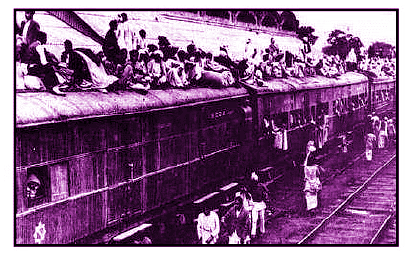
(i) What does this picture represent?
Ans: The picture depicts the painful scenes of partition in 1947, showing people forced to flee their homes, leaving behind property and community life amid violence and chaos.
(ii) List a few consequences of the partition.
Ans: (a) Communal riots, leading to large-scale loss of life and insecurity
(b) Social suffering, including mass displacement, family separations and trauma
(c) Administrative and financial strains on the new governments to deal with refugees and restore order. (Any Two)
(iii) Which year is depicted in the picture?
Ans: The year depicted is 1947, the year of Indian independence and the partition, which witnessed large-scale and often abrupt population movements.
Passage - 5
Q. 1. Read the passage below and respond to the following questions:
"The interim government took a firm stance against the possible division of India into smaller principalities of different sizes. The Muslim League opposed the Indian National Congress and took the view that the States should be free to adopt any course they liked. Sardar Patel, India's Deputy Prime Minister and the Home Minister during the crucial period, immediately after independence, played a historic role in negotiating with the rulers of princely states in bringing most of them into the Indian Union."
(i) What is referred to as the interim government?
Ans: The term refers to the provisional government formed under the leadership of the Indian National Congress to administer British India in the transitional period prior to and immediately after independence. [1]
(ii) Why did the Muslim League oppose the Indian National Congress?
Ans: The Muslim League opposed the Congress position because it argued that the princely states should have the freedom to choose their own future; the League feared that a strong central policy by Congress might deny the rulers and their states the option to decide independently. [2]
(iii) What makes Sardar Patel's role historically significant?
Ans: Sardar Vallabhbhai Patel's role was historically significant because he used firm but diplomatic negotiations to persuade and integrate the majority of princely states into the Indian Union, securing India's territorial unity at a critical moment. [2]
Passage - 6
Q. 2. Read the passage below and respond to the following questions:
"In the history of nation-building, only the Soviet experiment bears comparison with the Indian. There too, a sense of unity had to be forged between many diverse ethnic groups, religious, linguistic communities, and social classes. The scale-geographic as well as demographic-was comparably massive. The raw material the state had to work with was equally unpropitious: a people divided by faith and driven by debt and disease." -Ramachandra Guha
(i) What commonalities does the author identify between India and the Soviet Union? Provide one example of each from India.
Ans: The author highlights the following commonalities:
(a) Both required forging unity across numerous ethnic, religious and linguistic groups - for example, India brought together many language and faith communities within one political framework.
(b) The scale of the challenge was very large geographically and demographically - for example, India encompasses vast territory and a very large population spread over many regions.
(c) Both started with difficult socio-economic conditions - for example, India faced widespread poverty, disease and heavy economic challenges at independence. [2]
(ii) The author does not mention the differences between the two experiments. Can you list two dissimilarities?
Ans: Two clear dissimilarities are:
(a) The Soviet Union became a single-party communist state, whereas India adopted a multi-party democratic system.
(b) The Soviet Union eventually disintegrated into many independent states after 1991, while India has maintained its territorial unity and constitutional framework. [2]
(iii) In retrospect, which of these experiments proved more successful, and why?
Ans: The Indian experiment is generally seen as more successful in terms of sustaining a pluralistic democratic polity and preserving national unity while accommodating linguistic and cultural diversity. [1]
Passage - 7
Q. 3. Study the picture below and respond to the following questions:
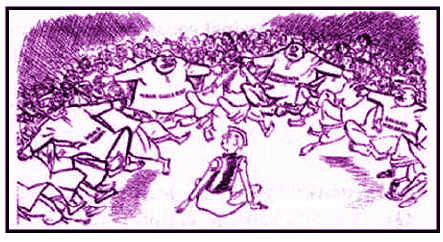
(i) Identify the individual at the center of the cartoon and describe the challenge he is facing.
Ans: The central figure is Pt. Jawaharlal Nehru. He is shown confronting the twin challenge of integrating diverse princely states and managing demands for the reorganisation of provinces on a linguistic basis, while preventing the disintegration of the country.
(ii) What is the picture actually referring to?
Ans: The cartoon refers to the difficult process of reorganising states on linguistic lines and the accompanying anxiety that such reorganisation might threaten national unity if not handled carefully.
(iii) How did India manage to avoid these conflicts?
Ans: India addressed regional demands through negotiations and institutional measures: it recognised linguistic aspirations by reorganising states, strengthened democratic processes and decentralised powers to states, thereby accommodating diversity and reducing the likelihood of secessionist conflict.
Passage - 8
Direction: Read the following Passage and Answer the Questions.This was not going to be easy. India was born in very difficult circumstances. Perhaps no other country by then was born in a situation more difficult than that of India in 1947. Freedom came with the partition of the country. The year 1947 was a year of unprecedented violence and trauma of displacement. It was in this situation that independent India started on its journey to achieve several objectives. Yet the turmoil that accompanied independence did not make our leaders lose sight of the multiple challenges that faced the new nation.
Q1: What challenges did India face during its early years of independence in 1947?
Ans:
- India faced the immediate trauma of partition, which produced widespread communal violence and the mass displacement of people.
- The new nation also had to begin its work of state-building and development despite the social and administrative turmoil of 1947.
Q2: What were the circumstances under which India gained independence in 1947?
Ans:
- India attained independence in 1947 at the cost of a partition that created two separate states, India and Pakistan.
- The circumstances were exceptionally difficult, marked by violence, refugee flows and the collapse of long-standing administrative arrangements.
Q3: Despite the difficult situation at the time of independence, what did India's leaders demonstrate in terms of their vision for the country's future?
Ans:
- India's leaders retained a long-term vision and determination to tackle multiple challenges and build democratic institutions, even while coping with immediate crises.
- They continued to plan for nation-building, social welfare and political stability, showing resolve to guide the country toward its objectives.
Passage - 9
Direction: Read the following Passage and Answer the Questions.
The second challenge was to establish democracy. You have already studied the Indian Constitution. You know that the Constitution granted fundamental rights and extended the right to vote to every citizen. India adopted representative democracy based on the parliamentary form of government. These features ensure that the political competition would take place in a democratic framework.
Q1: What was the second major challenge faced by India in its early years of independence, as mentioned in the passage?
Ans: The second major challenge was the establishment of democracy across a vast and diverse country.
Q2: How did the Indian Constitution address the challenge of establishing democracy, and what key rights and provisions were granted to citizens?
Ans:
- The Constitution granted fundamental rights and extended the right to vote to all adult citizens, ensuring universal franchise.
- India adopted a representative parliamentary system, enabling democratic political competition and accountability through elected institutions.
Q3: How do the features of the Indian Constitution, as described in the passage, contribute to ensuring political competition within a democratic framework?
Ans:
- Fundamental rights protect individual freedoms and provide a legal framework for political participation.
- Universal suffrage and the parliamentary system create institutions through which different political opinions can compete and be resolved peacefully within constitutional procedures.
Passage - 10
Direction: Read the following Passage and Answer the Questions.
The idea might appear simple, but it presented all kinds of difficulties. First of all, there was no single belt of Muslim majority areas in British India. There were two areas of concentration, one in the west and one in the east. There was no way these two parts could be joined. So it was decided that the new country, Pakistan, will comprise two territories, West and East Pakistan separated by a long expanse of Indian territory. Secondly, not all Muslim majority areas wanted to be in Pakistan. Khan Abdul Gaffar Khan, the undisputed leader of the North Western Frontier Province and known as 'Frontier Gandhi', was staunchly opposed to the two-nation theory. Eventually, his voice was simply ignored and the NWFP was made to merge with Pakistan.
Q1: What geographical challenge did the idea of creating Pakistan face, and how was it resolved?
Ans:
- There was no continuous contiguous belt of Muslim-majority areas; the concentration was split between western and eastern regions.
- To accommodate this, Pakistan was created as two separate territories-West Pakistan and East Pakistan-separated by a large stretch of Indian territory.
Q2: Who was Khan Abdul Gaffar Khan, and what was his stance regarding the two-nation theory and Pakistan's creation?
Ans:
- Khan Abdul Gaffar Khan, called 'Frontier Gandhi', was the leader of the North Western Frontier Province and a close associate of the Congress movement.
- He strongly opposed the two-nation theory and Pakistan's creation, but his objections were ultimately ignored and the NWFP was included in Pakistan.
Q3: What were the two major regions that formed the territories of Pakistan, and what geographical feature separated them?
Ans:
- Pakistan comprised two major regions: West Pakistan (present-day Pakistan) and East Pakistan (present-day Bangladesh).
- These regions were separated by a long expanse of Indian territory, making them non-contiguous.
Passage - 11
Direction: Read the following Passage and Answer the Questions.
Forced to abandon their homes and move across borders, people went through immense sufferings. Minorities on both sides of the border fled their home and often secured temporary shelter in 'refugee camps'. They often found unhelpful local administration and police in what was till recently their own country. They travelled to the other side of the new border by all sorts of means, often by foot. Even during this journey they were often attacked, killed or raped. Thousands of women were abducted on both sides of the border. They were made to convert to the religion of the abductor and were forced into marriage. In many cases women were killed by their own family members to preserve the 'family honour'. Many children were separated from their parents.
Q1: What were the common experiences of people who were forced to leave their homes and cross borders during this period?
Ans:
- Displaced people suffered greatly: they lost homes and livelihoods and often lived temporarily in overcrowded refugee camps.
- During the journey across borders many faced violence, attacks and lack of support from local authorities, making the trek extremely dangerous.
Q2: What were the fates of many women who were abducted during this period, as mentioned in the passage?
Ans:
- Thousands of women were abducted; many were forced to convert to the religion of their abductors and compelled into forced marriages.
- In some tragic cases, families killed women to preserve perceived 'honour', and many women endured long-term trauma and social stigma.
Q3: How did the forced migration affect families, especially in terms of relationships and separation?
Ans:
- Forced migration caused widespread family separations; many children became separated from parents and families were permanently divided.
- The social fabric of communities was severely disrupted, with long-lasting emotional and economic consequences for survivors.
Passage - 12
Direction: Read the following Passage and Answer the Questions.
Beyond the administrative concerns and financial strains, however, the partition posed another deeper issue. The leaders of the Indian national struggle did not believe in the two-nation theory. And yet, partition on religious basis had taken place. Did that make India a Hindu nation automatically? Even after large scale migration of Muslims to the newly created Pakistan, the Muslim population in India accounted for 12 per cent of the total population in 1951.
Q1: What deeper issue did the partition of India pose beyond administrative and financial concerns?
Ans: Partition raised the deeper constitutional and identity question of whether India would become automatically a Hindu nation simply because it had been partitioned on religious lines, despite its leaders' opposition to that theory.
Q2: What was the stance of the leaders of the Indian national struggle on the two-nation theory?
Ans: The leaders of the national movement rejected the two-nation theory and argued for a united, pluralistic India where different communities could coexist under a common political framework.
Q3: What was the demographic composition of India in terms of its Muslim population in 1951, and how did it relate to the question of India being automatically considered a Hindu nation?
Ans: In 1951, Muslims still made up about 12 per cent of India's population, indicating that India remained religiously diverse and challenging the idea that partition automatically turned India into a solely Hindu nation.
Passage - 13
Direction: Read the following Passage and Answer the Questions.
British India was divided into what were called the British Indian Provinces and the Princely States. The British Indian Provinces were directly under the control of the British government. On the other hand, several large and small states ruled by princes, called the Princely States, enjoyed some form of control over their internal affairs as long as they accepted British supremacy. This was called paramountcy or suzerainty of the British crown. Princely States covered one-third of the land area of the British Indian Empire and one out of four Indians lived under princely rule.
Q1: What were the two main categories of administrative divisions in British India, and how did they differ in terms of governance?
Ans: British India consisted of British Indian Provinces, which were directly governed by the British, and Princely States, which were ruled by local princes but recognised British suzerainty and retained some internal autonomy.
Q2: What was the extent of the Princely States' coverage in terms of land area and population within the British Indian Empire?
Ans:
- Princely States covered about one-third of the land area of the Empire.
- Approximately Indians lived under princely rule, showing their significant demographic presence.
Q3: How did the British crown's authority over the Princely States manifest, and what was the term used to describe it?
Ans: The British crown's control was expressed through a relationship of paramountcy or suzerainty, whereby princes retained internal control but accepted British supremacy in external matters and overall sovereignty.
Passage - 14
Direction: Read the following Passage and Answer the Questions.
Sardar Patel was India's Deputy Prime Minister and the Home Minister during the crucial period immediately following Independence. He played a historic role in negotiating with the rulers of princely states firmly but diplomatically and bringing most of them into the Indian Union. It may look easy now. But it was a very complicated task which required skilful persuasion. For instance, there were 26 small states in today's Orissa. Saurashtra region of Gujarat had 14 big states, 119 small states and numerous other different administrations.
Q1: What important roles did Sardar Patel hold in the Indian government immediately after Independence, and what was his historic contribution during that period?
Ans:
- Sardar Patel served as Deputy Prime Minister and Home Minister after Independence.
- He played a pivotal role in persuading and integrating a large number of princely states into the Indian Union, thereby securing India's territorial unity.
Q2: What was the nature of the challenge faced by Sardar Patel in negotiating with princely states, and what were some examples of regions with complex administrative divisions?
Ans:
- The task was highly complex because there were very many and very diverse princely states with different sizes and administrations.
- For example, the area of present-day Orissa had 26 small states, and Saurashtra included 14 big states and 119 small states with varied administrative arrangements.
Q3: What made Sardar Patel's role in integrating princely states into the Indian Union historically significant, and why was it considered a challenging task?
Ans:
- His role was significant because it achieved the political integration of India, preventing fragmentation.
- The sheer number of states, differing local rulers and administrative systems made the negotiations delicate and challenging, requiring both firmness and diplomacy.
Passage - 15
Direction: Read the following Passage and Answer the Questions.
In the meantime, a movement of the people of Hyderabad State against the Nizam's rule gathered force. The peasantry in the Telangana region in particular, was the victim of Nizam's oppressive rule and rose against him. Women who had seen the worst of this oppression joined the movement in large numbers. Hyderabad town was the nerve centre of this movement. The Communists and the Hyderabad Congress were in the forefront of the movement. The Nizam responded by unleashing a para-military force known as the Razakars on the people.
Q1: What was the key driving force behind the movement of the people of Hyderabad State against the Nizam's rule?
Ans: The movement was driven primarily by widespread oppression and exploitation of the peasantry, especially in the Telangana region, which provoked mass resistance against the Nizam's rule.
Q2: Which groups or organizations played a significant role in leading the movement against the Nizam's rule, and where was the nerve centre of this movement located?
Ans: The Communists and the Hyderabad Congress led the agitation, and Hyderabad town served as the nerve centre of the movement.
Q3: How did the Nizam respond to the growing movement against his rule, and what was the paramilitary force he used against the people?
Ans: The Nizam resorted to repression by deploying a para-military militia called the Razakars to intimidate and suppress the popular movement.
Passage - 16
Direction: Read the following Passage and Answer the Questions.
Under the pressure of public opinion, the Maharaja held elections in Manipur in June 1948 and the state became a constitutional monarchy. Thus Manipur was the first part of India to hold an election based on universal adult franchise. In the Legislative Assembly of Manipur there were sharp differences over the question of merger of Manipur with India. While the state Congress wanted the merger, other political parties were opposed to this. The Government of India succeeded in pressurising the Maharaja into signing a Merger Agreement in September 1949, without consulting the popularly elected Legislative Assembly of Manipur.
Q1: What significant event took place in Manipur in June 1948, and why was it historically noteworthy?
Ans:
- In June 1948 elections were held in Manipur under pressure from public opinion, and the state became a constitutional monarchy.
- Manipur was notable as the first area in India to hold an election based on universal adult franchise during that period.
Q2: What was the key point of contention in the Legislative Assembly of Manipur regarding the merger with India, and which political parties held differing views on this matter?
Ans: The main contention was whether Manipur should merge with the Indian Union; the state Congress supported merger while other regional parties opposed it.
Q3: How did the merger with India take place in Manipur, and why was it a source of controversy?
Ans: The Government of India persuaded the Maharaja to sign a Merger Agreement in September 1949, but this was done without consulting the popularly elected Legislative Assembly and therefore generated controversy about legitimacy and procedure.
Passage - 17
Direction: Read the following Passage and Answer the Questions.
Our national movement had rejected these divisions as artificial and had promised the linguistic principle as the basis of formation of states. In fact after the Nagpur session of Congress in 1920 the principle was recognised as the basis of the reorganisation of the Indian National Congress party itself. Many Provincial Congress Committees were created by linguistic zones, which did not follow the administrative divisions of British India.
Q1: What principle did the Indian national movement reject as artificial when it came to the formation of states, and what principle did it endorse instead?
Ans: The movement rejected artificial administrative divisions and instead endorsed the linguistic principle-that states should be organised to reflect linguistic and cultural affinities.
Q2: How was the linguistic principle embraced within the Indian National Congress, and what specific changes did it bring about within the party?
Ans: After the Nagpur session of 1920 the Congress accepted the linguistic principle and reorganised some of its structures accordingly, creating many Provincial Congress Committees on linguistic lines rather than strictly following British administrative boundaries.
Q3: Why was the linguistic principle favored for state formation, and how did it reflect the sentiment within the Indian national movement?
Ans: The linguistic principle was favoured because it respected people's cultural and linguistic identities and helped accommodate regional aspirations, reflecting the movement's aim to build unity while acknowledging diversity.
FAQs on Passage Based Questions: Challenges of Nation Building - 2
| 1. What are some of the challenges faced during nation building in the humanities/arts field? |  |
| 2. How can the humanities/arts contribute to nation building efforts? | |
| 3. What role do artists and cultural institutions play in the process of nation building? | |
| 4. How can government policies support the growth of the humanities/arts sector for effective nation building? | |
| 5. What are some examples of successful nation building efforts through the promotion of humanities/arts? | |