Worksheet Solutions: The Ant Explorer

Q1: Multiple Choice Questions (MCQs)
(i) What literary device is used when words in a sentence or phrase start with the same sound?
(a) Rhyme
(b) Repetition
(c) Alliteration
(d) Simile
Ans: (c)
Alliteration is the repetition of the same initial sound in words within a sentence or phrase.
(ii) Why did the little ant decide to go on an adventure?
(a) It was lost.
(b) It was hungry.
(c) It wanted to explore.
(d) Its mother sent it.
Ans: (c)
The ant went on an adventure to see what it could discover.
(iii) Which part of the ant's journey did it find the most challenging?
(a) Climbing the mountain
(b) Crossing the desert
(c) Going through the gully
(d) Exploring the forest
Ans: (b)
The desert was described as "dreadful" and "trackless," meaning it was very challenging and there were no clear paths for the ant to follow.
(iv) What emotion does the ant feel when it wishes to be back home?
(a) Joy
(b) Fear
(c) Tiredness
(d) Longing
Ans: (d)
The ant wishes to be back home, indicating a feeling of longing for its comfortable surroundings.
(v) How does the poet express that the ant was tiny in the poem?
(a) The ant was obedient.
(b) The ant was seven inches high.
(c) The ant is described as "a little sugar ant."
(d) The ant climbed a mighty mountain.
Ans: (c)
The description "little sugar ant" indicates the ant's small size.
Q2: Fill in the Blanks
(i) Alliteration is the repetition of _____________ in words at the beginning of a sentence or phrase.
Ans: the same sound
Alliteration involves repeating the same sound at the start of words.
(ii) The ant wished to explore the world after having ____________.
Ans: breakfast
The ant decided to go on an adventure after eating breakfast.
(iii) The ant's journey took it through a dense forest of ___________.
Ans: grass
The ant moved through a forest where tall grass nearly hid the sky.
(iv) The ant's little legs were __________ as it felt tired.
Ans: wobbly
"Wobbly" means shaky or unsteady, which the ant's legs felt due to tiredness.
(v) Repetition in the poem is used to emphasize and underscore certain aspects and create ____________.
Ans: rhythm
Repetition helps create a rhythmic pattern in the poem and emphasizes certain ideas.
Q3 Match the Column (In a Table)
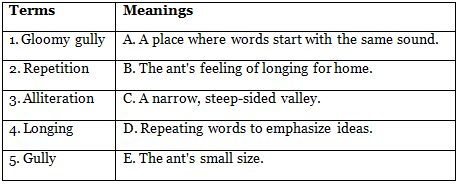
Ans: 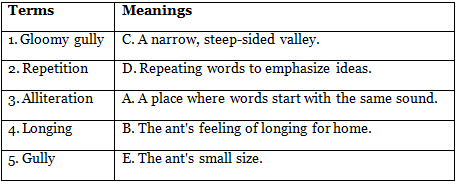
Q4: True or False
(i) Alliteration is the repetition of the same sounds at the end of words.
Ans: False
Alliteration involves repeating the same sounds at the beginning of words.
(ii) The ant decided to explore the world without eating breakfast.
Ans: False
The ant explored the world after having breakfast.
(iii) The ant felt most comfortable in the gloomy gully.
Ans: False
The ant loathed being alone in the gloomy gully.
(iv) Repetition is used to de-emphasize ideas in the poem.
Ans: False
Repetition is used to emphasize and underscore ideas in the poem.
(v) The ant was described as a "giant sugar ant" in the poem.
Ans: False
The ant is described as a "little sugar ant," highlighting its small size.
FAQs on Worksheet Solutions: The Ant Explorer
| 1. How do ants navigate and explore their surroundings? |  |
| 2. What is the role of the ant explorer in the colony? | |
| 3. How do ant explorers contribute to the overall success of the colony? | |
| 4. What are some challenges that ant explorers face during their exploration? | |
| 5. How do ant explorers communicate with other ants in the colony? | |