Summary: Landscape of the Soul

Key Points of the Story
- The summary of Landscape to Soul will help you learn about this chapter in a very basic and straightforward way.
- Nathalie Trouveroy's tale "Landscape of the Soul" is about art.
- The story, Landscape to soul stimulates the diverse sense of beauty and wishes of artists from Western and Eastern cultures.
- While the Western eye yearns for an exact depiction of life, artists in the East seek active and emotional involvement with their profession.
- The chapter is divided into two sections.
- The first section is from the book 'Landscape of the Soul: Ethics and Spirituality in Chinese Painting.'
- The second portion is taken from 'Getting Inside 'Outsider Art,' a Hindustan Times piece authored by Brinda Suri.
Detailed Summary
This chapter is structured into two parts, each presenting insights into the world of art and its history through engaging anecdotes. These stories are essentially short and intriguing narratives meant to convey specific points. Within the pages of 'Landscape of the Soul: Ethics and Spirituality in Chinese Painting,' readers are introduced to the art of painting through two captivating tales.
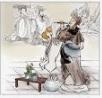
The first story revolves around Wu Daozi, a renowned Chinese painter from the eighth century. Wu was commissioned by Tang Emperor Xuanzong to adorn a palace wall. His artwork depicted breathtaking landscapes featuring mountains, waterfalls, forests, clouds, and a clear blue sky, with people living harmoniously in a picturesque setting. One unique element of his painting was a cave at the mountain's base inhabited by a spirit. During a presentation to the emperor, Wu clapped his hands, and miraculously, an opening to the cave appeared, allowing him to enter and vanish. According to the author, this disappearing act symbolizes the awareness of a mystical inner realm, accessible only to masters who understand the route inside and can transcend material forms. Another Chinese painter showcased similar caution; he refrained from painting a dragon's eye, fearing it might come to life and escape his creation.The second story introduces Quinten Metsys, a skilled blacksmith who falls in love with a painter's daughter, despite his father's disapproval of his occupation. Quinten's passion for painting persisted, and he managed to convince his father-in-law by showcasing his talent through a meticulously painted fly on a board. This tiny detail possessed such authenticity that it reminded the father-in-law of a real fly. The author also delves into the concept of Shanshui in Chinese philosophy, denoting the harmony between mountains and water in art.
In the latter half of Brinda Suri's work, 'Getting Inside 'Outsider Art,'' the discussion revolves around the concept of 'art brut.' This term refers to the art created by individuals considered to have "no right" to be artists, primarily due to their lack of formal training. Despite this, these artists possess exceptional skills and understanding of art. They are described as those who think beyond conventional boundaries and reject established norms. Their creations are often labeled as 'unorthodox' art. Nek Chand's work in the Rock Garden in Chandigarh serves as an exemplar of art brut, as discussed by the author.
Conclusion
The author's work is well illustrated in this narrative. This chapter compares various art genres and the interpretation of these works from the artist's point of view. The author attempts to demonstrate a comparison of various art genres. This chapter discusses the legends and myths that circulated about great artworks in ancient times. The emphasis is on how realistic and finely produced the paintings were. This chapter explains the significance of imagination and how painters perceive things differently and uniquely. The art form does not have to be viewed via a single lens; several ways exist to imagine a single picture with multiple perspectives.
Difficult Words
Word - Meaning
- landscape- the portion of land which one can view at a single glance,
- commissioned-ordered, commanded, made on demand,
- hidden-kept behind a curtain.
- Immense-vast,
- dwells-lives;
- clapped-beat,
- entrance-doorway,
- splendid-grand,
- convey-communicate, express,
- astonished-taken by surprise;
- utter-speak,
- vanished-disappeared,
- trace-sign,
- classical-based on ancient knowledge,
- Confucius-a Chinese philosopher,
- disciple-pupil,
- anecdote-a short event or story,
- revealing-disclosing expressive,
- Considered-regarded;
- contrast-mark the difference.
- dragon-a mythical or imaginary reptile with wings,
- Flanders-a country;
- profession-job, vocation,
- sneaked-entered secretly,
- panel-a piece of wood on which a picture is painted,
- delicate realism-soft truthfulness,
- swat-give a hard blow,
- realised-came to know,
- apprentice-trainee,
- Illustrate-show, make clear.
- illusionistic-causing illusion,
- likeness-similarity,
- essence-gist,
- commissions-orders to be painted;
- appreciates-admires;
- reveals-explains,
- Dao-the path or the method,
- universe-the entire visible world,
- landscape-painting,
- figurative-flowery,
- specific angle-definite point;
- leisurely-slow and peaceful;
- specific-typical, definite,
- horizontal-parallel to level ground.
- scroll- a roll of paper.
- dimension-extent,
- participation-activity, taking part.
- conceptual-pertaining to mind or idea,
- Concept- Idea,
- elements-essential parts,
- Image-picture,
- complementary-together making up a whole,
- reflecting-showing, explaining;
- vertically-In a perpendicular manner;
- stable-firm, ;
- fluid-liquid substance,
- moist-wet,
- interaction-union, reciprocal action,
- receptive-the receiving end;
- counterpart-complementary part,
- fundamental-basic.
- essential-necessary, primary,
- notion-Idea,
- retain-hold on, keep;
- suspension-stoppage,
- void-empty space,
- meditation-contemplation,
- occurs-takes place;
- conduit-channel, pipe;
- oppressed-weighed down,
- lofty-high,
- getting inside'Outsider Art': mooted-first gave art brut
FAQs on Summary: Landscape of the Soul
| 1. What is the main theme of the story "Landscape of the Soul"? |  |
| 2. How does the protagonist's journey in the story impact their inner self? | |
| 3. What role does nature play in the story? | |
| 4. How does the story portray the healing power of nature? | |
| 5. What is the significance of the title "Landscape of the Soul"? | |