Worksheet Solutions: Rural Development - 1


Multiple Choice Questions (MCQs)
Q1: What is the primary objective of rural development in India?
(a) Economic growth and development
(b) Agricultural productivity
(c) Poverty alleviation and improving living standards
(d) Urbanization and industrialization
Ans: (c)
Explanation: The main aim of rural development is to reduce poverty and raise the standard of living of rural people. While economic growth and agricultural productivity contribute to this goal, the central objective is to alleviate poverty and improve overall living conditions through better income, health, education and basic infrastructure.
Q2: Which of the following is a key feature of rural development programs in India?
(a) Focus only on agricultural development
(b) Ignoring social and educational aspects
(c) Holistic development of rural areas
(d) Limited government intervention
Ans: (c)
Explanation: Rural development programmes adopt a holistic approach: they combine improvements in agriculture with social sectors (education, health), infrastructure (roads, electricity), livelihood support and local governance. This integrated approach ensures balanced improvements in quality of life rather than focusing only on one sector.
Q3: Which scheme aims to provide employment opportunities to rural households?
(a) National Rural Health Mission (NRHM)
(b) Mahatma Gandhi National Rural Employment Guarantee Act (MGNREGA)
(c) Pradhan Mantri Jan Dhan Yojana (PMJDY)
(d) Swachh Bharat Abhiyan
Ans: (b)
Explanation: MGNREGA (formerly NREGA) is a statutory guarantee of up to 100 days of paid manual work per rural household on demand. Its principal objective is to provide livelihood security by offering wage employment and creating durable rural assets.
Q4: What is the role of Panchayati Raj institutions in rural development?
(a) Centralized decision-making
(b) No role in rural development
(c) Decentralized decision-making and local governance
(d) Limited to urban areas
Ans: (c)
Explanation: Panchayati Raj institutions are local self-governments that enable decentralised planning, prioritise local needs, implement developmental schemes, and ensure community participation. This local governance helps make programmes more responsive and accountable.
Q5: Which sector plays a crucial role in the development of rural economy?
(a) Information technology
(b) Manufacturing industries
(c) Service sector
(d) Agriculture and allied activities
Ans: (d)
True and False
Q1: Rural development focuses solely on economic growth.
Ans: False
Explanation: Rural development is multi-dimensional. It includes economic growth, social development (education, health), infrastructure, livelihood security and environmental sustainability. Focusing only on growth would overlook important social and human-development aspects.
Q2: MGNREGA guarantees 100 days of wage employment to every rural household.
Ans: True
Explanation: Under MGNREGA a rural household that applies for work is entitled to up to 100 days of paid unskilled manual work in a financial year, ensuring a statutory safety net and creating productive rural assets.
Q3: Education and healthcare are not integral components of rural development.
Ans: False
Explanation: Education and healthcare are essential for improving human capital. Better education raises skills and employability, while healthcare reduces disease burden and improves productivity - both are central to effective rural development.
Q4: Green Revolution contributed significantly to the enhancement of agricultural productivity in rural areas.
Ans: True
Explanation: The Green Revolution introduced high-yielding varieties, improved irrigation and better inputs, which raised foodgrain production and productivity in many rural areas, especially for wheat and rice.
Q5: Panchayati Raj institutions have no role in planning and implementing rural development programs.
Ans: False
Explanation: Panchayati Raj institutions are explicitly designed to play a key role in planning, implementing and monitoring rural development programmes at the local level, thus making them central to effective delivery and local accountability.
Match the Following
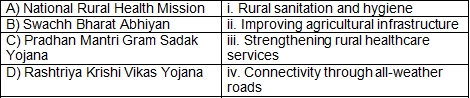
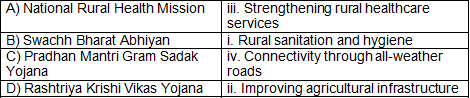
Q1: Match the following programs with their objectives:
Ans:
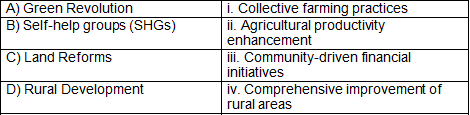
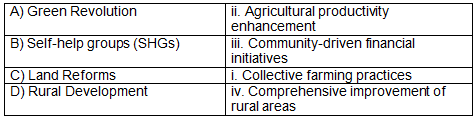
Q2: Match the following terms with their meanings:
Ans:
Very Short Answers
Q1: Define rural development.
Ans: Rural development refers to the process of improving the quality of life and economic well-being of people living in rural areas. It includes enhancing incomes, providing basic services (health, education, water, sanitation), improving infrastructure, and promoting local livelihoods and governance.
Q2: Name any two poverty alleviation programs in rural areas.
Ans: Two important poverty alleviation programmes are MGNREGA (employment guarantee) and Pradhan Mantri Awas Yojana (PMAY) - rural component (housing support for poor households).
Q3: What is the significance of watershed management in rural development?
Ans: Watershed management involves conserving and managing land, water and vegetation in a drainage basin to improve water availability, reduce soil erosion and raise agricultural productivity. It helps sustain livelihoods, increases cropping intensity and reduces vulnerability to drought in rural areas.
Q4: Briefly explain the role of cooperatives in rural economic development.
Ans: Cooperatives are member-owned organisations that pool resources for mutual benefit. Their roles include:
- Providing affordable credit and inputs to farmers and artisans.
- Facilitating collective marketing and better price realisation.
- Enabling access to technology and storage facilities, thereby improving incomes and stability.
Q5: What are the challenges faced in the implementation of rural development programs in India?
Ans: Major challenges include:
- Inadequate infrastructure (roads, storage, power).
- Limited and irregular funding and weak administrative capacity.
- Social and cultural barriers that limit participation of women and marginal groups.
- Poor monitoring, corruption and weak implementation at local level.
Short Answers
Q1: Explain the concept of sustainable rural development and its importance in the Indian context.
Ans: Sustainable rural development aims to achieve economic growth, social equity and environmental protection together so that future generations can also meet their needs. In India, where a large share of the population lives in villages, sustainability is important because:
- It preserves natural resources (soil, water) vital for agriculture.
- It ensures long-term livelihood security and reduces vulnerability to climate and market shocks.
- It promotes inclusive growth by integrating social services (education, health) with economic initiatives.
Q2: Discuss the role of non-governmental organizations (NGOs) in promoting rural development in India.
Ans: NGOs play a supportive and complementary role in rural development by:
- Implementing pilot projects and demonstrating best practices (e.g., watershed management, women's livelihoods).
- Capacity building through training, awareness campaigns and institution building (SHGs, cooperatives).
- Mobilising resources and linking communities to government schemes, markets and finance.
- Acting as advocates for marginalised groups and promoting participatory planning.
Q3: Describe the major components of the National Rural Employment Guarantee Act (NREGA) and its impact on rural livelihoods.
Ans: Major components of MGNREGA include:
- Legal guarantee of up to 100 days of unskilled work per rural household on demand.
- Demand-driven nature: work is provided when households demand it.
- Creation of durable rural assets (water conservation, land development, afforestation).
- Social audit and transparency measures (job cards, wage payments).
Impact on livelihoods:
- Provides income security and reduces seasonal migration.
- Builds community assets that support agriculture and local resilience.
- Empowers marginal groups, including women, through ensured participation and wages.
Q4: Explain the importance of skill development programs in empowering rural youth and promoting entrepreneurship.
Ans: Skill development programmes are important because they:
- Improve employability by teaching practical trades and vocational skills.
- Support self-employment and entrepreneurship through training in business skills, market linkages and access to credit.
- Reduce rural unemployment and migration by creating local opportunities.
Examples of relevant initiatives include DDU-GKY and various state-level rural skill programmes that link training with placement and micro-enterprise support.
Q5: Discuss the challenges and prospects of harnessing technology for agricultural development in rural India.
Ans: Challenges:
- Digital divide: limited internet, electricity and low digital literacy among farmers.
- High initial costs for precision tools and machinery for small farmers.
Prospects:
- Mobile advisory services, weather forecasts and market prices can improve decision-making.
- E-platforms (e.g., eNAM), mechanisation services and precision farming can raise productivity and reduce post-harvest losses.
- Increasing public-private partnerships and affordable technology rental services can make modern tools accessible to smallholders.
Section 6: Long Answers
Q1: Enumerate the steps taken by the government to promote inclusive growth in rural areas. Discuss their impact on poverty reduction and social development.
Ans: The government has adopted a range of measures to promote inclusive growth in rural areas. Major steps include:
- Employment programmes: MGNREGA provides income support and creates local assets.
- Infrastructure: PMGSY (rural roads), rural electrification and water supply improve connectivity and services.
- Social services: Schemes for education (SSA/Samagra Shiksha) and health (NHM) strengthen human capital.
- Housing and sanitation: PMAY (rural), Swachh Bharat have improved living conditions.
- Financial inclusion and credit: PMJDY, Kisan Credit Card and support to SHGs under NRLM increase access to finance.
Impact on poverty reduction and social development:
- Increased incomes and employment opportunities have reduced absolute poverty in many areas.
- Improved infrastructure and services have enhanced access to markets, education and healthcare, raising human development indicators.
- Greater inclusion of women and marginal groups through SHGs, reservations in local bodies and targeted schemes has strengthened social development and participation.
Overall, these measures have contributed to a decline in poverty and more equitable rural growth, though challenges in implementation and coverage remain.
Q2: Examine the role of women in rural development. Discuss the initiatives taken by the government to empower rural women and enhance their participation in the development process.
Ans: Women are central to rural development: they contribute to agriculture, livestock care, household economies and community life. Their active involvement improves outcomes for families and communities. Key roles and initiatives include:
- Self-Help Groups (SHGs) and NRLM: These provide microcredit, skill training and market linkages, helping women start micro-enterprises and gain financial independence.
- Reservation in Panchayats: The 73rd Constitutional Amendment provided reservation for women in local bodies (about one-third seats), increasing political participation and decision-making power at grassroots level.
- Skill development and livelihood support: Programmes provide vocational training, entrepreneurship support and linkage to markets.
- Social programmes: Schemes for maternal health, nutrition, sanitation and education (e.g., NHM, SSA) improve women's health and human capital.
These measures empower women economically and socially, increasing their participation in planning and improving development outcomes.
Q3: Elaborate on the strategies to address the issue of unemployment in rural areas. How can skill development and vocational training programs contribute to solving this problem?
Ans: Strategies to reduce rural unemployment include:
- Employment guarantees: Programmes such as MGNREGA provide temporary income and assets.
- Promotion of rural non-farm activities: Support for small enterprises, agro-processing and cottage industries creates local jobs.
- Infrastructure development: Better roads, electricity and storage open up market opportunities and encourage investment.
Role of skill development and vocational training:
- These programmes increase employability by teaching practical trades (mechanics, carpentry, tailoring, agri-processing).
- They promote self-employment and entrepreneurship when combined with credit and market access.
- Linkages with industry and placement services (public-private partnerships) help absorb trained youth into the workforce.
Q4: Discuss the challenges faced by farmers in rural India. Explain the measures that can be adopted to enhance agricultural productivity and ensure the economic well-being of farmers.
Ans: Challenges faced by farmers:
- Limited access to affordable credit and insurance.
- Dependence on monsoon and inadequate irrigation.
- Small and fragmented land holdings, lack of storage and market access.
Measures to improve productivity and well-being:
- Access to credit: Expand Kisan Credit Card coverage and affordable loans.
- Soil health and inputs: Soil Health Cards, balanced fertilisation and improved seeds.
- Irrigation and water management: Watershed development and micro-irrigation to reduce monsoon dependence.
- Market access and price support: Strengthening minimum support price mechanisms, promoting e-NAM and farmer producer organisations (FPOs).
- Value addition and storage: Cold chains, processing units and rural storage reduce post-harvest loss and increase incomes.
Q5: Analyse the role of education and healthcare in rural development. How can improved access to quality education and healthcare services contribute to the overall development of rural areas?
Ans: Education and healthcare are foundational for rural development:
- Education raises literacy and skills, enabling better agricultural practices, non-farm employment and informed use of technologies. Schooling and vocational training create a skilled workforce for local industries and services.
- Healthcare reduces disease burden, improves labour productivity and lowers medical expenditure risk. Preventive care, nutrition and maternal-child health boost long-term human capital.
Government schemes such as Samagra Shiksha and the National Health Mission expand access to quality education and health services. When combined with livelihood and infrastructure interventions, improved education and healthcare lead to better living standards, higher incomes and sustainable rural development.