NCERT Solutions: Exercise: Miscellaneous - Complex Numbers

Question 1: Evaluate:

Answer:
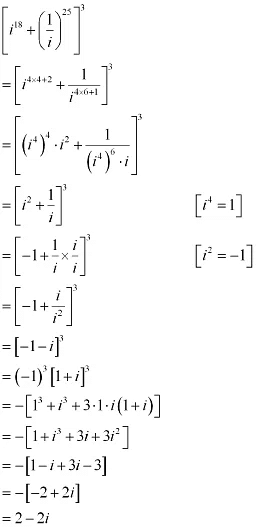
Explanation: Multiply numerator and denominator by the conjugate of the denominator to remove the imaginary part from the denominator. Simplify the resulting real and imaginary parts to reach the final value shown above.
Question 2: For any two complex numbers z1 and z2, prove that
Re (z1z2) = Re z1 Re z2 - Im z1 Im z2
Answer:
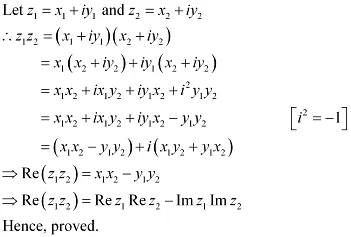
Let z1 = a + ib and z2 = c + id, where a, b, c, d are real numbers.
Then z1z2 = (a + ib)(c + id) = ac - bd + i(ad + bc).
Therefore, Re(z1z2) = ac - bd = (Re z1)(Re z2) - (Im z1)(Im z2), as required.
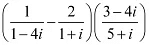
Question 3: Reduce
Answer:
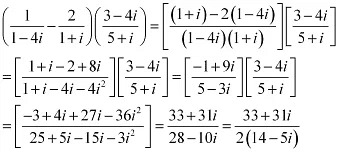
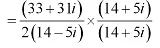
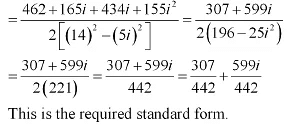
Explanation: To reduce to the standard form a + ib, multiply numerator and denominator by the conjugate of the denominator (here, 14 + 5i). Expand the numerator and denominator, simplify the real and imaginary parts, and then divide both parts by the (now real) denominator. The intermediate algebra and the final standard form are shown in the images above.
Question 4: If x - iy =

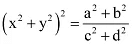
Answer:
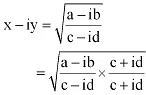
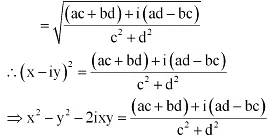
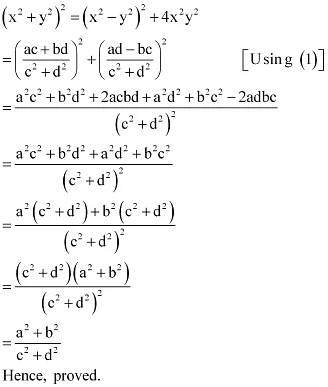
Explanation: Write the given complex expression and multiply both numerator and denominator by the conjugate of the denominator (here c + id). Expand and combine like terms to separate the real and imaginary parts. Equating the real and imaginary parts gives the desired relation; the algebraic steps are displayed in the images above.
Question 5: Convert the following in the polar form:
(i)

(ii)

Answer:
(i) Here,

Let r cos θ = -1 and r sin θ = 1
On squaring and adding, we obtain
r2 (cos2 θ + sin2 θ) = 1+ 1
⇒ r2 (cos2 θ + sin2 θ) = 2
⇒ r2 = 2 [cos2 θ + sin2 θ = 1]
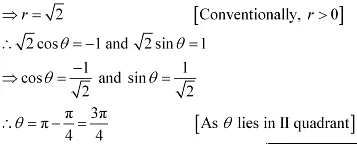
∴z = r cos θ + i r sin θ

This is the required polar form.
(ii) Here,

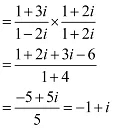
Let r cos θ = -1 and r sin θ = 1
On squaring and adding, we obtain
r2 (cos2 θ + sin2 θ) = 1+ 1
⇒r2 (cos2 θ +sin2 θ) = 2
⇒ r2 = 2 [cos2 θ + sin2 θ = 1]
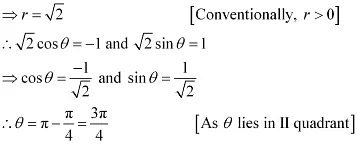
∴z = r cos θ + i r sin θ

This is the required polar form.
Question 6: Solve the equation
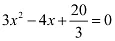
Answer:
The given quadratic equation is
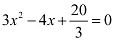
This equation can also be written as

On comparing this equation with ax2 + bx + c = 0, we obtain
a = 9, b = -12, and c = 20
Therefore, the discriminant of the given equation is
D = b2 - 4ac = (-12)2 - 4 × 9 × 20 = 144 - 720 = -576
Therefore, the required solutions are
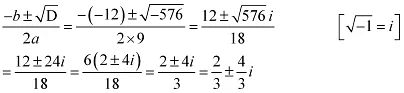
Explanation: Use the quadratic formula x = (-b ± √D)/(2a). Here D is negative, so the roots are complex conjugates. Substitute a, b and D = -576 into the formula and simplify to obtain the two complex roots shown in the image.
Question 7: Solve the equation
Answer:
The given quadratic equation is

This equation can also be written as
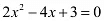
On comparing this equation with ax2 + bx + c = 0, we obtain
a = 2, b = -4, and c = 3
Therefore, the discriminant of the given equation is
D = b2 - 4ac = (-4)2 - 4 × 2 × 3 = 16 - 24 = -8
Therefore, the required solutions are
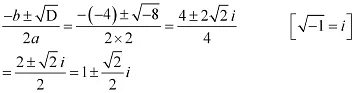
Explanation: Apply the quadratic formula with a = 2, b = -4 and D = -8. As D < 0, the solutions are complex conjugates. Substitute into the formula and simplify to get the roots displayed above.
Question 8: Solve the equation 27x2 - 10x + 1 = 0
Answer:
The given quadratic equation is 27x2 - 10x + 1 = 0
On comparing the given equation with ax2 + bx + c = 0, we obtain
a = 27, b = -10, and c = 1
Therefore, the discriminant of the given equation is
D = b2 - 4ac = (-10)2 - 4 × 27 × 1 = 100 - 108 = -8
Therefore, the required solutions are
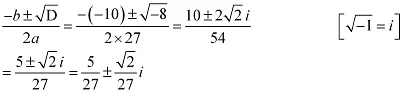
Explanation: Use the quadratic formula x = (-b ± √D)/(2a). With D = -8, the roots are complex; substitute the values and simplify to obtain the two complex conjugate roots given in the image.
Question 9: Solve the equation 21x2 - 28x + 10 = 0
Answer:
The given quadratic equation is 21x2 - 28x + 10 = 0
On comparing the given equation with ax2 + bx + c = 0, we obtain
a = 21, b = -28, and c = 10
Therefore, the discriminant of the given equation is
D = b2 - 4ac = (-28)2 - 4 × 21 × 10 = 784 - 840 = -56
Therefore, the required solutions are
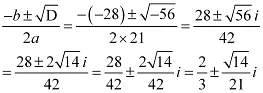
Explanation: Again apply the quadratic formula. Here D = -56 < 0, so the two roots are complex conjugates. Substitution and simplification give the roots shown in the image.
Question 9: If

Answer:
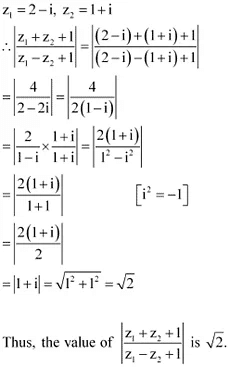
Explanation: Use the given relation and simplify algebraically-expand where necessary and equate real and imaginary parts to obtain the required expression. The full algebraic simplification is shown in the image above.
Question 10: If a + ib =

Answer:
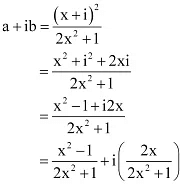
On comparing real and imaginary parts, we obtain
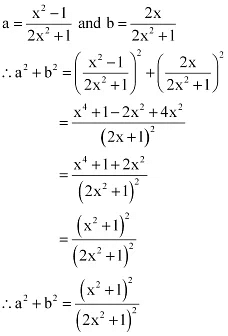
Hence, proved.
Explanation: Take the modulus of both sides of the given equality. The square of the modulus of a complex number a + ib is a2 + b2. Compute the modulus² of the right-hand side and equate it to a2 + b2. The comparison of real and imaginary parts, as displayed, completes the proof.
Question 10: Let

(i)

(ii)

Answer:

(i)

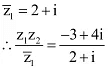
On multiplying numerator and denominator by (2 - i), we obtain
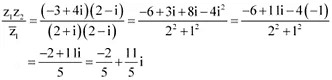
On comparing real parts, we obtain

(ii)
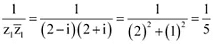
On comparing imaginary parts, we obtain

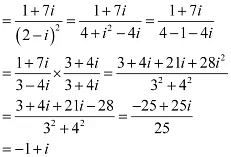
Explanation: For each part, write the complex number in the form (p + iq). To find the required quantity, multiply numerator and denominator by the conjugate of the denominator to make the denominator real. Then compare the real parts for (i) and the imaginary parts for (ii). The necessary algebraic steps and results are shown in the images above.
Question 11: Find the modulus and argument of the complex number

Answer:
Let

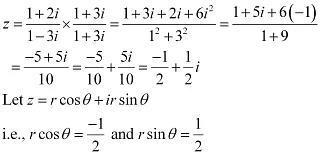
On squaring and adding, we obtain
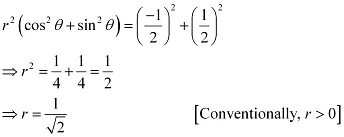
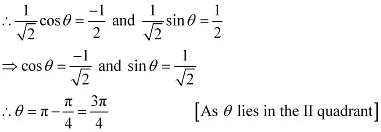
Therefore, the modulus and argument of the given complex number are

Explanation: The modulus is found by √(x² + y²) where x and y are the real and imaginary parts respectively. The argument θ is found from tan θ = y/x, taking care to choose the correct quadrant for θ. The intermediate calculations and the final numerical values are given in the images above.
Question 12: Find the real numbers x and y if (x - iy) (3+5i) is the conjugate of -6 - 24i.
Answer:
Let
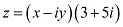

It is given that,


Equating real and imaginary parts, we obtain
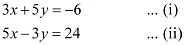
Multiplying equation (i) by 3 and equation (ii) by 5 and then adding them, we obtain
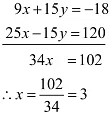
Putting the value of x in equation (i), we obtain
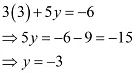
Thus, the values of x and y are 3 and -3 respectively.
Expanded stepwise solution (text form):
Multiply (x - iy)(3 + 5i): (x - iy)(3 + 5i) = (3x + 5y) + i(5x - 3y).
The conjugate of -6 - 24i is -6 + 24i. Equate real and imaginary parts:
3x + 5y = -6,
5x - 3y = 24.
Multiply the first equation by 3: 9x + 15y = -18.
Multiply the second equation by 5: 25x - 15y = 120.
Add these two: 34x = 102 ⇒ x = 3.
Substitute x = 3 in 3x + 5y = -6 ⇒ 9 + 5y = -6 ⇒ 5y = -15 ⇒ y = -3.
Hence x = 3 and y = -3.
Question 13: Find the modulus of

Answer:
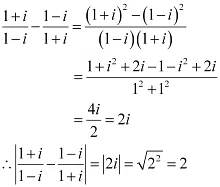
Explanation: Determine the real and imaginary parts of the given complex number, say x and y. Then compute the modulus as √(x² + y²). The detailed algebra leading to the numeric value is shown in the image above.
Question 14: If (x + iy)3 = u + iv, then show that
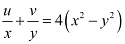
Answer:
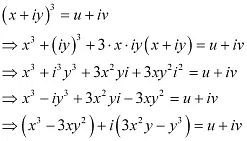
On equating real and imaginary parts, we obtain
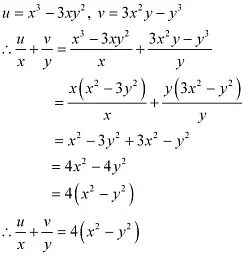
Hence, proved.
Explanation: Expand (x + iy)3 using binomial expansion, separate the real and imaginary parts and set them equal to u and v respectively. Eliminate u and v as required to obtain the stated relation; the expansion and algebraic steps are displayed in the images above.
Question 15: If α and β are different complex numbers with

Answer:
Let α = a + ib and β = x + iy
It is given that,

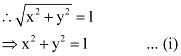
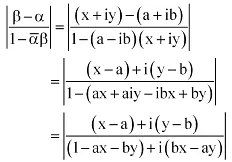

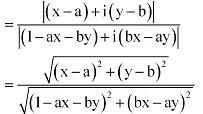

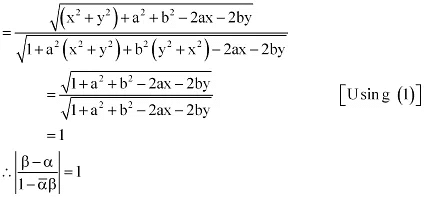
Explanation: Use the given condition |α/β| = 1 (or the equivalent relation shown) to deduce constraints on α and β. Manipulate the algebraic forms and simplify to obtain the required expression; the full derivation is presented in the images above.
Question 16: Find the number of non-zero integral solutions of the equation

Answer:
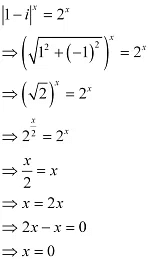
Thus, 0 is the only integral solution of the given equation. Therefore, the number of non-zero integral solutions of the given equation is 0.
Explanation: Solve the given equation and check for integral values. The algebra shows that the only integer satisfying the equation is 0; hence there are no non-zero integral solutions.
Question 17: If (a + ib) (c + id) (e + if) (g + ih) = A + iB, then show that
(a2 + b2) (c2+ d2) (e2 + f2) (g2 + h2) = A2 +B2.
Answer:


On squaring both sides, we obtain
(a2 + b2) (c2 + d2) (e2 + f2) (g2 + h2) = A2 + B2
Hence, proved.
Explanation: Use the multiplicative property of modulus: |zw| = |z| |w|. The modulus squared of each complex number a + ib is a2 + b2. Therefore, the square of the modulus of the product equals the product of the squares of the moduli, which is |A + iB|² = A² + B². The steps are summarised above and shown in the images.
Question 18: If

Answer:
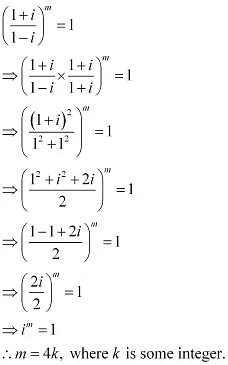
Therefore, the least positive integer is 1.
Thus, the least positive integral value of m is 4 (= 4 × 1).
Explanation: From the given condition we find the smallest positive integer k that satisfies the relation shown in the image. Substituting k = 1 gives the least positive value of m as 4. The detailed reasoning and intermediary steps are displayed in the image above.